


Current Molecular Medicine - Volume 18, Issue 3, 2018
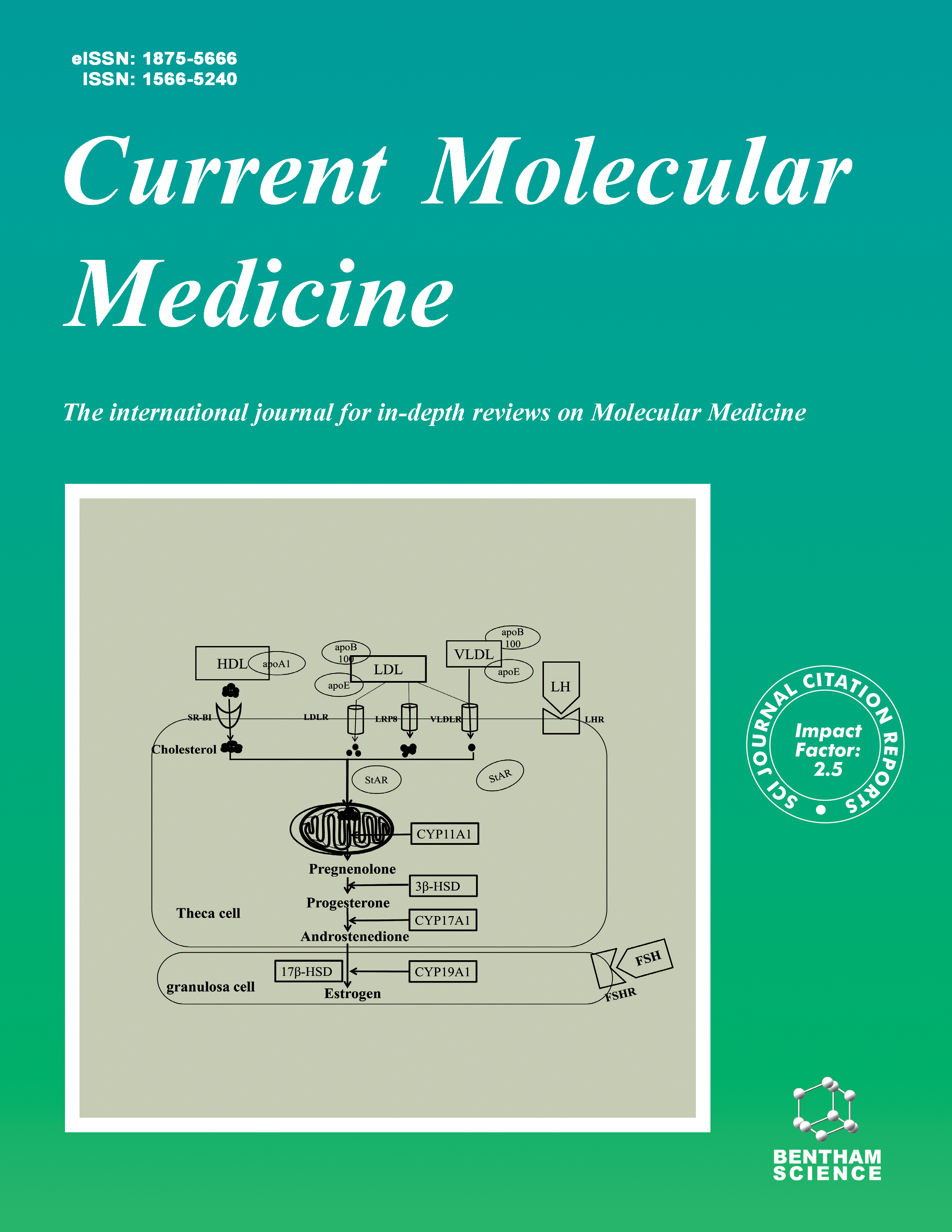
Volume 18, Issue 3, 2018
-
-
miR-142-3p Inhibits the Metastasis of Hepatocellular Carcinoma Cells by Regulating HMGB1 Gene Expression
More LessBackground: Non-coding small RNAs are involved in organism development, and their aberrant regulation induces various diseases, including hepatocellular carcinoma (HCC), but their exact mechanisms have not been determined. Objective: The aim was to investigate the role of miR-142-3p on HMGB1 expression in hepatocellular carcinoma. Methods: Expression levels of miR-142-3p in HCC tissues and cultured cells were measured by RT-PCR. The invasion and metastasis abilities of HepG2 cells according to Transwell migration and invasion assays, and protein expression was measured by western blotting. Results: The present study reported that miR-142-3p promotes the invasion and migration of HCC cells. miR-142-3p levels are lower in HCC tissues than in adjacent non-cancerous tissues, suggesting a tumor suppressor role for miR-142-3p. Highmobility group box protein 1 (HMGB1) is an oncogene that promotes the metastasis of HCC. miR-142-3p or HMGB1 knockdown alone inhibits the invasion and migration of HCC cells, and HMGB1 overexpression impedes the effect of miR-142-3p. Further studies showed that HMGB1 is a direct target gene of miR-142-3p in HCC. miR-142-3p represses HMGB1 gene transcription by directly binding to the 3′ untranslated region (UTR) of HMGB1, thereby inhibiting cancer cell invasion and migration. Conclusion: This study, for the first time, reports that miR-142-3p is a novel tumor suppressor that inhibits the invasion and migration of HCC cells by directly regulating gene transcription of HMGB1. Thus, miR-142-3p may be a potential diagnostic and therapeutic biomarker for HCC patients.
-
-
-
An Antioxidant Role by Minocycline Via Enhancing the Activation of LKB1/AMPK Signaling in the Process of Cerebral Ischemia Injury
More LessBackground: LKB1/AMPK signaling pathway, as a metabolic checkpoint, is involved in the pathogenesis of cerebral ischemia injury. Minocycline, a tetracycline derivative, protects against cerebral ischemia via reducing inflammation, oxidative stress, and apoptosis. The aim of the study was to evaluate the influence of minocycline on oxidative biomarkers and LKB1/AMPK signaling pathway in Wistar rats with focal cerebral ischemia injury and to clarify the neuroprotective mechanism of minocycline against focal cerebral ischemia injury. Methods: The focal cerebral ischemia injury of Wistar rats was established by inserting a thread into the left middle cerebral artery. 2,3,5-Triphenyltetrazolium chloride (TTC) staining was used to label infarct volume. The levels of MDA and LPO were measured with a biochemical assay. All other items were determined by Western blotting. Results: Minocycline decreased cerebral infarct volume, but had no effects on neurological scores. Minocycline improved the biological activity of GPx-1/2, GSS and GR, while limited the GGT1 activity in the hippocampus of cerebral ischemia-reperfusion rats. Minocycline also elevated the biological activity of SOD and counteracted lipid peroxidation. Minocycline enhanced the activity of both LKB1 and the levels of the three AMPK subunits in the hippocampus of cerebral ischemia-reperfusion rats. Conclusion: Minocycline effectively inhibits oxidative stress via modulating antioxidative enzymes and activating the LKB1/AMPK signaling pathway in the process of acute cerebral infarct.
-
-
-
Seven Novel and Three Known Mutations in FOXL2 in 10 Chinese Families with Blepharophimosis Syndrome
More LessBackground: Blepharophimosis syndrome (BPES) is characterized by eyelid malformation with occasional premature ovarian failure. Mutations in FOXL2 underlie a fraction of BPES cases. Objective: We aimed to investigate the genetic basis of BPES in 26 Chinese families that included 78 patients. Methods: We performed ophthalmological examinations on each family member. We used Sanger sequencing to screen FOXL2 exons and their flanking sequences. We also performed bioinformatics studies, structural modeling and pathogenicity evaluations on all identified variations. Literature was reviewed and genotype-phenotype correlation analysis was performed. Results: The patients had typical manifestations of BPES. Ten mutations were identified in ten of the twenty-six families. Among these, seven were novel mutations. These included the six truncating mutations, p.Glu69*, p.Gly256Glyfs*14, p.Ala14Serfs*135, p.Pro333Profs*200, p.Pro290Leufs*70, and p.Pro157Profs*91, and one missense mutation, p.Tyr59Cys. The mutations were scattered within the gene, and no mutational hotspots were found. Genotype-phenotype correlation analysis showed that frameshift or nonsense mutations were correlated with type I BPES, while in-frame or missense mutations were associated with type II BPES. Conclusion: We report the largest BPES cohort in China thus far as well as seven novel mutations in FOXL2. The identification of novel mutations has not only expanded the mutational spectrum of the gene (which is valuable for mutation detection-based screening) but also suggests that most mutations within the Chinese population may not have been characterized yet.
-
-
-
Oxidative Stress in Cerebral Small Vessel Disease Dizziness Patients, Basally and After Polyphenol Compound Supplementation
More LessAuthors: L. Ulivi, M. Maccarrone, N. Giannini, E. Ferrari, M.C. Caselli, V. Montano, L. Chico, A. Casani, E. Navari, N. Cerchiai, G. Siciliano, U. Bonuccelli and M. MancusoBackground: Leukoaraiosis (LA) is a common radiological finding in elderly, frequently associated with several clinical disorders, including unexplained dizziness. The pathogenesis of LA is multifactorial, with a dysfunction of cerebral microcirculation resulting in chronic hypoperfusion and tissue loss, with oxidative stress involved in this cascade. Objective: The aim of this study was to analyse some oxidative stress biomarkers in a cohort of LA patients. Method: Fifty-five consecutive patients (33 males, median age 75 years) with LA were recruited. In a subgroup of 33 patients with LA and unexplained dizziness, we have then performed an open study to evaluate if 60-day supplementation with a polyphenol compound may modify these biomarkers and influence quality of life, analysed with the Dizziness Handicap Inventory (DHI) scale. Results: At baseline, blood oxidative stress parameters values were outside normal ranges and compared to matched healthy controls. After the two months supplementation, we observed a significant decrement of advanced oxidation protein products values and a significant improvement of DHI. Conclusion: Oxidative stress biomarkers may be useful to detect redox imbalance in LA and to provide non-invasive tools to monitor disease status and response to therapy.
-
-
-
Crocin Protects Human Umbilical Vein Endothelial Cells from High Glucose-Induced Injury Via Inhibiting the Endoplasmic Reticulum Stress Response
More LessBackground: Endothelial dysfunction plays a key role in diabetic atherosclerosis. High glucose (HG) is considered a stimulator in the development of diabetic atherosclerosis. The endoplasmic reticulum (ER) stress response is involved in HG-induced vascular injury. Crocin has antioxidative and antiapoptotic properties. Objective: The current study was to evaluate whether crocin can protect human umbilical vein endothelial cells (HUVECs) from HG-induced injury and explored the associated mechanism. Methods: HUVECs were treated with 33 mmol/L glucose as the HG condition. The endothelial protective effects of crocin were evaluated by comparison with the control groups. Results: The exposure of HUVECs to HG for 24 h remarkably induced the ER stress response and a sequence of injuries, as demonstrated an increase in the apoptotic cell number, the reactive oxygen species level and inflammatory cytokine generation, as well as a decline in vascular endothelial growth factor A expression. These changes were markedly alleviated by pretreating the HUVECs with either crocin or 4-phenylbutyrate (ER stress inhibitor) before exposure to HG. Conclusion: Crocin exerted antioxidative, antiapoptotic, anti-inflammatory and proangiogenic effects in the HG-induced HUVEC injury model, which were probably mediated by a favorable modification of ER stress that requires further investigation.
-
-
-
Aging and Proteins: What Does Proteostasis Have to Do with Age?
More LessAuthors: S. Magalhaes, B.J. Goodfellow and A. NunesThe world is aging and we must face the challenges that this brings. One of the reasons for the increasing aging of the world's population is the increase in life expectancy and, since we live longer, it is of paramount importance to live well and to prevent age-associated diseases. In this way, it is crucial to improve knowledge of the aging process and of the mechanisms that contribute to it. Ideally it would be of great interest to have a panel of biomarkers of healthy aging that would allow an estimate of the biological age of an individual. One of the changes that greatly contribute to aging is the loss of protein homeostasis, also called proteostasis. To ensure the proper function of cells and to maintain cellular proteostasis, organisms have developed systems to control protein synthesis, folding and degradation. Loss or dysfunction of proteostasis is at the root of many well-studied human neurological diseases, such as Alzheimer's disease and, more recently, it has been implicated in the aging process with some reports showing long-lived animals to have improved proteostasis. Growing evidence suggests a strong link between modifications in the quantity and/or activity of several players involved in proteostasis and longevity. In this review, we give an overview of the main characteristics of aging with focus on proteostasis. We present how changes in components of proteostasis, during aging, impact the lifespan of model organisms. We also briefly review the current state of aging biomarkers and discuss the potential of proteostasis network components as markers of healthy aging.
-
-
-
MicroRNAs in the Intestine: Role in Renewal, Homeostasis, and Inflammation
More LessThe mammalian intestine is not only an organ for food digestion and nutrient absorption but also an integral part of the immune and endocrine systems. The intestinal epithelium under stressful environments requires epithelial cells to rapidly elicit changes in gene expression patterns to regulate their survival, adapt to stress, and maintain epithelial homeostasis. Recently, miRNAs have emerged as a novel class of posttranscriptional gene regulators that are fundamentally involved in many aspects of intestinal epithelial differentiation, architecture, and barrier function. In this review, we highlight the critical roles of miRNAs in both the crypt-villus axis of cellular self-renewal and inflammation in the mammalian intestinal mucosa and their impact on the microbiota. We also discuss the functions of specific miRNAs within the intestine to better understand the cellular mechanisms that promote intestinal homeostasis, and the influence of dietary components in the regulation of endogenous miRNA in the study of nutrition and gene regulation in intestinal health.
-
Volumes & issues
-
Volume 25 (2025)
-
Volume 24 (2024)
-
Volume 23 (2023)
-
Volume 22 (2022)
-
Volume 21 (2021)
-
Volume 20 (2020)
-
Volume 19 (2019)
-
Volume 18 (2018)
-
Volume 17 (2017)
-
Volume 16 (2016)
-
Volume 15 (2015)
-
Volume 14 (2014)
-
Volume 13 (2013)
-
Volume 12 (2012)
-
Volume 11 (2011)
-
Volume 10 (2010)
-
Volume 9 (2009)
-
Volume 8 (2008)
-
Volume 7 (2007)
-
Volume 6 (2006)
-
Volume 5 (2005)
-
Volume 4 (2004)
-
Volume 3 (2003)
-
Volume 2 (2002)
-
Volume 1 (2001)
Most Read This Month
