


Letters in Drug Design & Discovery - Volume 19, Issue 3, 2022
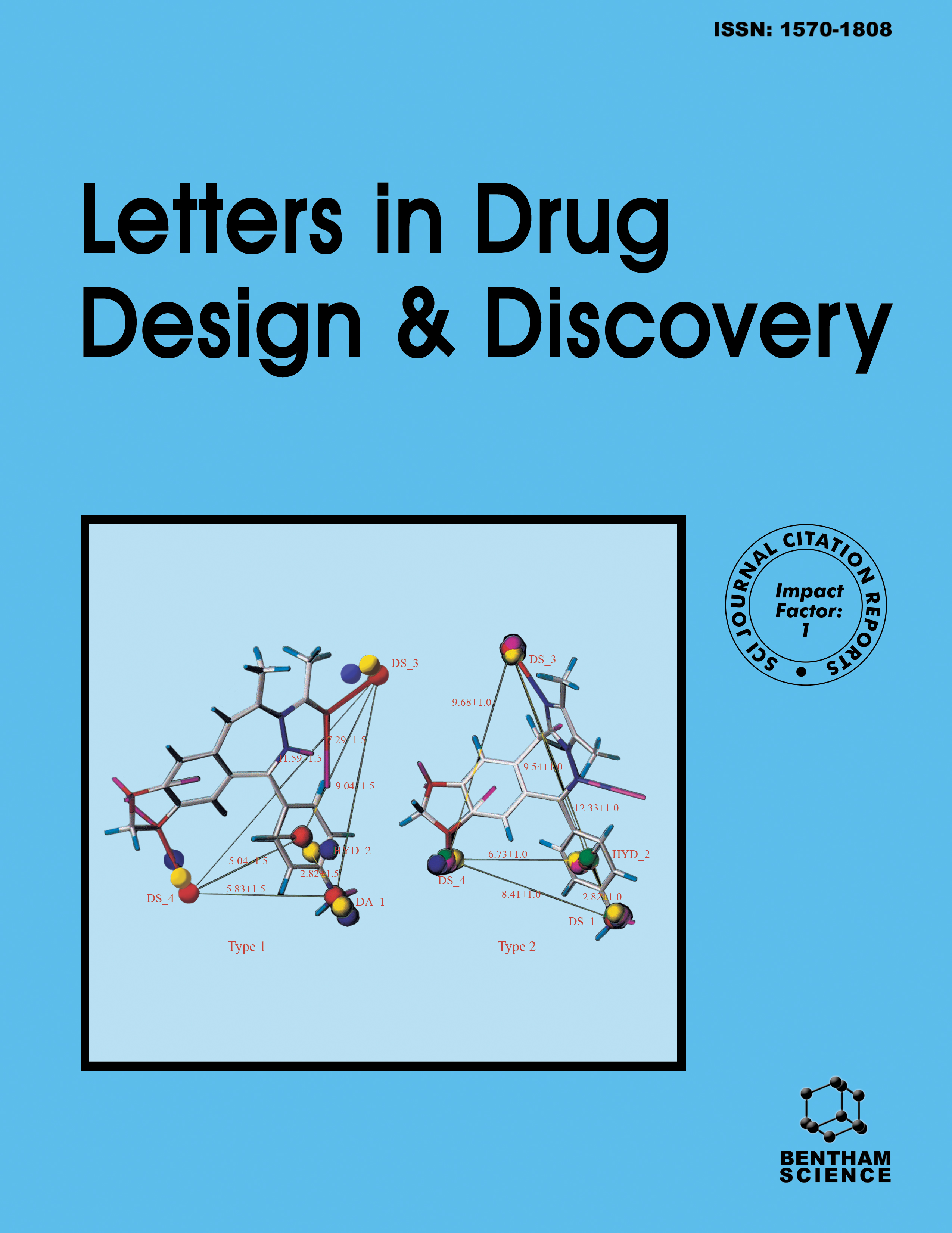
Volume 19, Issue 3, 2022
-
-
In Silico Identification of New Anti-SARS-CoV-2 Agents from Bioactive Phytocompounds Targeting the Viral Spike Glycoprotein and Human TLR4
More LessBackground: The recent outbreak of novel coronavirus disease (COVID-19) pandemic caused by SARS-CoV-2 has posed a tremendous threat to mankind. The unavailability of a specific drug or vaccine has been the major concern to date. Spike (S) glycoprotein of SARS-CoV-2 plays the most crucial role in viral infection and immunopathogenesis, and hence this protein appears to be an efficacious target for drug discovery. Objective: The objective of this study was to identify potent bioactive phytocompound that can target viral spike (S) glycoprotein and human TLR4 to reduce immunopathological manifestations of COVID- 19. Methods: A series of thirty (30) bioactive phytocompounds, previously documented for antiviral activity, were theoretically screened for their binding efficacy against key proteins related to the pathogenesis of SARS-CoV-2, namely viral spike (S) glycoprotein, and human TLR4. MD simulation was employed to verify the postulations of molecular docking study, and further ADME analysis was performed to predict the most effective one. Results: Studies hypothesized that two new phytochemicals, viz. cajaninstilbene acid (-8.83 kcal/mol) and papaverine (-5.81 kcal/mol), might be the potent inhibitors of spike glycoprotein with stout binding affinity and favourable ADME attributes. MD simulation further ratified the stability of the docked complexes between the phytochemicals and S protein through strong hydrogen bonding. Our In Silico data also indicated that cajaninstilbene acid and papaverine might block human TLR4, which could be useful in mitigating SARS-CoV-2-induced lethal proinflammatory responses. Conclusion: Experimental data collectively predict cajaninstilbene acid as the potential blocker of S protein which may be used as an anti-viral against COVID-19 in the future. However, further experimental validations alongside toxicological detailing are needed for claiming the candidature of these molecules as future anti-corona therapeutics.
-
-
-
Design and Study of In Silico Binding Dynamics of Certain Isoxazole Bearing Leads Against Aβ-42 and BACE-1 Loop in Protein Fibrillation
More LessAuthors: Puja Mishra, Souvik Basak, Arup Mukherjee and Anindya BasuAims: Design isoxazole bearing leads as dual inhibitors against Amyloid β and BACE-1 loop in protein fibrillation. Background: Protein fibrillation is one of the key reasons for several diseases, namely Alzheimer’s, Parkinson’s, and many others. One of the key strategies of preventing protein fibrillation is destabilizing the protein fibrils themselves or inhibiting the amyloid fibril-forming pathway in the initial stage. Introduction: Attempts have been taken to design newer leads to inhibit protein fibrillation by targeting the β-amyloidogenesis pathway in the brain. To exploit interfenestration between Amyloid β -42 protein and BACE-1 (β-site amyloid precursor protein cleaving enzyme) for amyloidogenesis, studies are undertaken to design dual inhibitors against the same. Methods: In vitro binding interactions were found using docking, de novo ligand design, and MD simulation study. Results: Three compounds bearing an isoxazole heterocyclic nucleus were designed which could successfully bind to the hydrophobic raft and salt bridge residues Asp 23-Lys-26 of Amyloid β, destabilizing the growing fibril. Additionally, one of our candidate compounds exhibited force of interaction with Thr232 at the S3 pocket of BACE-1, interacted with key residue Asp228, Tyr71, and Thr72 of the β-hairpin flap and hydrogen bonding with Gly11 at loop 10s. Conclusion: Protein flexibility dynamics of the Aβ-42 protein revealed that there is a considerable conformational change of the same with or without ligand binding. The lower RMSF of the bound region and reprogramming residual contacts within the Aβ-42 protein suggested successful binding of the ligand with the protein, lowering the access for further β-β dimerization.
-
-
-
Homology Modelling, Docking-based Virtual Screening, ADME Properties, and Molecular Dynamics Simulation for Identification of Probable Type II Inhibitors of AXL Kinase
More LessAuthors: Heena R. Bhojwani and Urmila J. JoshiBackground: AXL kinase is an important member of the TAM family for kinases which is involved in most cancers. Considering its role in different cancers due to its pro-tumorigenic effects and its involvement in the resistance, it has gained importance recently. Majority of research carried out is on Type I inhibitors and limited studies have been carried out for Type II inhibitors. Taking this into consideration, we have attempted to build Homology models to identify the Type II inhibitors for the AXL kinase. Methods: Homology Models for DFG-out C-helix-in/out state were developed using SWISS Model, PRIMO, and Prime. These models were validated by different methods and further evaluated for stability by molecular dynamics simulation using Desmond software. Selected models PED1-EB and PEDI1-EB were used for the docking-based virtual screening of four compound libraries using Glide software. The hits identified were subjected to interaction analysis and shortlisted compounds were subjected to Prime MM-GBSA studies for energy calculation. These compounds were also docked in the DFG-in state to check for binding and elimination of any compounds that may not be Type II inhibitors. The Prime energies were calculated for these complexes as well and some compounds were eliminated. ADMET studies were carried out using Qikprop. Some selected compounds were subjected to molecular dynamics simulation using Desmond for evaluating the stability of the complexes. Results: Out of 78 models inclusive of both DFG-out C-helix-in and DFG-out C-helix-out, 5 models were identified after different types of evaluation as well as validation studies. 1 model representing each type (PED1-EB and PEDI1-EB) was selected for the screening studies. The screening studies resulted in the identification of 29 compounds from the screen on PED1-EB and 10 compounds from the screen on PEDI1-EB. Hydrogen bonding interactions with Pro621, Met623, and Asp690 were observed for these compounds primarily. In some compounds, hydrogen bonding with Leu542, Glu544, Lys567, and Asn677 as well as pi-pi stacking interactions with either Phe622 or Phe691 were also seen. 4 compounds identified from PED1-EB screen were subjected to molecular dynamics simulation and their interactions were found to be consistent during the simulation. 2 compounds identified from PEDI1-EB screen were also subjected to the simulation studies, however, their interactions with Asp690 were not observed for a significant time and in both cases differed from the docked pose. Conclusion: Multiple models of DFG-out conformations of AXL kinase were built, validated and used for virtual screening. Different compounds were identified in the virtual screening, which may possibly act as Type II inhibitors for AXL kinase. Some more experimental studies can be done to validate these findings in future. This study will play a guiding role in the further development of the newer Type II inhibitors of the AXL kinase for the probable treatment of cancer.
-
-
-
Design and Synthesis of Tri-substituted Imidazole Derivatives as CD73 Inhibitors for Their Anticancer Activity
More LessBackground: Monoclonal antibodies licensed by the US Food and Drug Administration (FDA) target diverse biological targets relevant to immuno-oncology, and small compounds in clinical trials target various aspects of immuno-oncology. Several small compounds that target CD73 are at various stages of clinical studies. Several imidazoles are currently being utilized to treat malignancies, including Dacarbazine, Zoledronic acid, Mercaptopurine, and others. As a result, we evaluated the cytotoxicity of modified tri-phenyl imidazoles against breast cancer cell lines, as well as conducted virtual tests. Methods: We used Accelrys Drug Discovery Studio 3.5 software to undertake molecular docking, ADMET, and molecular properties studies on 68 proposed imidazole derivatives. The synthesized compounds' binding mechanisms were investigated against the CD73 protein (PDB Code: 4H1S). To find the drugs with the best pharmacokinetics, researchers assessed ADMET solubility, BBB penetration, hepatotoxicity, PPB binding, and polar surface area. The MDA-MB-231 breast cancer cell line was treated with these produced compounds, and the MTT test method was used to determine the IC50 values. Results: The selected 14 compounds showed good binding in the active site of CD73 by forming Hbonds with amino acid residues, according to molecular docking studies. Breast cancer cell lines were treated with substituted tri-phenyl imidazole derivatives, which displayed anticancer activity. Compounds 3a and 3h, which had an electron-donating group at the 2nd and 3rd positions and p-substitutions of the chloro and nitro groups, respectively, showed considerable anticancer action. Conclusion: Fourteen imidazole derivatives were produced and tested against breast cancer cell lines based on in-silico research. The MDA-MB-231 cell line was strongly suppressed by compounds 3a and 3h. In-vitro enzyme inhibition experiments revealed that only 3h demonstrated considerable inhibition.
-
-
-
Identification of Natural Compounds with Analgesic and Antiinflammatory Properties Using Machine Learning and Molecular Docking Studies
More LessAuthors: Mohammad F. Khan, Ridwan Bin Rashid and Mohammad A. RashidBackground: Natural products have been a rich source of compounds for drug discovery. Usually, compounds obtained from natural sources have little or no side effects, thus searching for new lead compounds from traditionally used plant species is still a rational strategy. Introduction: Natural products serve as a useful repository of compounds for new drugs; however, their use has been decreasing, in part because of technical barriers to screening natural products in highthroughput assays against molecular targets. To address this unmet demand, we have developed and validated a high throughput in silico machine learning screening method to identify potential compounds from natural sources. Methods: In the current study, three machine learning approaches, including Support Vector Machine (SVM), Random Forest (RF) and Gradient Boosting Machine (GBM) have been applied to develop the classification model. The model was generated using the cyclooxygenase-2 (COX-2) inhibitors reported in the ChEMBL database. The developed model was validated by evaluating the accuracy, sensitivity, specificity, Matthews correlation coefficient and Cohen’s kappa statistic of the test set. The molecular docking study was conducted on AutoDock vina and the results were analyzed in PyMOL. Results: The accuracy of the model for SVM, RF and GBM was found to be 75.40 %, 74.97 % and 74.60 %, respectively, which indicates the good performance of the developed model. Further, the model has demonstrated good sensitivity (61.25 % - 68.60 %) and excellent specificity (77.72 %- 81.41 %). Application of the model on the NuBBE database, a repository of natural compounds, led us to identify a natural compound, enhydrin possessing analgesic and anti-inflammatory activities. The ML methods and the molecular docking study suggest that enhydrin likely demonstrates its analgesic and anti-inflammatory actions by inhibiting COX-2. Conclusion: Our developed and validated in silico high throughput ML screening methods may assist in identifying drug-like compounds from natural sources.
-
Volumes & issues
-
Volume 21 (2024)
-
Volume 20 (2023)
-
Volume 19 (2022)
-
Volume 18 (2021)
-
Volume 17 (2020)
-
Volume 16 (2019)
-
Volume 15 (2018)
-
Volume 14 (2017)
-
Volume 13 (2016)
-
Volume 12 (2015)
-
Volume 11 (2014)
-
Volume 10 (2013)
-
Volume 9 (2012)
-
Volume 8 (2011)
-
Volume 7 (2010)
-
Volume 6 (2009)
-
Volume 5 (2008)
-
Volume 4 (2007)
-
Volume 3 (2006)
-
Volume 2 (2005)
-
Volume 1 (2004)
Most Read This Month
