


Combinatorial Chemistry & High Throughput Screening - Volume 16, Issue 10, 2013
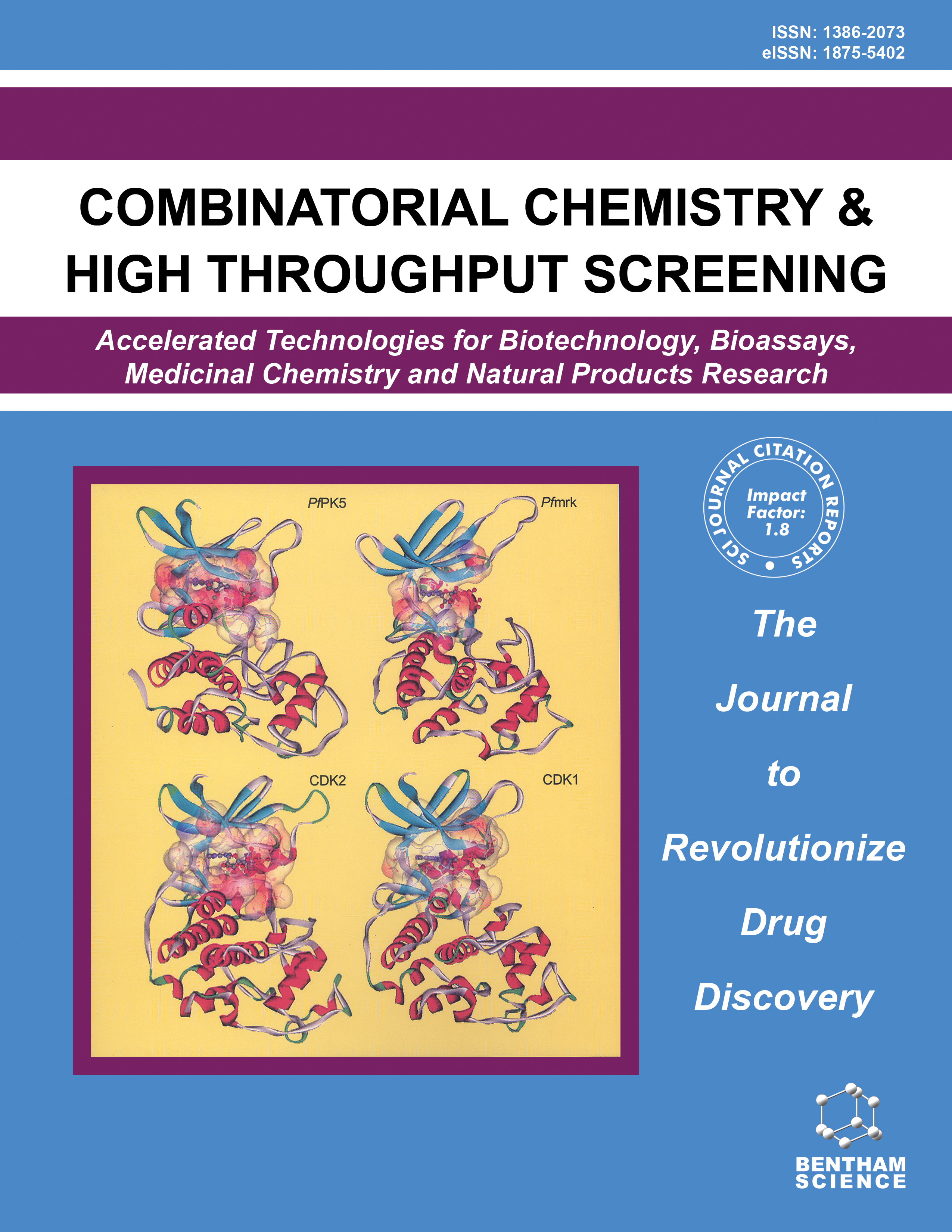
Volume 16, Issue 10, 2013
-
-
Chemical Informatics and the Drug Discovery Knowledge Pyramid
More LessAuthors: Gerald H. Lushington, Yinghua Dong and Bhargav TheerthamThe magnitude of the challenges in preclinical drug discovery is evident in the large amount of capital invested in such efforts in pursuit of a small static number of eventually successful marketable therapeutics. An explosion in the availability of potentially drug-like compounds and chemical biology data on these molecules can provide us with the means to improve the eventual success rates for compounds being considered at the preclinical level, but only if the community is able to access available information in an efficient and meaningful way. Thus, chemical database resources are critical to any serious drug discovery effort. This paper explores the basic principles underlying the development and implementation of chemical databases, and examines key issues of how molecular information may be encoded within these databases so as to enhance the likelihood that users will be able to extract meaningful information from data queries. In addition to a broad survey of conventional data representation and query strategies, key enabling technologies such as new context-sensitive chemical similarity measures and chemical cartridges are examined, with recommendations on how such resources may be integrated into a practical database environment.
-
-
-
Screening of Photosynthetic Pigments for Herbicidal Activity with a New Computational Molecular Approach
More LessAuthors: R. Navanietha Krishnaraj, Saravanan Chandran, Parimal Pal and Sheela BerchmansThere is an immense interest among the researchers to identify new herbicides which are effective against the herbs without affecting the environment. In this work, photosynthetic pigments are used as the ligands to predict their herbicidal activity. The enzyme 5-enolpyruvylshikimate-3-phosphate (EPSP) synthase is a good target for the herbicides. Homology modeling of the target enzyme is done using Modeler 9.11 and the model is validated. Docking studies were performed with AutoDock Vina algorithm to predict the binding of the natural pigments such as β-carotene, chlorophyll a, chlorophyll b, phycoerythrin and phycocyanin to the target. β-carotene, phycoerythrin and phycocyanin have higher binding energies indicating the herbicidal activity of the pigments. This work reports a procedure to screen herbicides with computational molecular approach. These pigments will serve as potential bioherbicides in the future.
-
-
-
Cu(II) Schiff Base Complex as a Highly Efficient Catalyst for the Synthesis of Polyhydroquinoline Derivatives via Hantzsch Condensation in Water
More LessIn the present study, Cu(II) Schiff-base complex is introduced as a highly efficient and green solid catalyst for the unsymmetrical Hantzsch condensation through a four-component coupling of various aldehydes, dimedone, ethyl acetoacetate and ammonium acetate to form polyhydroquinoline derivatives in good to excellent yields. This reaction was carried out in the presence of 1 mol% of catalysts in water at room temperature. The reusability of the catalysts was demonstrated by a five-run test. Remarkable features of this new procedure are cleaner reaction profiles, shorter reactiontimes, simple experimental and work-up procedures.
-
-
-
Facile and Efficient Synthesis of New Class of Imidazole Derivatives via One-Pot Multicomponent Reactions in Water
More LessA water-accelerated multicomponent synthesis of organic target molecules has been used as a key method for the preparation of novel imidazole derivatives. The three-component condensation reactions of primary amines with trichloroacetonitrile in the presence of ninhydrine in water are developed as efficient and clean green synthetic procedures for the high-yielding preparation of imidazoles.
-
-
-
Modulators of the microRNA Biogenesis Pathway via Arrayed Lentiviral Enabled RNAi Screening for Drug and Biomarker Discovery
More LessAuthors: David Shum, Bhavneet Bhinder and Hakim DjaballahMicroRNAs (miRNAs) are small endogenous and conserved non-coding RNA molecules that regulate gene expression. Although the first miRNA was discovered well over sixteen years ago, little is known about their biogenesis and it is only recently that we have begun to understand their scope and diversity. For this purpose, we performed an RNAi screen aimed at identifying genes involved in their biogenesis pathway with a potential use as biomarkers. Using a previously developed miRNA 21 (miR-21) EGFP-based biosensor cell based assay monitoring green fluorescence enhancements, we performed an arrayed short hairpin RNA (shRNA) screen against a lentiviral particle ready TRC1 library covering 16,039 genes in 384-well plate format, and interrogating the genome one gene at a time building a panoramic view of endogenous miRNA activity. Using the BDA method for RNAi data analysis, we nominate 497 gene candidates the knockdown of which increased the EGFP fluorescence and yielding an initial hit rate of 3.09%; of which only 22, with reported validated clones, are deemed high-confidence gene candidates. An unexpected and surprising result was that only DROSHA was identified as a hit out of the seven core essential miRNA biogenesis genes; suggesting that perhaps intracellular shRNA processing into the correct duplex may be cell dependent and with differential outcome. Biological classification revealed several major control junctions among them genes involved in transport and vesicular trafficking. In summary, we report on 22 high confidence gene candidate regulators of miRNA biogenesis with potential use in drug and biomarker discovery.
-
-
-
Insecticidal Activity of Fatty Acid-Rich Turkish Bryophyte Extracts Against Sitophilus granarius (Coleoptera: Curculionidae)
More LessAuthors: Gokhan Abay, Muhammed Altun, Omer C. Karakoc, Fatih Gul and Ibrahim DemirtasThe composition of fatty acids and insecticidal effects was performed for the Turkish mosses Dicranum scoparium, Hypnum cupressiforme, Polytrichastrum formosum, Homalothecium lutescens and the Turkish liverwort Conocephalum conicum. All structures were determined by means of gas chromatography and gas chromatography-mass spectrometry techniques. The determination of fatty acids was done using a simple and mild method that utilized different solvent extractions ranging from nonpolar to polar solvents (hexane, dichloromethane, chloroform, ethyl acetate and methanol, respectively), and the samples were powdered with and without liquid nitrogen. The correlations between the saturated and unsaturated fatty acid contents depending on the solvent polarity and their crushing process by liquid nitrogen were observed. The insecticidal activity of the bryophytes was analyzed by using the methanol, hexane and esterified methanol extracts. The hexane extracts of Polytrichastrum formosum showed the highest insecticidal activity (70.33%) against Sitophilus granarius. Contact toxicity activities of lauric, myristic and palmitic acids besides single dose studies of the solvent extracts were carried out. The highest mortality rate (53.34%) was obtained from the myristic acid among the tested pure fatty acids. The activities of palmitic and lauric acids were 17.75% and 4.32%, respectively.
-
-
-
A Novel Method for High Throughput Lipophilicity Determination by Microscale Shake Flask and Liquid Chromatography Tandem Mass Spectrometry
More LessAuthors: Baiwei Lin and Joseph H. PeaseModern small molecule drug design requires the optimization of not only the binding characteristics of the molecule but also its physicochemical properties for ADMET performance. A key physical property is lipophilicity and medicinal chemists need rapid access to high quality data in order to drive their decision making. Traditionally lipophilicity (log D) measurements are performed with a shake flask method and UV determination. This method suffers from low sensitivity and is not easily converted to a high throughput format. Over the past decade, several groups have taken different approaches to improve this assay, including replacing the shake flask method with one that utilizes reverse phase HPLC. Here we describe a new microscale shake flask method that utilizes UPLC–MS/MS to achieve increased throughput, sensitivity and accuracy. Approaches for assessing data quality are also described. This platform technology only requires micrograms of compound and is routinely used by most small molecule drug discovery project teams at Genentech.
-
-
-
Identification of Potent Inhibitors for Salmonella Typhimurium Quorum Sensing via Virtual Screening and Pharmacophore Modeling
More LessAuthors: Shanmugam Gnanendra, Syed Mohamed and Jeyakumar NatarajanThe quorum sensing (QS) enhanced transcriptional regulator SdiA of S. typhimurium is the best known and potential target and responds to a broad range of AHLs and AHL analogs. On the other hand, in many gram-negative bacteria including S. typhimurium, brominated furanones were reported to have inhibitory activity against the QS phenotypes. Motivated by both, we designed an in silico group of halogenated AHLs by substituting halogen compounds (Br, Cl, F and I) on the lactone ring of AHLs and analyzed their interactions with SdiA. The best analogs based on their docking score and another 18 training sets with inhibitory activity against S. typhimurium QS were used to design the pharmacophore. This pharmacophore model was used as a 3D database query against the MayBridge Database consisting of 56,000 compounds and subsequently, the screened compounds were filtered by Lipinski’s rule and ADMET properties. This results in 10 compounds as probable leads to inhibit the SdiA activity and they were docked in the active site of SdiA. Among these, 3 compounds CD01374, RJF00047, and KM10117 exhibited the best docking scores and also favors the necessary hydrogen bond interactions with the essential amino acids in SdiA, and thus identified as novel leads to inhibit Salmonella pathogenicity.
-
-
-
A Novel Three-Component Reaction for the Synthesis of 1,3-Benzoxazines in Water
More LessA simple and proficient method for the synthesis of 1,3-benzoxazine derivatives via three-component reaction of isocyanide and isoquinoline with 1-(6-hydroxy-2-isopropenyl-1-benzofuran-yl)-1-ethanone or 4-hydroxycumarine in water in the presence of piperidine at 70°C is reported.
-
-
-
One-pot Synthesis of Dihydropyrano[2,3-c]chromenes via a Three-component Reaction in Aqueous Media
More LessAuthors: Saeed Balalaie, Ahmad Khazaie and Morteza AshourihaAn efficient protocol for the synthesis of dihydropyrano [2,3-c] chromenes derivatives by one-pot threecomponent reaction of aromatic aldehydes, malononitrile or methyl cyanoacetate, and 4-hydroxy coumarin has been developed using catalytic amount (10%) of three different catalysts piperidine, triethyl amine, and natrium carbonate in aqueous media. The present protocol has significant features such as easy set-up and work-up, environmentally benign, high yields, short reaction times.
-
-
-
Fast and Green One-Pot Multicomponent Synthesis of a Library of Pyrrolo[1,2-c] Pyrimidines Under Microwave Irradiation
More LessA simple, clean and rapid one-pot three component, microwave-assisted synthesis of pyrrolo[1,2-c]pyrimidine derivatives starting from various substituted pyrimidines, 2-bromoacetophenones and nonsymmetrical, electron deficient alkynes in 1,2-epoxybutane which acts both as solvent and acid scavenger is reported. This one-pot three component synthesis implies short reaction times being at the same time highly cost-effective and environmental friendly.
-
-
-
A Passerini-Type Condensation: A Carboxylic Acid-Free Approach for the Synthesis of the α-Acyloxycarboxamides
More LessAuthors: Mojtaba Mahyari, Shabnam Shaabani, Ahmad Shaabani and Seik Weng NgA Passerini-type condensation for the synthesis of α-acyloxycarboxamides starting from simple and readily available inputs, including an isocyanide, aldehydes and water in the presence of trimethylsilyl azide as a catalyst under reflux conditions in toluene in good yields, is described.
-
Volumes & issues
-
Volume 28 (2025)
-
Volume 27 (2024)
-
Volume 26 (2023)
-
Volume 25 (2022)
-
Volume 24 (2021)
-
Volume 23 (2020)
-
Volume 22 (2019)
-
Volume 21 (2018)
-
Volume 20 (2017)
-
Volume 19 (2016)
-
Volume 18 (2015)
-
Volume 17 (2014)
-
Volume 16 (2013)
-
Volume 15 (2012)
-
Volume 14 (2011)
-
Volume 13 (2010)
-
Volume 12 (2009)
-
Volume 11 (2008)
-
Volume 10 (2007)
-
Volume 9 (2006)
-
Volume 8 (2005)
-
Volume 7 (2004)
-
Volume 6 (2003)
-
Volume 5 (2002)
-
Volume 4 (2001)
-
Volume 3 (2000)
Most Read This Month

Most Cited Most Cited RSS feed
-
-
Label-Free Detection of Biomolecular Interactions Using BioLayer Interferometry for Kinetic Characterization
Authors: Joy Concepcion, Krista Witte, Charles Wartchow, Sae Choo, Danfeng Yao, Henrik Persson, Jing Wei, Pu Li, Bettina Heidecker, Weilei Ma, Ram Varma, Lian-She Zhao, Donald Perillat, Greg Carricato, Michael Recknor, Kevin Du, Huddee Ho, Tim Ellis, Juan Gamez, Michael Howes, Janette Phi-Wilson, Scott Lockard, Robert Zuk and Hong Tan
-
-
- More Less