


UV, Visible, and Near-Infrared Responsive Photocatalyst for Dye Degradation
- Authors: Natarajan Prakash1, Subramanian Balachandran2, Muhammad Y. Bashouti3, Mukkanan Arivananthan4, Yasuhiro Hayakawa5
-
View Affiliations Hide Affiliations1 Department of Materials Chemistry, SIMATS School of Engineering, Saveetha Institute of Medical and Technical Sciences, Thandalam 600056, Tamil Nadu, India 2 Department of Physiology, Saveetha Dental College and Hospitals, Saveetha Institute of Medical and Technical Sciences, Saveetha University, Chennai-600077, Tamil Nadu, India 3 Department of Solar Energy and Environmental Physics, Ben-Gurion University of the Negev, Midreshet Ben-Gurion-8499000, Beersheba, Israel 4 Center for Nanoscience and Technology, Anna University, Chennai-600025, Tamil Nadu, India 5 Research Institute of Electronics, Shizuoka University, Hamamatsu, Shizuoka-432-8011, Japan
- Source: Advances in Dye Degradation: Volume 2 , pp 54-76
- Publication Date: July 2024
- Language: English


UV, Visible, and Near-Infrared Responsive Photocatalyst for Dye Degradation, Page 1 of 1
< Previous page | Next page > /docserver/preview/fulltext/9789815238150/chapter-3-1.gif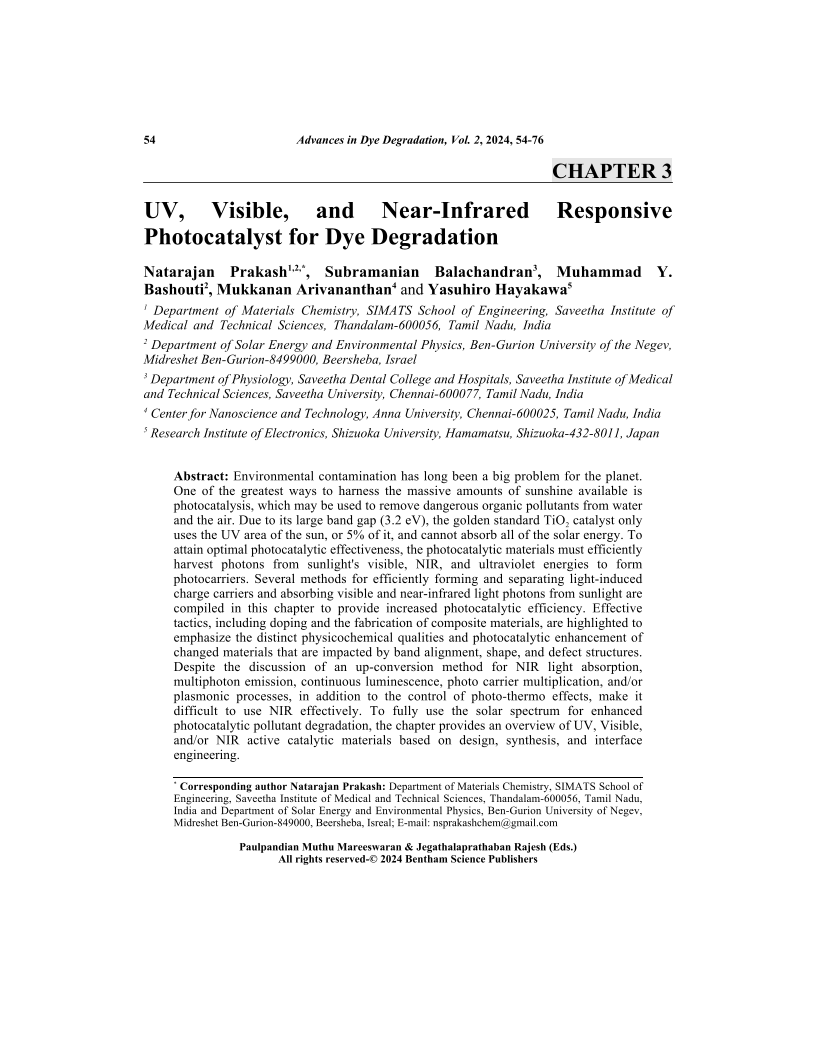
Environmental contamination has long been a big problem for the planet. One of the greatest ways to harness the massive amounts of sunshine available is photocatalysis, which may be used to remove dangerous organic pollutants from water and the air. Due to its large band gap (3.2 eV), the golden standard TiO2 catalyst only uses the UV area of the sun, or 5% of it, and cannot absorb all of the solar energy. To attain optimal photocatalytic effectiveness, the photocatalytic materials must efficiently harvest photons from sunlight's visible, NIR, and ultraviolet energies to form photocarriers. Several methods for efficiently forming and separating light-induced charge carriers and absorbing visible and near-infrared light photons from sunlight are compiled in this chapter to provide increased photocatalytic efficiency. Effective tactics, including doping and the fabrication of composite materials, are highlighted to emphasize the distinct physicochemical qualities and photocatalytic enhancement of changed materials that are impacted by band alignment, shape, and defect structures. Despite the discussion of an up-conversion method for NIR light absorption, multiphoton emission, continuous luminescence, photo carrier multiplication, and/or plasmonic processes, in addition to the control of photo-thermo effects, make it difficult to use NIR effectively. To fully use the solar spectrum for enhanced photocatalytic pollutant degradation, the chapter provides an overview of UV, Visible, and/or NIR active catalytic materials based on design, synthesis, and interface engineering.
-
From This Site
/content/books/9789815238150.chapter-3dcterms_subject,pub_keyword-contentType:Journal -contentType:Figure -contentType:Table -contentType:SupplementaryData105
