


Emerging Nanotherapeutic Strategies in Alzheimer's Disease
- Authors: Soheila Montazersaheb1, Elham Ahmadian2, Solmaz Maleki Dizaj3, Yalda Jahanbani4, Soodabeh Davaran5, Irada Huseynova6, Cumali Keskin7, Renad I. Zhdanov8, Rovshan Khalilov9, Aziz Eftekhari10
-
View Affiliations Hide Affiliations1 Molecular Medicine Research Center, Tabriz University of Medical Sciences, Tabriz, Iran 2 Kidney Research Center, Tabriz University of Medical Sciences, Tabriz, Iran 3 Dental and Periodontal Research Center, Tabriz University of Medical Sciences, Tabriz, Iran 4 Department of Medicinal Chemistry, School of Pharmacy, Tabriz University of Medical Sciences, Tabriz, Iran 5 Department of Medicinal Chemistry, School of Pharmacy, Tabriz University of Medical Sciences, Tabriz, Iran 6 Institute of Molecular Biology & Biotechnologies, Azerbaijan National Academy of Sciences, 11 Izzat Nabiyev, Baku AZ 1073, Azerbaijan 7 Medical Laboratory Techniques, Vocational Higher School of Healthcare Studies, Mardin Artuklu University, Mardin, Turkey 8 Russian Institute for Advanced Study, Moscow State Pedagogical University, 1/1, Malaya Pirogovskaya St, Moscow, 119991, Russian Federation 9 Russian Institute for Advanced Study, Moscow State Pedagogical University, 1/1, Malaya Pirogovskaya St, Moscow, 119991, Russian Federation 10 Russian Institute for Advanced Study, Moscow State Pedagogical University, 1/1, Malaya Pirogovskaya St, Moscow, 119991, Russian Federation
- Source: Frontiers in Clinical Drug Research - Dementia: Volume 2 , pp 173-203
- Publication Date: November 2021
- Language: English


Emerging Nanotherapeutic Strategies in Alzheimer's Disease, Page 1 of 1
< Previous page | Next page > /docserver/preview/fulltext/9789815039474/chapter-4-1.gif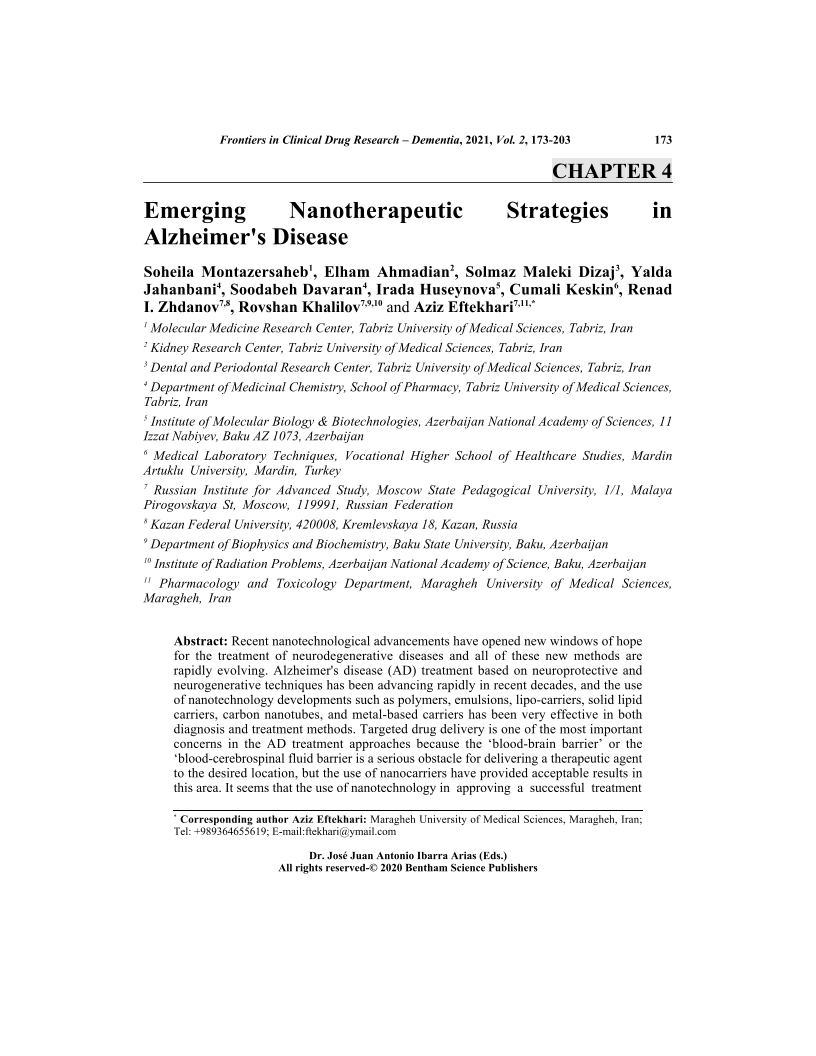
Recent nanotechnological advancements have opened new windows of hope for the treatment of neurodegenerative diseases and all of these new methods are rapidly evolving. Alzheimer's disease (AD) treatment based on neuroprotective and neurogenerative techniques has been advancing rapidly in recent decades, and the use of nanotechnology developments such as polymers, emulsions, lipo-carriers, solid lipid carriers, carbon nanotubes, and metal-based carriers has been very effective in both diagnosis and treatment methods. Targeted drug delivery is one of the most important concerns in the AD treatment approaches because the blood-brain barrier or the blood-cerebrospinal fluid barrier is a serious obstacle for delivering a therapeutic agent to the desired location, but the use of nanocarriers have provided acceptable results in this area. It seems that the use of nanotechnology in approving a successful treatment method for Alzheimer's is inevitable and this review has collected a complete copy of the recent nanotechnology-based approaches for the treatment of AD.
-
From This Site
/content/books/9789815039474.chapter-4dcterms_subject,pub_keyword-contentType:Journal -contentType:Figure -contentType:Table -contentType:SupplementaryData105
