


Polyphenol Compounds as Potential Therapeutic Agents in Alzheimers Disease
- Authors: rika Paiva de Moura1, Alex France Messias Monteiro2, Natan Dias Fernandes3, Herbert Igor Rodrigues de Medeiros4, Igor José dos Santos Nascimentos5, Marcus Tullius Scotti6, Francisco Jaime Bezerra Mendonça Júnior7, Edeildo Ferreira da Silva-Júnior8, Luciana Scotti9
-
View Affiliations Hide Affiliations1 Postgraduate Program in Natural and Bioactive Synthetic Products, Health Sciences Center, Federal University of Paraba, Castelo Branco Street, Joo Pessoa, PB, Brazil 2 Postgraduate Program in Natural and Bioactive Synthetic Products, Health Sciences Center, Federal University of Paraba, Castelo Branco Street, Joo Pessoa, PB, Brazil 3 Postgraduate Program in Natural and Bioactive Synthetic Products, Health Sciences Center, Federal University of Paraba, Castelo Branco Street, Joo Pessoa, PB, Brazil 4 Postgraduate Program in Natural and Bioactive Synthetic Products, Health Sciences Center, Federal University of Paraba, Castelo Branco Street, Joo Pessoa, PB, Brazil 5 Chemistry and Biotechnology Institute, Federal University of Alagoas, 57072 970, Macei, AL, Brazil 6 Postgraduate Program in Natural and Bioactive Synthetic Products, Health Sciences Center, Federal University of Paraba, Castelo Branco Street, Joo Pessoa, PB, Brazil 7 Laboratory of Synthesis and Drug Delivery, State University of Paraba, Horcio Trajano de Oliveira Street, Joo Pessoa, PB, Brazil 8 Chemistry and Biotechnology Institute, Federal University of Alagoas, 57072-970, Macei, AL, Brazil 9 Postgraduate Program in Natural and Bioactive Synthetic Products, Health Sciences Center, Federal University of Paraba, Castelo Branco Street, Joo Pessoa, PB, Brazil
- Source: Frontiers in Clinical Drug Research - Dementia: Volume 2 , pp 204-255
- Publication Date: November 2021
- Language: English


Polyphenol Compounds as Potential Therapeutic Agents in Alzheimers Disease, Page 1 of 1
< Previous page | Next page > /docserver/preview/fulltext/9789815039474/chapter-5-1.gif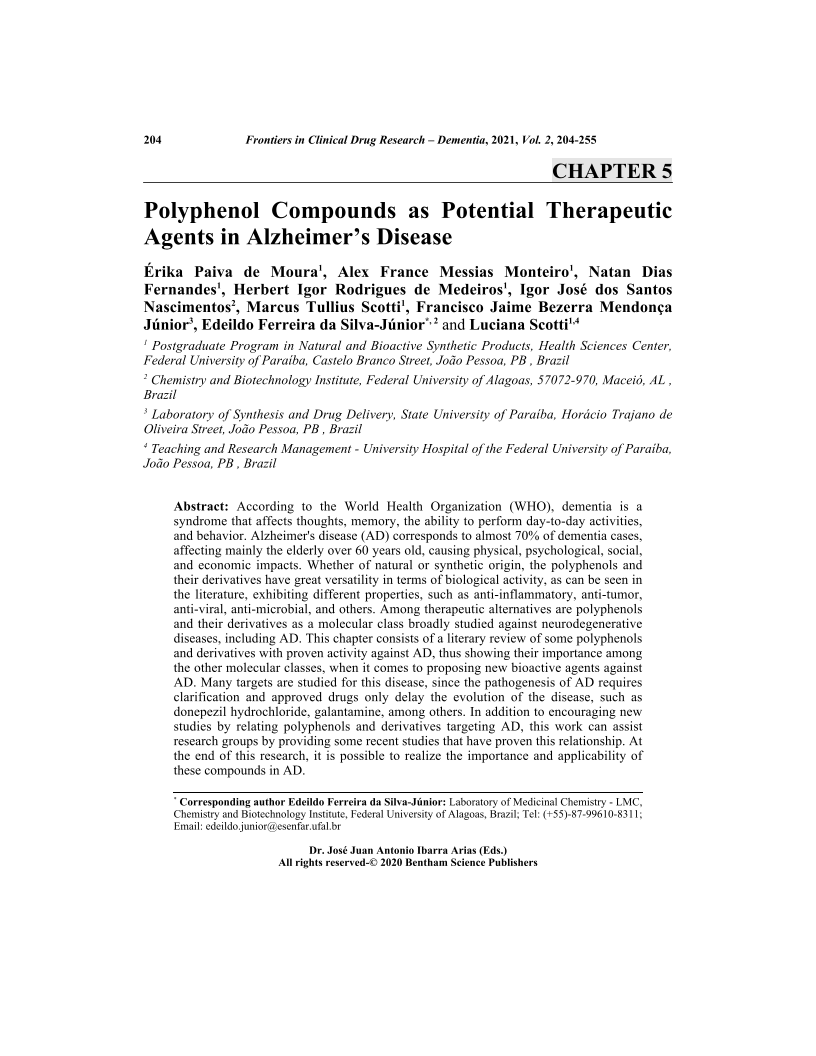
According to the World Health Organization (WHO), dementia is a syndrome that affects thoughts, memory, the ability to perform day-to-day activities, and behavior. Alzheimer's disease (AD) corresponds to almost 70% of dementia cases, affecting mainly the elderly over 60 years old, causing physical, psychological, social, and economic impacts. Whether of natural or synthetic origin, the polyphenols and their derivatives have great versatility in terms of biological activity, as can be seen in the literature, exhibiting different properties, such as anti-inflammatory, anti-tumor, anti-viral, anti-microbial, and others. Among therapeutic alternatives are polyphenols and their derivatives as a molecular class broadly studied against neurodegenerative diseases, including AD. This chapter consists of a literary review of some polyphenols and derivatives with proven activity against AD, thus showing their importance among the other molecular classes, when it comes to proposing new bioactive agents against AD. Many targets are studied for this disease, since the pathogenesis of AD requires clarification and approved drugs only delay the evolution of the disease, such as donepezil hydrochloride, galantamine, among others. In addition to encouraging new studies by relating polyphenols and derivatives targeting AD, this work can assist research groups by providing some recent studies that have proven this relationship. At the end of this research, it is possible to realize the importance and applicability of these compounds in AD.
-
From This Site
/content/books/9789815039474.chapter-5dcterms_subject,pub_keyword-contentType:Journal -contentType:Figure -contentType:Table -contentType:SupplementaryData105
