


From Cells to Clinic - Direct Biomolecule Quantification of Clinically Relevant Biomolecules
- Authors: Swati Jain1, Harsimran Singh Bindra2, Sruti Chattopadhyay3
-
View Affiliations Hide Affiliations1 Amity Institute of Nanotechnology, Amity University, Noida, UP, India Department of Science & Technology, Technology Bhavan, New Mehrauli Road, New Delhi, India 2 School of Biotechnology, Sher e-Kashmir University of Agricultural Sciences and Technology ofJammu, Jammu and Kashmir, India 3 Center for Biomedical Engineering, Indian Institute of Technology Delhi (IITD), New Delhi, India
- Source: Surface Enhanced Raman Spectroscopy: Biosensing and Diagnostic Technique for Healthcare Applications , pp 154-190
- Publication Date: December 2021
- Language: English


From Cells to Clinic - Direct Biomolecule Quantification of Clinically Relevant Biomolecules, Page 1 of 1
< Previous page | Next page > /docserver/preview/fulltext/9789815039115/chapter-6-1.gif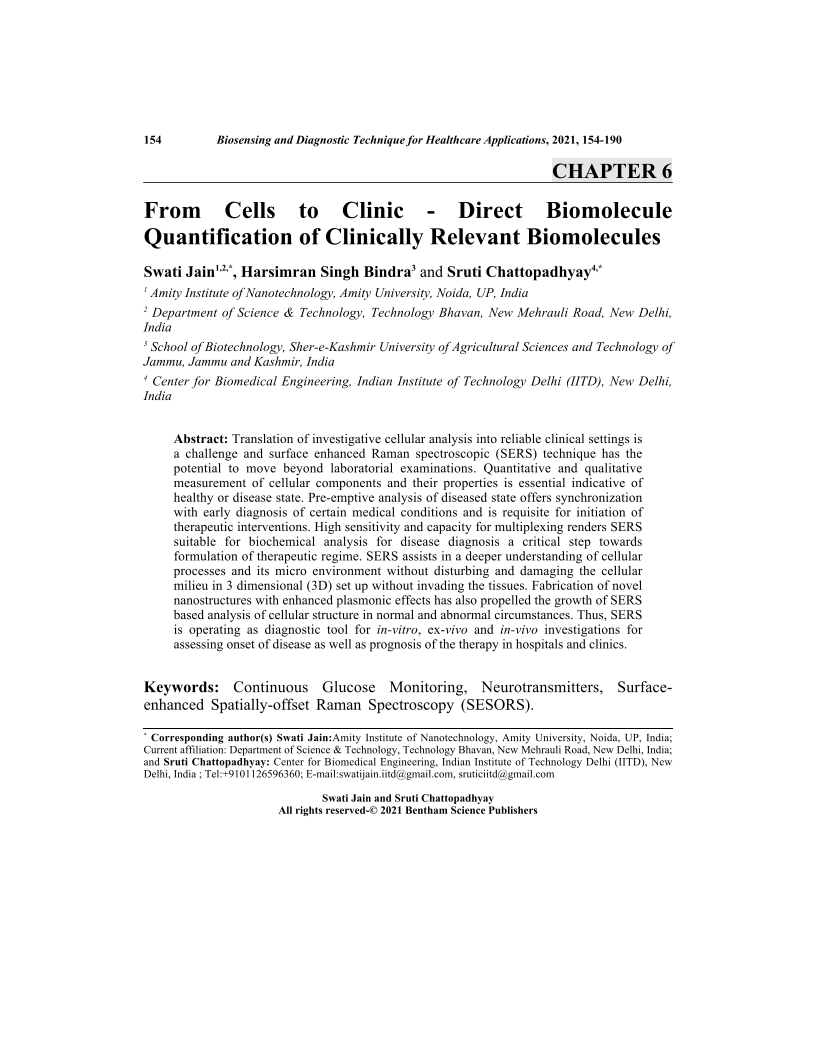
<div>Translation of investigative cellular analysis into reliable clinical settings is</div><div>a challenge and surface enhanced Raman spectroscopic (SERS) technique has the</div><div>potential to move beyond laboratorial examinations. Quantitative and qualitative</div><div>measurement of cellular components and their properties is essential indicative of</div><div>healthy or disease state. Pre-emptive analysis of diseased state offers synchronization</div><div>with early diagnosis of certain medical conditions and is requisite for initiation of</div><div>therapeutic interventions. High sensitivity and capacity for multiplexing renders SERS</div><div>suitable for biochemical analysis for disease diagnosis a critical step towards</div><div>formulation of therapeutic regime. SERS assists in a deeper understanding of cellular</div><div>processes and its micro environment without disturbing and damaging the cellular</div><div>milieu in 3 dimensional (3D) set up without invading the tissues. Fabrication of novel</div><div>nanostructures with enhanced plasmonic effects has also propelled the growth of SERS</div><div>based analysis of cellular structure in normal and abnormal circumstances. Thus, SERS</div><div>is operating as diagnostic tool for in-vitro, ex-vivo and in-vivo investigations for</div><div>assessing onset of disease as well as prognosis of the therapy in hospitals and clinics.</div>
-
From This Site
/content/books/9789815039115.chapter-6dcterms_subject,pub_keyword-contentType:Journal -contentType:Figure -contentType:Table -contentType:SupplementaryData105
