


Surface-Enhanced Raman Scattering Based Rapid Pathogen Detection
- Authors: Ujjal Kumar Sur1, Amar Ghosh2
-
View Affiliations Hide Affiliations1 Department of Chemistry, Behala College, University of Calcutta, Kolkata 60, India 2 Department of Chemistry, Behala College, University of Calcutta, Kolkata-60, India
- Source: Surface Enhanced Raman Spectroscopy: Biosensing and Diagnostic Technique for Healthcare Applications , pp 131-153
- Publication Date: December 2021
- Language: English


Surface-Enhanced Raman Scattering Based Rapid Pathogen Detection, Page 1 of 1
< Previous page | Next page > /docserver/preview/fulltext/9789815039115/chapter-5-1.gif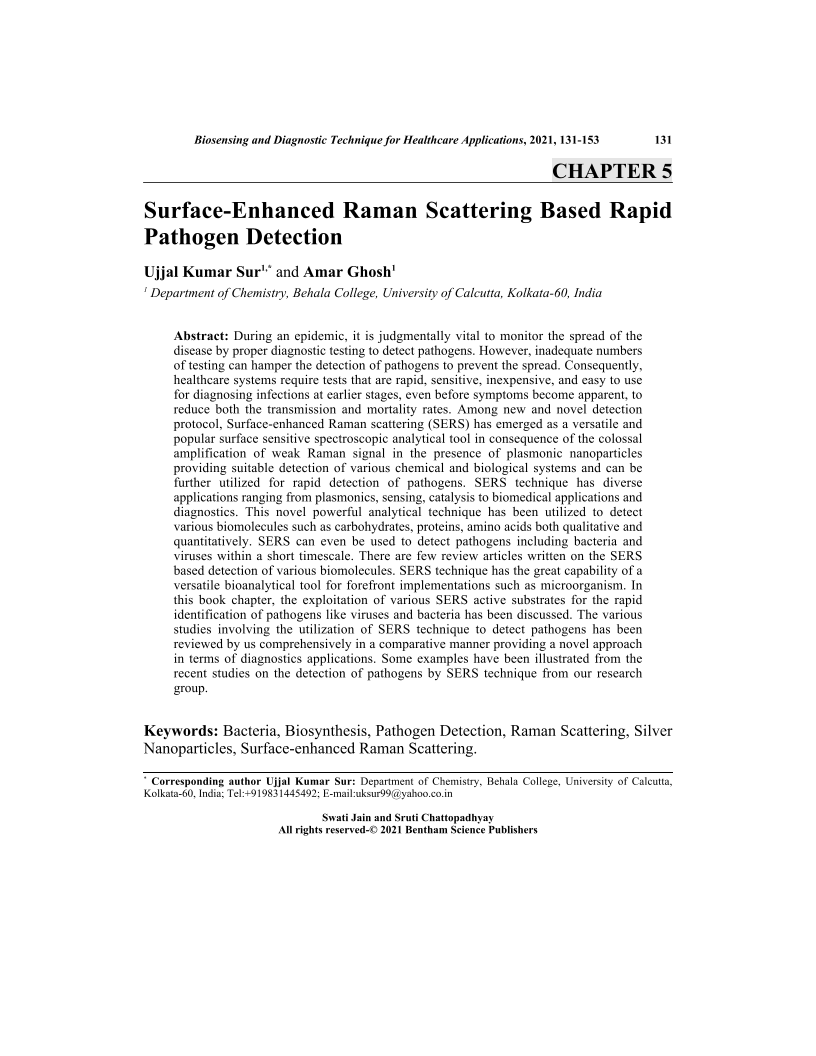
<div>During an epidemic, it is judgmentally vital to monitor the spread of the</div><div>disease by proper diagnostic testing to detect pathogens. However, inadequate numbers</div><div>of testing can hamper the detection of pathogens to prevent the spread. Consequently,</div><div>healthcare systems require tests that are rapid, sensitive, inexpensive, and easy to use</div><div>for diagnosing infections at earlier stages, even before symptoms become apparent, to</div><div>reduce both the transmission and mortality rates. Among new and novel detection</div><div>protocol, Surface-enhanced Raman scattering (SERS) has emerged as a versatile and</div><div>popular surface sensitive spectroscopic analytical tool in consequence of the colossal</div><div>amplification of weak Raman signal in the presence of plasmonic nanoparticles</div><div>providing suitable detection of various chemical and biological systems and can be</div><div>further utilized for rapid detection of pathogens. SERS technique has diverse</div><div>applications ranging from plasmonics, sensing, catalysis to biomedical applications and</div><div>diagnostics. This novel powerful analytical technique has been utilized to detect</div><div>various biomolecules such as carbohydrates, proteins, amino acids both qualitative and</div><div>quantitatively. SERS can even be used to detect pathogens including bacteria and</div><div>viruses within a short timescale. There are few review articles written on the SERS</div><div>based detection of various biomolecules. SERS technique has the great capability of a</div><div>versatile bioanalytical tool for forefront implementations such as microorganism. In</div><div>this book chapter, the exploitation of various SERS active substrates for the rapid</div><div>identification of pathogens like viruses and bacteria has been discussed. The various</div><div>studies involving the utilization of SERS technique to detect pathogens has been</div><div>reviewed by us comprehensively in a comparative manner providing a novel approach</div><div>in terms of diagnostics applications. Some examples have been illustrated from the</div><div>recent studies on the detection of pathogens by SERS technique from our research</div><div>group.</div>
-
From This Site
/content/books/9789815039115.chapter-5dcterms_subject,pub_keyword-contentType:Journal -contentType:Figure -contentType:Table -contentType:SupplementaryData105
