


- ISSN: 1389-2002
- E-ISSN: 1875-5453
 HTML
HTML
-
f Advancing Liposomal Drug Delivery through Physiologically-Based Pharmacokinetic Modeling
- Authors: Hellen Flávia Gonçalves Braz1, Gabriel Silva Marques Borges1 and Eduardo Burgarelli Lages2,3
-
View Affiliations Hide Affiliations1 Departamento de Farmácia, Faculdade de Ciências Biológicas e da Saúde, Universidade Federal dos Vales do Jequitinhonha e Mucuri, Diamantina, MG, Brazil; 2 Departamento de Produtos Farmacêuticos, Faculdade de Farmácia, Universidade Federal de Minas Gerais, Belo Horizonte, MG, Brazil ; 3 Centro de Desenvolvimento Analítico Farmacêutico (CEDAFAR), Faculdade de Farmácia, Universidade Federal de Minas Gerais, Belo Horizonte, MG, Brazil
- Source: Current Drug Metabolism, Volume 26, Issue 3, Mar 2025, p. 149 - 152
- DOI: https://doi.org/10.2174/0113892002411444250714224249
-
- Received: 30 Apr 2025
- Accepted: 25 Jun 2025
- Available online: 31 Jul 2025
Preview this article:
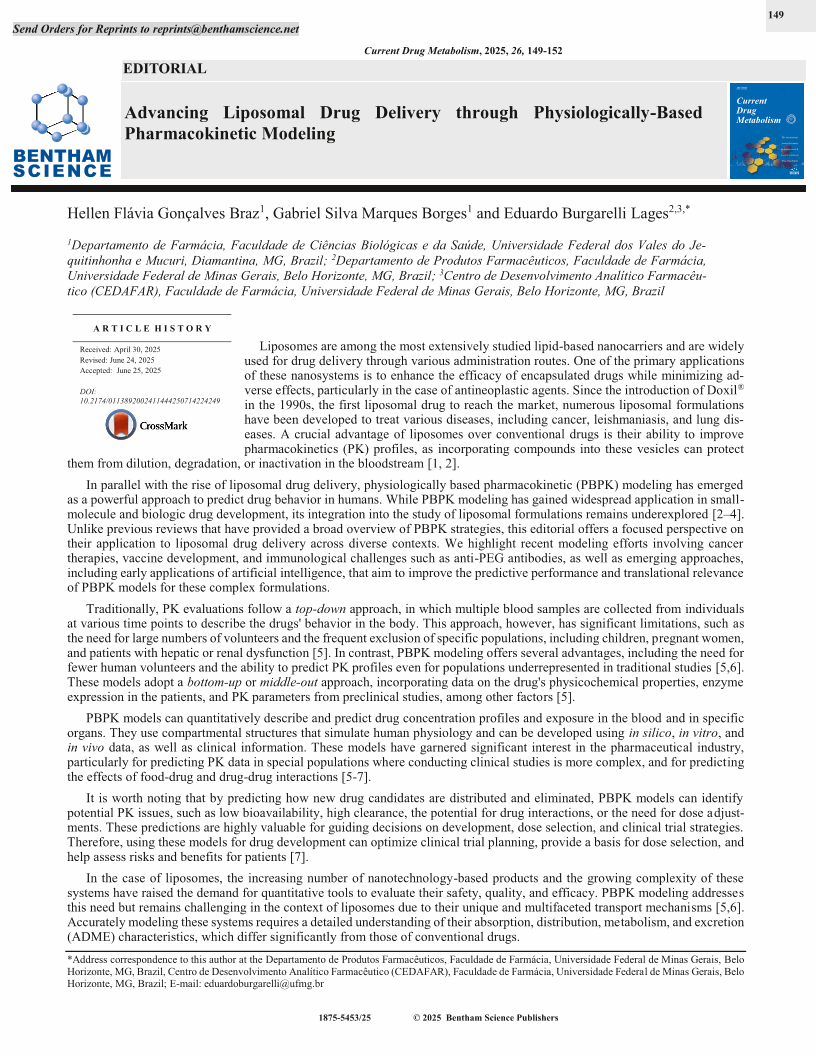


Advancing Liposomal Drug Delivery through Physiologically-Based Pharmacokinetic Modeling, Page 1 of 1
< Previous page | Next page > /docserver/preview/fulltext/cdm/26/3/CDM-26-3-01-1.gif
There is no abstract available.
©
2025 Bentham Science Publishers

Article metrics loading...
/content/journals/cdm/10.2174/0113892002411444250714224249
2025-07-31
2026-02-28
-
From This Site
/content/journals/cdm/10.2174/0113892002411444250714224249dcterms_title,dcterms_subject,pub_keyword-contentType:Contributor -contentType:Concept -contentType:Institution105
Full text loading...
/deliver/fulltext/cdm/26/3/CDM-26-3-01.html?itemId=/content/journals/cdm/10.2174/0113892002411444250714224249&mimeType=html&fmt=ahah
[Citing articles]
[Web of Science]
[Medline]
References
-
van der KoogL. GandekT.B. NagelkerkeA. Liposomes and extracellular vesicles as drug delivery systems: A comparison of composition, pharmacokinetics, and functionalization.Adv. Healthc. Mater.2022115210063910.1002/adhm.202100639 34165909
-
HeH. YuanD. WuY. CaoY. Pharmacokinetics and pharmacodynamics modeling and simulation systems to support the development and regulation of liposomal drugs.Pharmaceutics201911311010.3390/pharmaceutics11030110 30866479
-
OzbekO. GencD.E.O. UlgenK. Advances in physiologically based pharmacokinetic (PBPK) modeling of nanomaterials.ACS Pharmacol. Transl. Sci.2024782251227910.1021/acsptsci.4c00250 39144562
-
MinnemaJ. BorgosS.E.F. LiptrottN. VandebrielR. DelmaarC. Physiologically based pharmacokinetic modeling of intravenously administered nanoformulated substances.Drug Deliv. Transl. Res.20221292132214410.1007/s13346‑022‑01159‑w 35551616
-
LinW. ChenY. UnadkatJ.D. ZhangX. WuD. HeimbachT. Applications, challenges, and outlook for pbpk modeling and simulation: A regulatory, industrial and academic perspective.Pharm. Res.20223981701173110.1007/s11095‑022‑03274‑2 35552967
-
LiM. ZouP. TynerK. LeeS. Physiologically Based Pharmacokinetic (PBPK) modeling of pharmaceutical nanoparticles.AAPS J.2017191264210.1208/s12248‑016‑0010‑3 27834047
-
HartmanshennC. ScherholzM. AndroulakisI.P. Physiologically-based pharmacokinetic models: Approaches for enabling personalized medicine.J. Pharmacokinet. Pharmacodyn.201643548150410.1007/s10928‑016‑9492‑y 27647273
-
VizirianakisI.S. MystridisG.A. AvgoustakisK. FatourosD.G. SpanakisM. Enabling personalized cancer medicine decisions: The challenging pharmacological approach of PBPK models for nanomedicine and pharmacogenomics (Review).Oncol. Rep.20163541891190410.3892/or.2016.4575 26781205
-
JablonkaL. AshtikarM. GaoG.F. ThurnM. ModhH. WangJ.W. PreußA. ScheglmannD. AlbrechtV. RöderB. WackerM.G. Predicting human pharmacokinetics of liposomal temoporfin using a hybrid in silico model.Eur. J. Pharm. Biopharm.202014912113410.1016/j.ejpb.2020.02.001 32035970
-
TalkingtonA.M. McSweeneyM.D. WesslerT. RathM.K. LiZ. ZhangT. YuanH. FrankJ.E. ForestM.G. CaoY. LaiS.K. A PBPK model recapitulates early kinetics of anti-PEG antibody-mediated clearance of PEG-liposomes.J. Control. Release202234351852710.1016/j.jconrel.2022.01.022 35066099
-
MontanhaM.C. HowarthA. MohamedD.A. LoierE. MainL. RössleinM. DelmaarC. Prina-MelloA. SiccardiM. A physiologically based pharmacokinetic model to predict pegylated liposomal doxorubicin disposition in rats and human.Drug Deliv. Transl. Res.20221292178218610.1007/s13346‑022‑01175‑w 35551629
-
BadhanR. KhadkeS. PerrieY. Application of pharmacokinetics modelling to predict human exposure of a cationic liposomal subunit antigen vaccine system.Pharmaceutics2017945710.3390/pharmaceutics9040057 29215597
-
SaldanhaL. LangelÜ. ValeN. A physiologically based pharmacokinetic (PBPK) study to assess the adjuvanticity of three peptides in an oral vaccine.Pharmaceutics202416678010.3390/pharmaceutics16060780 38931901
-
LinZ. ChouW.C. ChengY.H. HeC. Monteiro-RiviereN.A. RiviereJ.E. Predicting nanoparticle delivery to tumors using machine learning and artificial intelligence approaches.Int. J. Nanomedicine2022171365137910.2147/IJN.S344208 35360005
-
ChouW.C. ChenQ. YuanL. ChengY.H. HeC. Monteiro-RiviereN.A. RiviereJ.E. LinZ. An artificial intelligence-assisted physiologically-based pharmacokinetic model to predict nanoparticle delivery to tumors in mice.J. Control. Release2023361536310.1016/j.jconrel.2023.07.040 37499908
/content/journals/cdm/10.2174/0113892002411444250714224249
-
Article Type: Editorial
Most Read This Month
Article
content/journals/cdm
Journal
5
3
false
en