


Depression Detection on Social Media Using the CNN-LSTM Model

- By Lakshay Singh Mahur1
-
View Affiliations Hide Affiliations1 Raj Kumar Goel Institute of Technology, Ghaziabad, India
- Source: Computational Intelligence and its Applications , pp 191-206
- Publication Date: March 2025
- Language: English


Depression Detection on Social Media Using the CNN-LSTM Model, Page 1 of 1
< Previous page | Next page > /docserver/preview/fulltext/9789815313321/chapter-12-1.gif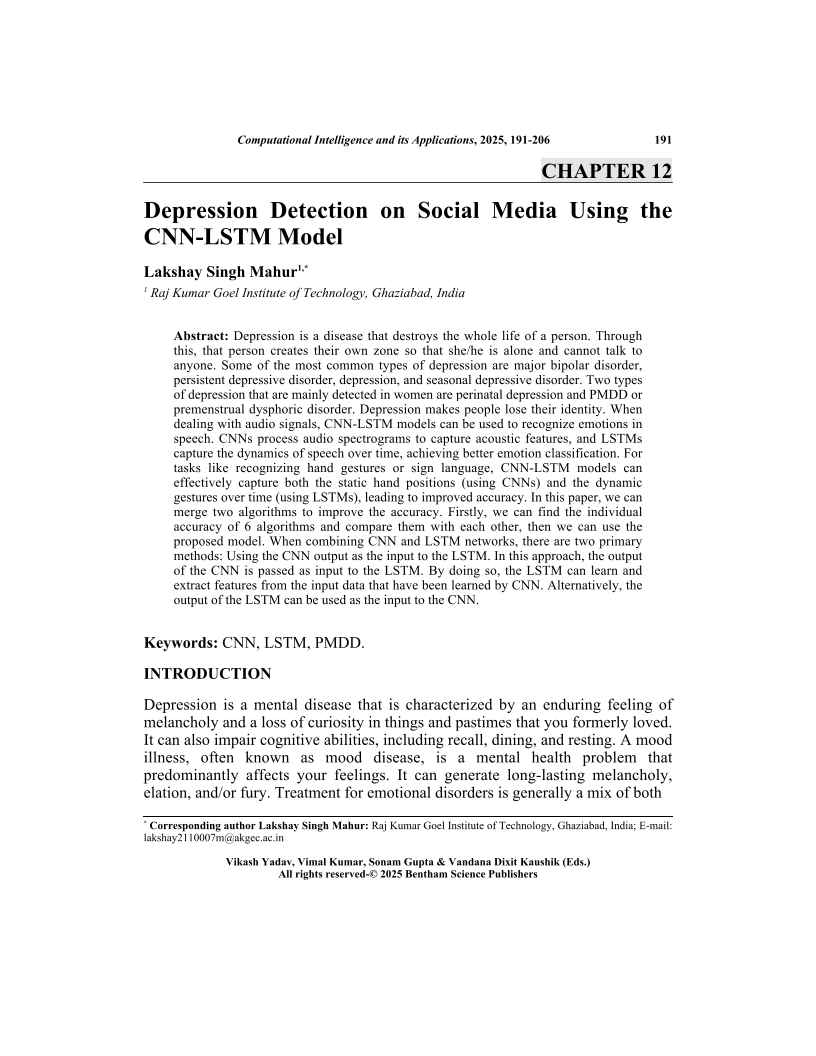
Depression is a disease that destroys the whole life of a person. Through this, that person creates their own zone so that she/he is alone and cannot talk to anyone. Some of the most common types of depression are major bipolar disorder, persistent depressive disorder, depression, and seasonal depressive disorder. Two types of depression that are mainly detected in women are perinatal depression and PMDD or premenstrual dysphoric disorder. Depression makes people lose their identity. When dealing with audio signals, CNN-LSTM models can be used to recognize emotions in speech. CNNs process audio spectrograms to capture acoustic features, and LSTMs capture the dynamics of speech over time, achieving better emotion classification. For tasks like recognizing hand gestures or sign language, CNN-LSTM models can effectively capture both the static hand positions (using CNNs) and the dynamic gestures over time (using LSTMs), leading to improved accuracy. In this paper, we can merge two algorithms to improve the accuracy. Firstly, we can find the individual accuracy of 6 algorithms and compare them with each other, then we can use the proposed model. When combining CNN and LSTM networks, there are two primary methods: Using the CNN output as the input to the LSTM. In this approach, the output of the CNN is passed as input to the LSTM. By doing so, the LSTM can learn and extract features from the input data that have been learned by CNN. Alternatively, the output of the LSTM can be used as the input to the CNN.
-
From This Site
/content/books/9789815313321.chapter-12dcterms_subject,pub_keyword-contentType:Journal -contentType:Figure -contentType:Table -contentType:SupplementaryData105
