


Enhancement Mechanisms and Theory of SERS
- Authors: Pragya Agar Palod1, Manika Khanuja2
-
View Affiliations Hide Affiliations1 Department of Physics, Shri Vaishnav Vidyapeeth Vishwavidyalaya, Indore 453111, India 2 Centre for Nanoscience and Nanotechnology, Jamia Millia Islamia, New Delhi - 110025, India
- Source: Surface Enhanced Raman Spectroscopy: Biosensing and Diagnostic Technique for Healthcare Applications , pp 21-63
- Publication Date: December 2021
- Language: English


Enhancement Mechanisms and Theory of SERS, Page 1 of 1
< Previous page | Next page > /docserver/preview/fulltext/9789815039115/chapter-2-1.gif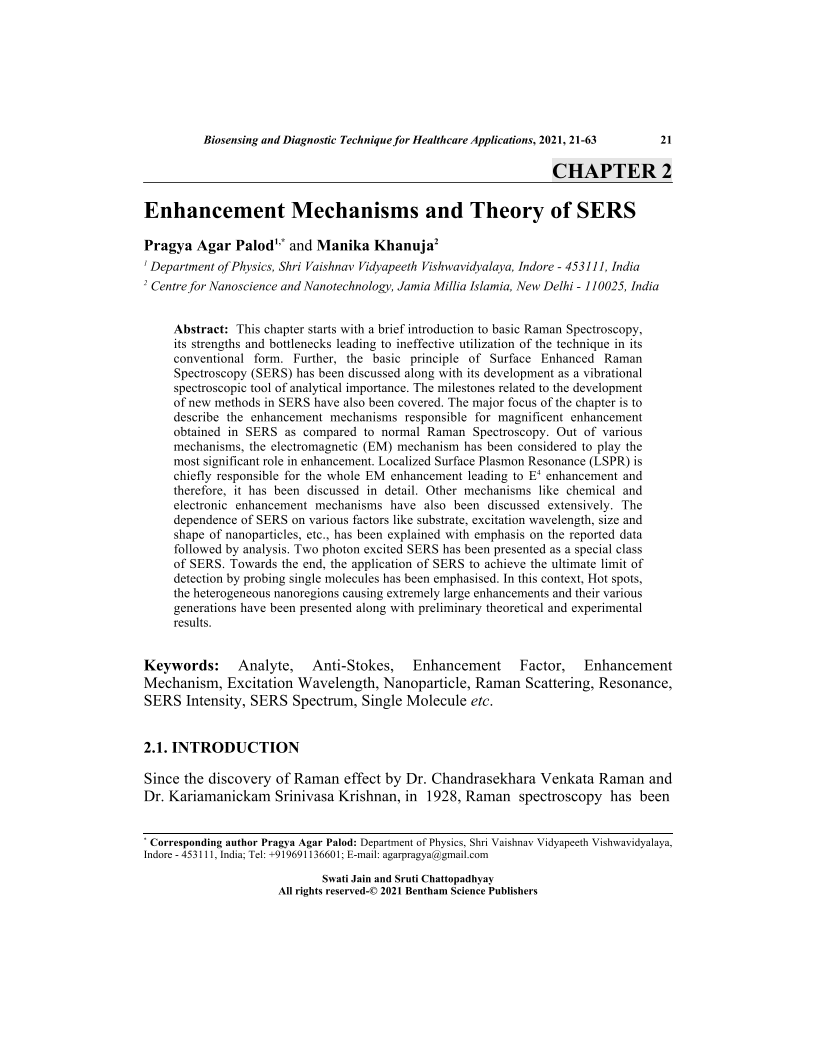
<div>This chapter starts with a brief introduction to basic Raman Spectroscopy,</div><div>its strengths and bottlenecks leading to ineffective utilization of the technique in its</div><div>conventional form. Further, the basic principle of Surface Enhanced Raman</div><div>Spectroscopy (SERS) has been discussed along with its development as a vibrational</div><div>spectroscopic tool of analytical importance. The milestones related to the development</div><div>of new methods in SERS have also been covered. The major focus of the chapter is to</div><div>describe the enhancement mechanisms responsible for magnificent enhancement</div><div>obtained in SERS as compared to normal Raman Spectroscopy. Out of various</div><div>mechanisms, the electromagnetic (EM) mechanism has been considered to play the</div><div>most significant role in enhancement. Localized Surface Plasmon Resonance (LSPR) is</div><div>chiefly responsible for the whole EM enhancement leading to E4 enhancement and</div><div>therefore, it has been discussed in detail. Other mechanisms like chemical and</div><div>electronic enhancement mechanisms have also been discussed extensively. The</div><div>dependence of SERS on various factors like substrate, excitation wavelength, size and</div><div>shape of nanoparticles, etc., has been explained with emphasis on the reported data</div><div>followed by analysis. Two photon excited SERS has been presented as a special class</div><div>of SERS. Towards the end, the application of SERS to achieve the ultimate limit of</div><div>detection by probing single molecules has been emphasised. In this context, Hot spots,</div><div>the heterogeneous nanoregions causing extremely large enhancements and their various</div><div>generations have been presented along with preliminary theoretical and experimental</div><div>results.</div>
-
From This Site
/content/books/9789815039115.chapter-2dcterms_subject,pub_keyword-contentType:Journal -contentType:Figure -contentType:Table -contentType:SupplementaryData105
