


State of the Art: Raman Vibrational Spectroscopy and Surface Enhanced Raman Spectroscopy
- Authors: Jagjiwan Mittal1, Robin Kumar2
-
View Affiliations Hide Affiliations1 Amity Institute of Nanotechnology, Amity University, Sector125, Noida, Uttar Pradesh 201313, India 2 Amity Institute of Nanotechnology, Amity University, Sector125, Noida, Uttar Pradesh 201313, India
- Source: Surface Enhanced Raman Spectroscopy: Biosensing and Diagnostic Technique for Healthcare Applications , pp 1-20
- Publication Date: December 2021
- Language: English


State of the Art: Raman Vibrational Spectroscopy and Surface Enhanced Raman Spectroscopy, Page 1 of 1
< Previous page | Next page > /docserver/preview/fulltext/9789815039115/chapter-1-1.gif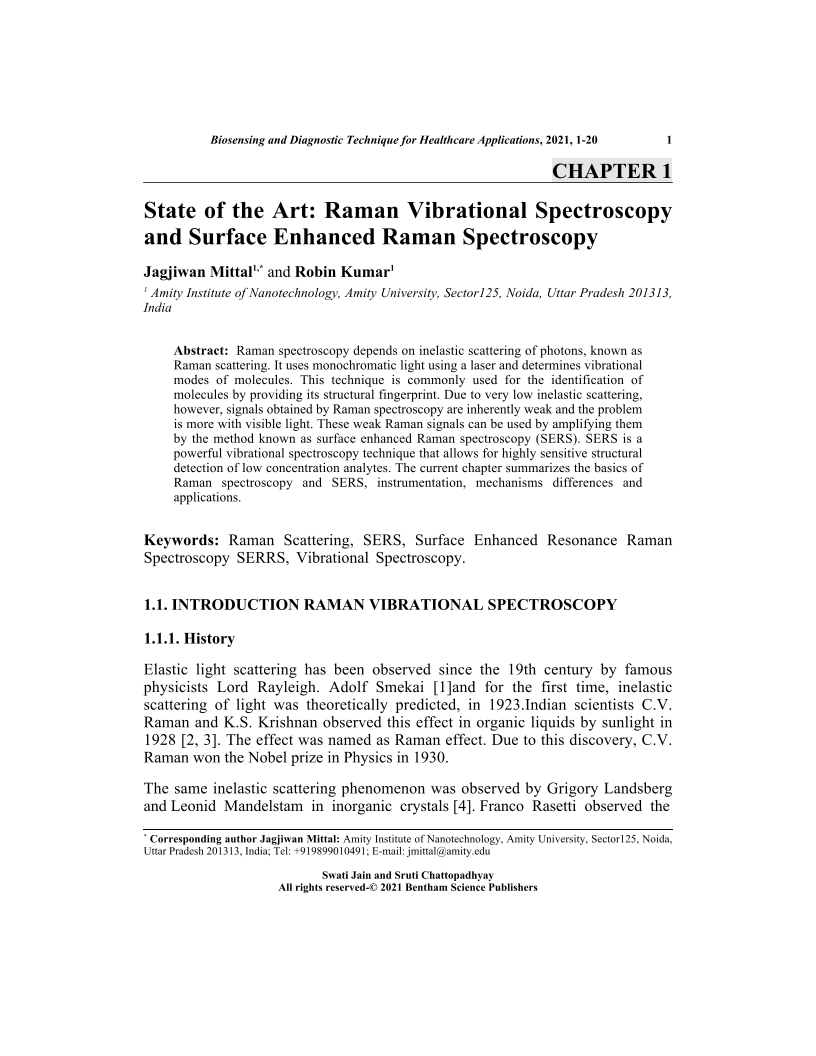
<div>Raman spectroscopy depends on inelastic scattering of photons, known as</div><div>Raman scattering. It uses monochromatic light using a laser and determines vibrational</div><div>modes of molecules. This technique is commonly used for the identification of</div><div>molecules by providing its structural fingerprint. Due to very low inelastic scattering,</div><div>however, signals obtained by Raman spectroscopy are inherently weak and the problem</div><div>is more with visible light. These weak Raman signals can be used by amplifying them</div><div>by the method known as surface enhanced Raman spectroscopy (SERS). SERS is a</div><div>powerful vibrational spectroscopy technique that allows for highly sensitive structural</div><div>detection of low concentration analytes. The current chapter summarizes the basics of</div><div>Raman spectroscopy and SERS, instrumentation, mechanisms differences and</div><div>applications.</div>
-
From This Site
/content/books/9789815039115.chapter-1dcterms_subject,pub_keyword-contentType:Journal -contentType:Figure -contentType:Table -contentType:SupplementaryData105
