


Why Empathy is Sometimes Lacking: The Influence of Environmental Factors
- By Kathleen Stephany1
-
View Affiliations Hide Affiliations1 Full Time Nurse Educator in the Faculty of Health SciencesDouglas CollegeBC Canada
- Source: Cultivating Empathy: Inspiring Health Professionals to Communicate More Effectively (Revised Edition) , pp 52-77
- Publication Date: January 2022
- Language: English


Why Empathy is Sometimes Lacking: The Influence of Environmental Factors, Page 1 of 1
< Previous page | Next page > /docserver/preview/fulltext/9789815036480/chapter-3-1.gif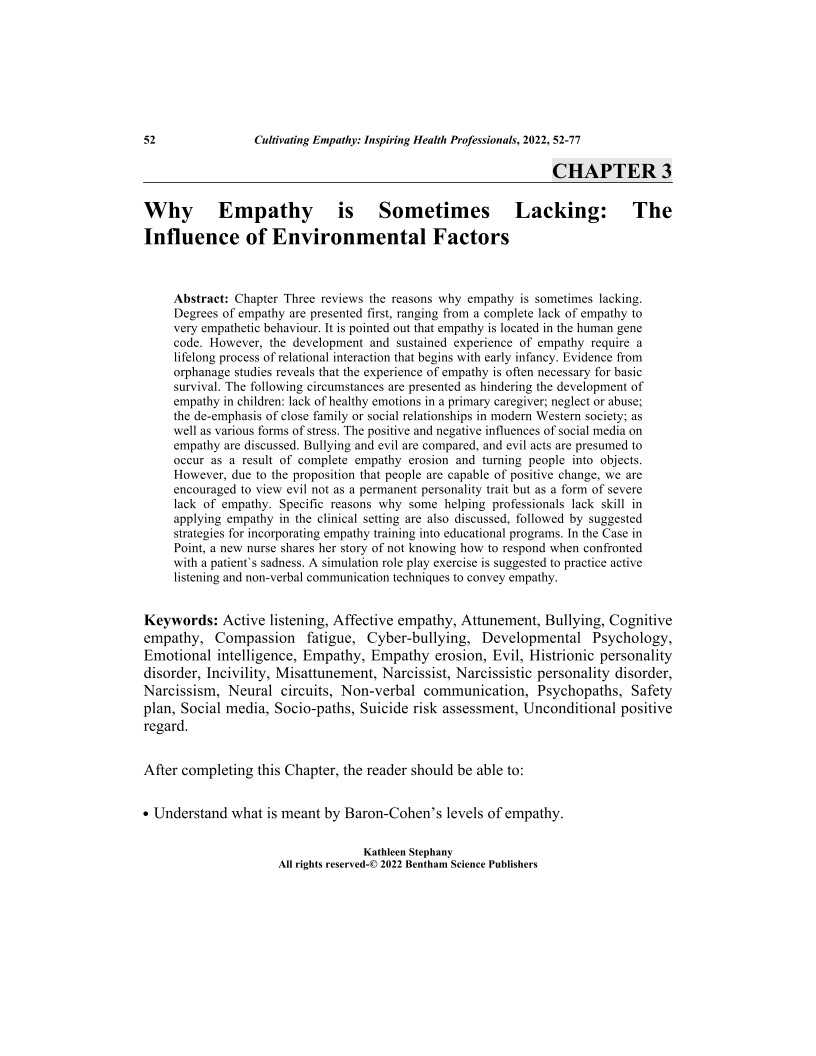
<div>Chapter Three reviews the reasons why empathy is sometimes lacking.</div><div>Degrees of empathy are presented first, ranging from a complete lack of empathy to</div><div>very empathetic behaviour. It is pointed out that empathy is located in the human gene</div><div>code. However, the development and sustained experience of empathy require a</div><div>lifelong process of relational interaction that begins with early infancy. Evidence from</div><div>orphanage studies reveals that the experience of empathy is often necessary for basic</div><div>survival. The following circumstances are presented as hindering the development of</div><div>empathy in children: lack of healthy emotions in a primary caregiver; neglect or abuse;</div><div>the de-emphasis of close family or social relationships in modern Western society; as</div><div>well as various forms of stress. The positive and negative influences of social media on</div><div>empathy are discussed. Bullying and evil are compared, and evil acts are presumed to</div><div>occur as a result of complete empathy erosion and turning people into objects.</div><div>However, due to the proposition that people are capable of positive change, we are</div><div>encouraged to view evil not as a permanent personality trait but as a form of severe</div><div>lack of empathy. Specific reasons why some helping professionals lack skill in</div><div>applying empathy in the clinical setting are also discussed, followed by suggested</div><div>strategies for incorporating empathy training into educational programs. In the Case in</div><div>Point, a new nurse shares her story of not knowing how to respond when confronted</div><div>with a patient`s sadness. A simulation role play exercise is suggested to practice active</div><div>listening and non-verbal communication techniques to convey empathy.</div>
-
From This Site
/content/books/9789815036480.chapter-3dcterms_subject,pub_keyword-contentType:Journal -contentType:Figure -contentType:Table -contentType:SupplementaryData105
