


A Baseline for Nonlinear Bilateral Negotiations: The full results of the agents competing in ANAC 2014

- Authors: Reyhan Aydoğan1,2, Catholijn M. Jonker3, Katsuhide Fujita4, Tim Baarslag5, Takayuki Ito6, Rafik Hadfi7, Kohei Hayakawa8
-
View Affiliations Hide Affiliations1 Deaparment of Computer Science, zyein University, Istanbul,Turkey 2 Interactive Intelligence Group, Delft University of Technology, Delft, The Netherlands 3 Interactive Intelligence Group, Delft University of Technology, Delft, The Netherlands 4 Faculty of Engineering, Tokyo University of Agriculture and Technology, Tokyo, Japan 5 Agents, Interaction and Complexity Group, University of Southampton, Southampton, UK 6 Department of Computer Science and Engineering, Nagoya Institute of Technology,Nagoya,Japan 7 Department of Computer Science and Engineering, Nagoya Institute of Technology,Nagoya,Japan 8 Department of Computer Science and Engineering, Nagoya Institute of Technology,Nagoya,Japan
- Source: Intelligent Computational Systems: A Multi-Disciplinary Perspective , pp 93-121
- Publication Date: August 2017
- Language: English


A Baseline for Nonlinear Bilateral Negotiations: The full results of the agents competing in ANAC 2014, Page 1 of 1
< Previous page | Next page > /docserver/preview/fulltext/9781681085029/chapter-3-1.gif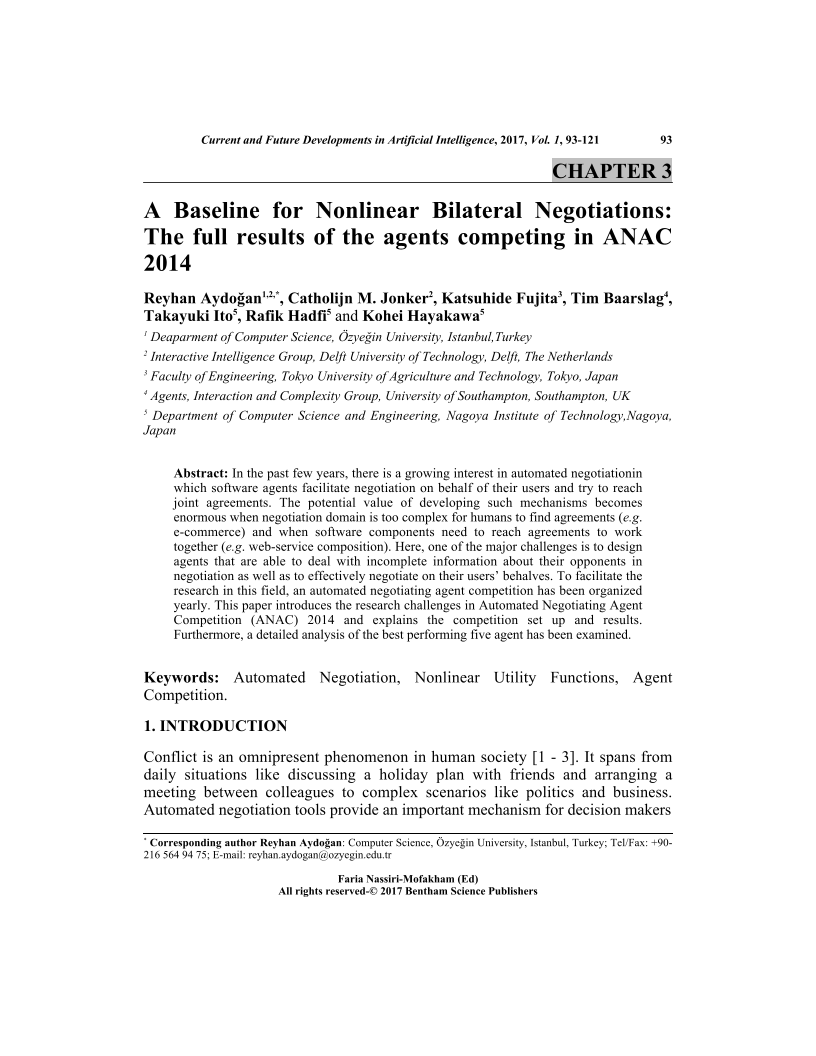
In the past few years, there is a growing interest in automated negotiationin which software agents facilitate negotiation on behalf of their users and try to reach joint agreements. The potential value of developing such mechanisms becomes enormous when negotiation domain is too complex for humans to find agreements (e.g. e-commerce) and when software components need to reach agreements to work together (e.g. web-service composition). Here, one of the major challenges is to design agents that are able to deal with incomplete information about their opponents in negotiation as well as to effectively negotiate on their users behalves. To facilitate the research in this field, an automated negotiating agent competition has been organized yearly. This paper introduces the research challenges in Automated Negotiating Agent Competition (ANAC) 2014 and explains the competition set up and results. Furthermore, a detailed analysis of the best performing five agent has been examined.
-
From This Site
/content/books/9781681085029.chapter-3dcterms_subject,pub_keyword-contentType:Journal -contentType:Figure -contentType:Table -contentType:SupplementaryData105
