


Artificial Neural Network Model Based QSAR for Oxygen Containing Heterocycles as Selective COX-2 Inhibitors
- Authors: Ponnurengam Malliappan Sivakumar, Mukesh Doble2
-
View Affiliations Hide Affiliations2 Department of Biotechnology, Indian Institute of Technology, Madras, Chennai 600036, India
- Source: Recent Trends on QSAR in the Pharmaceutical Perceptions , pp 255-271
- Publication Date: June 2012
- Language: English


Artificial Neural Network Model Based QSAR for Oxygen Containing Heterocycles as Selective COX-2 Inhibitors, Page 1 of 1
< Previous page | Next page > /docserver/preview/fulltext/9781608053797/chapter-8-1.gif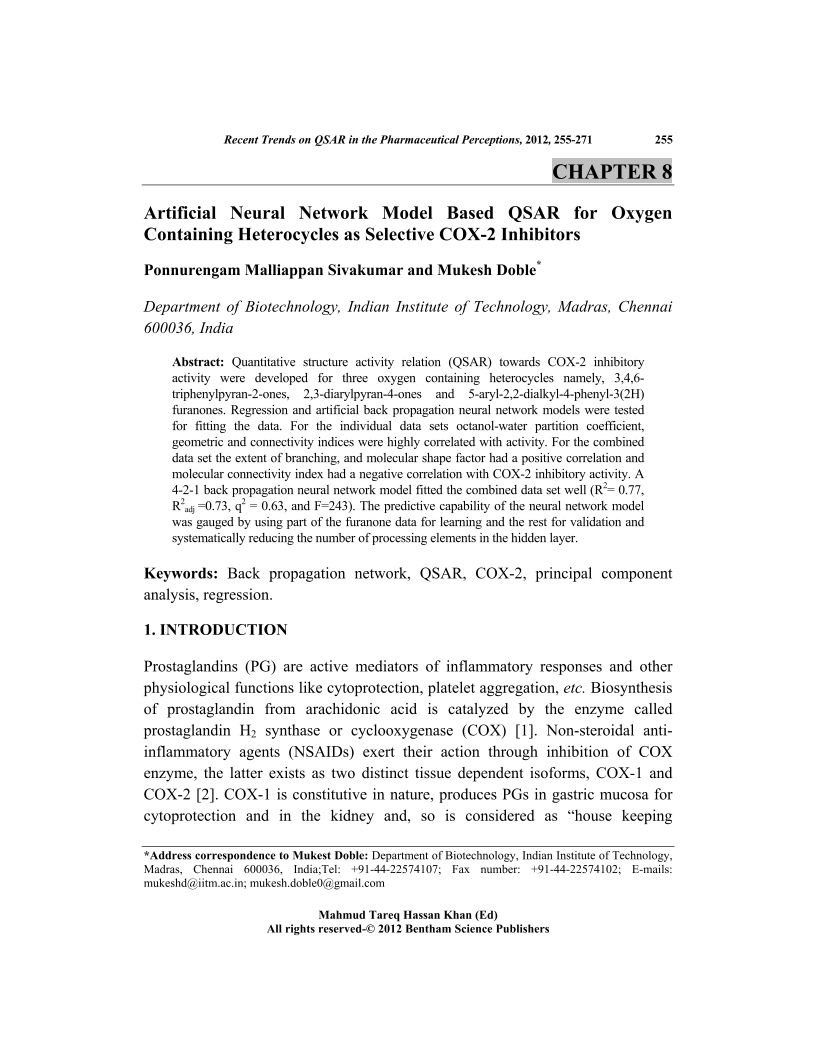
Quantitative structure activity relation (QSAR) towards COX-2 inhibitory activity were developed for three oxygen containing heterocycles namely, 3,4,6- triphenylpyran-2-ones, 2,3-diarylpyran-4-ones and 5-aryl-2,2-dialkyl-4-phenyl-3(2H) furanones. Regression and artificial back propagation neural network models were tested for fitting the data. For the individual data sets octanol-water partition coefficient, geometric and connectivity indices were highly correlated with activity. For the combined data set the extent of branching, and molecular shape factor had a positive correlation and molecular connectivity index had a negative correlation with COX-2 inhibitory activity. A 4-2-1 back propagation neural network model fitted the combined data set well (R2= 0.77, R2 adj =0.73, q2 = 0.63, and F=243). The predictive capability of the neural network model was gauged by using part of the furanone data for learning and the rest for validation and systematically reducing the number of processing elements in the hidden layer.
-
From This Site
/content/books/9781608053797.chapter-8dcterms_subject,pub_keyword-contentType:Journal -contentType:Figure -contentType:Table -contentType:SupplementaryData105
