


QSAR for the Cytotoxicity of tert-Butylphenols and 2- Methoxyphenols in Terms of Inhibition Rate Constant and a Theoretical Parameter
- Authors: Seiichiro Fujisawa1, Yoshinori Kadoma2
-
View Affiliations Hide Affiliations1 Meikai University School of Dentistry, 1 1 Keyakidai, Sakado, Saitama 350- 0283, Japan 2 Department of Material-based Medical Engineering, Institute of Biomaterials and Bioengineering, Tokyo Medical and Dental University, 2-3-10,Kanda-Surugadai, Chiyoda-Ku, Tokyo 101-0062, Japan
- Source: Recent Trends on QSAR in the Pharmaceutical Perceptions , pp 242-254
- Publication Date: June 2012
- Language: English


QSAR for the Cytotoxicity of tert-Butylphenols and 2- Methoxyphenols in Terms of Inhibition Rate Constant and a Theoretical Parameter, Page 1 of 1
< Previous page | Next page > /docserver/preview/fulltext/9781608053797/chapter-7-1.gif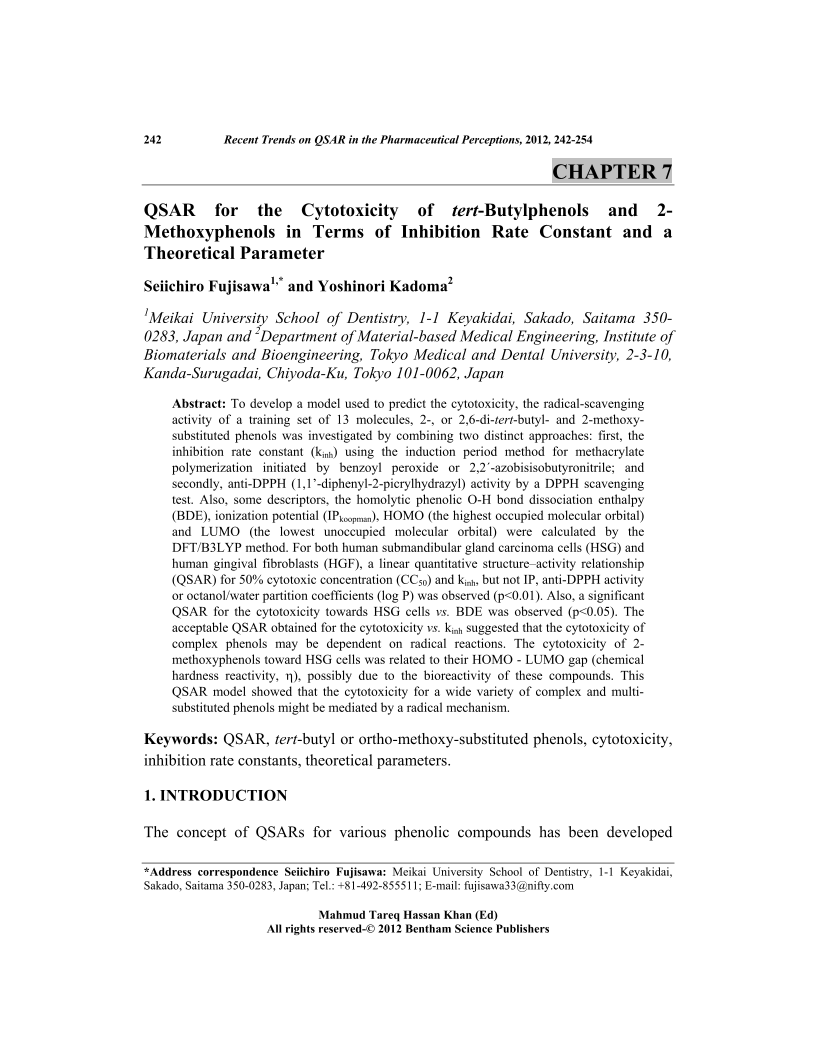
To develop a model used to predict the cytotoxicity, the radical-scavenging activity of a training set of 13 molecules, 2-, or 2,6-di-tert-butyl- and 2-methoxysubstituted phenols was investigated by combining two distinct approaches: first, the inhibition rate constant (k<sub>inh</sub>) using the induction period method for methacrylate polymerization initiated by benzoyl peroxide or 2,2´-azobisisobutyronitrile; and secondly, anti-DPPH (1,1-diphenyl-2-picrylhydrazyl) activity by a DPPH scavenging test. Also, some descriptors, the homolytic phenolic O-H bond dissociation enthalpy (BDE), ionization potential (IP<sub>koopman</sub>), HOMO (the highest occupied molecular orbital) and LUMO (the lowest unoccupied molecular orbital) were calculated by the DFT/B3LYP method. For both human submandibular gland carcinoma cells (HSG) and human gingival fibroblasts (HGF), a linear quantitative structureactivity relationship (QSAR) for 50% cytotoxic concentration (CC50) and k<sub>inh</sub>, but not IP, anti-DPPH activity or octanol/water partition coefficients (log P) was observed (p<0.01). Also, a significant QSAR for the cytotoxicity towards HSG cells vs. BDE was observed (p<0.05). The acceptable QSAR obtained for the cytotoxicity vs. k<sub>inh</sub> suggested that the cytotoxicity of complex phenols may be dependent on radical reactions. The cytotoxicity of 2- methoxyphenols toward HSG cells was related to their HOMO - LUMO gap (chemical hardness reactivity, η), possibly due to the bioreactivity of these compounds. This QSAR model showed that the cytotoxicity for a wide variety of complex and multisubstituted phenols might be mediated by a radical mechanism.
-
From This Site
/content/books/9781608053797.chapter-7dcterms_subject,pub_keyword-contentType:Journal -contentType:Figure -contentType:Table -contentType:SupplementaryData105
