


Mineralogy of Natural Zeolites
- By Mihaela Ulmanu1
-
View Affiliations Hide Affiliations1 National R&D Institute for Non Ferrous and Rare Metals, IMNR, Bd. Biruintei 102, 77145 Pantelimon, Romania
- Source: Handbook of Natural Zeolites , pp 52-69
- Publication Date: July 2012
- Language: English


Mineralogy of Natural Zeolites, Page 1 of 1
< Previous page | Next page > /docserver/preview/fulltext/9781608052615/chapter-4-1.gif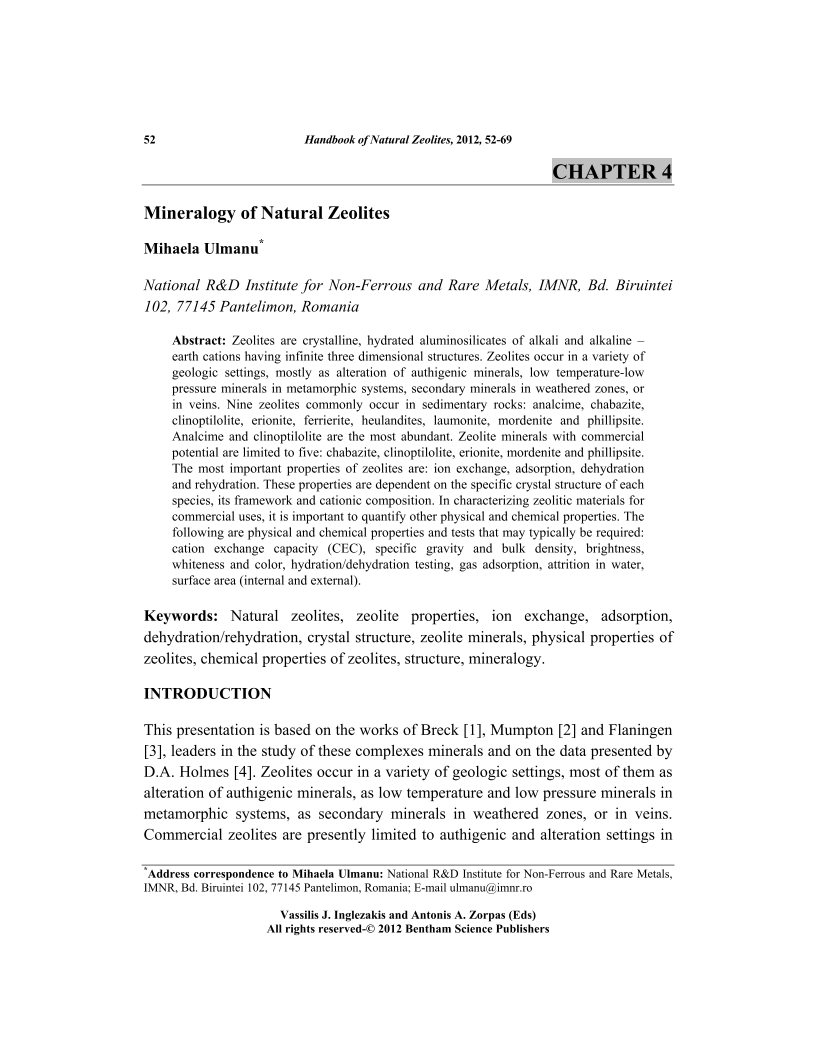
Zeolites are crystalline, hydrated aluminosilicates of alkali and alkaline earth cations having infinite three dimensional structures. Zeolites occur in a variety of geologic settings, mostly as alteration of authigenic minerals, low temperature-low pressure minerals in metamorphic systems, secondary minerals in weathered zones, or in veins. Nine zeolites commonly occur in sedimentary rocks: analcime, chabazite, clinoptilolite, erionite, ferrierite, heulandites, laumonite, mordenite and phillipsite. Analcime and clinoptilolite are the most abundant. Zeolite minerals with commercial potential are limited to five: chabazite, clinoptilolite, erionite, mordenite and phillipsite. The most important properties of zeolites are: ion exchange, adsorption, dehydration and rehydration. These properties are dependent on the specific crystal structure of each species, its framework and cationic composition. In characterizing zeolitic materials for commercial uses, it is important to quantify other physical and chemical properties. The following are physical and chemical properties and tests that may typically be required: cation exchange capacity (CEC), specific gravity and bulk density, brightness, whiteness and color, hydration/dehydration testing, gas adsorption, attrition in water, surface area (internal and external).
-
From This Site
/content/books/9781608052615.chapter-4dcterms_subject,pub_keyword-contentType:Journal -contentType:Figure -contentType:Table -contentType:SupplementaryData105
