


Data Management and Security in Blockchain Networks
- Authors: M. M. Dhabu1, Ashish Tiwari2, Kavita Sharma3, V.S. S. Koushik4, Vrudhula Sreedhar5, V. V. Jithin6, Malla Abhilash7
-
View Affiliations Hide Affiliations1 Department of Computer Science and Engineering, Visvesvaraya National Institute of Technology, Nagpur, Maharashtra, 440010, India 2 Department of Computer Science and Engineering, Visvesvaraya National Institute of Technology, Nagpur, Maharashtra, 440010, India 3 Department of Computer Science and Engineering, Visvesvaraya National Institute of Technology, Nagpur, Maharashtra, 440010, India 4 Department of Computer Science and Engineering, Visvesvaraya National Institute of Technology, Nagpur, Maharashtra, 440010, India 5 Department of Computer Science and Engineering, Visvesvaraya National Institute of Technology, Nagpur, Maharashtra, 440010, India 6 Department of Computer Science and Engineering, Visvesvaraya National Institute of Technology, Nagpur, Maharashtra, 440010, India 7 Department of Computer Science and Engineering, Visvesvaraya National Institute of Technology, Nagpur, Maharashtra, 440010, India
- Source: Data Management and Security in Blockchain Systems , pp 64-84
- Publication Date: December 2024
- Language: English


Data Management and Security in Blockchain Networks, Page 1 of 1
< Previous page | Next page > /docserver/preview/fulltext/9789815305814/chapter-3-1.gif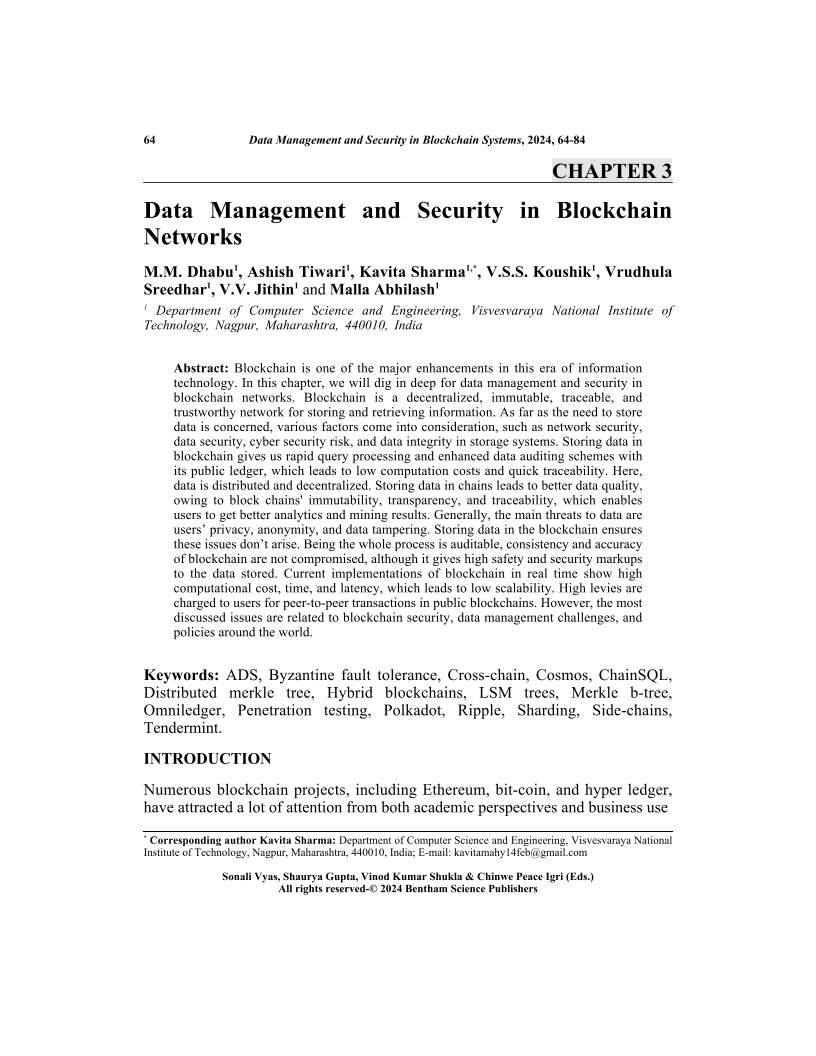
Blockchain is one of the major enhancements in this era of information technology. In this chapter, we will dig in deep for data management and security in blockchain networks. Blockchain is a decentralized, immutable, traceable, and trustworthy network for storing and retrieving information. As far as the need to store data is concerned, various factors come into consideration, such as network security, data security, cyber security risk, and data integrity in storage systems. Storing data in blockchain gives us rapid query processing and enhanced data auditing schemes with its public ledger, which leads to low computation costs and quick traceability. Here, data is distributed and decentralized. Storing data in chains leads to better data quality, owing to block chains' immutability, transparency, and traceability, which enables users to get better analytics and mining results. Generally, the main threats to data are users' privacy, anonymity, and data tampering. Storing data in the blockchain ensures these issues don't arise. Being the whole process is auditable, consistency and accuracy of blockchain are not compromised, although it gives high safety and security markups to the data stored. Current implementations of blockchain in real time show high computational cost, time, and latency, which leads to low scalability. High levies are charged to users for peer-to-peer transactions in public blockchains. However, the most discussed issues are related to blockchain security, data management challenges, and policies around the world.
-
From This Site
/content/books/9789815305814.chapter-3dcterms_subject,pub_keyword-contentType:Journal -contentType:Figure -contentType:Table -contentType:SupplementaryData105
