


Hard Disk Data Organization
- Authors: Sanchit Dhankhar1, Nitika Garg2, Himanshu Sharma3
-
View Affiliations Hide Affiliations1 Chitkara College of Pharmacy, Chitkara University, Rajpura, Punjab, India 2 Chitkara College of Pharmacy, Chitkara University, Rajpura, Punjab, India 3 Chitkara College of Pharmacy, Chitkara University, Rajpura, Punjab, India
- Source: Data Recovery Techniques for Computer Forensics , pp 122-146
- Publication Date: April 2025
- Language: English


Hard Disk Data Organization, Page 1 of 1
< Previous page | Next page > /docserver/preview/fulltext/9789815274677/chapter-5-1.gif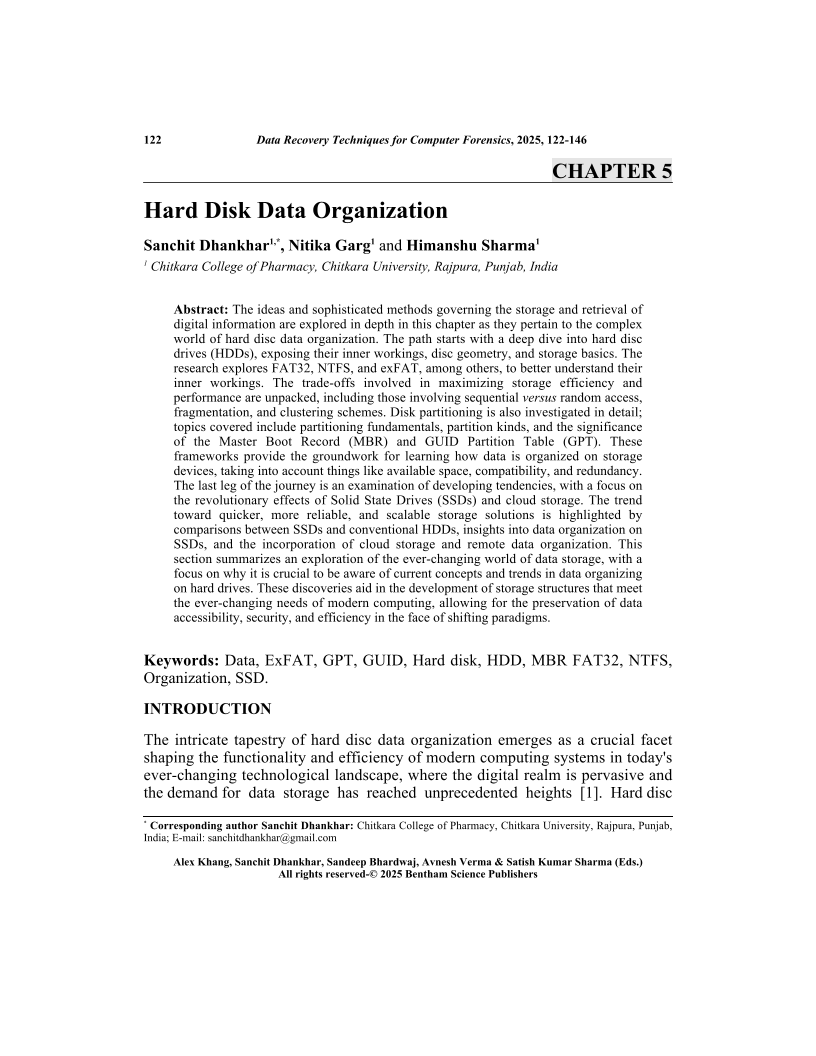
<u></u>The ideas and sophisticated methods governing the storage and retrieval of digital information are explored in depth in this chapter as they pertain to the complex world of hard disc data organization. The path starts with a deep dive into hard disc drives (HDDs), exposing their inner workings, disc geometry, and storage basics. The research explores FAT32, NTFS, and exFAT, among others, to better understand their inner workings. The trade-offs involved in maximizing storage efficiency and performance are unpacked, including those involving sequential versus random access, fragmentation, and clustering schemes. Disk partitioning is also investigated in detail; topics covered include partitioning fundamentals, partition kinds, and the significance of the Master Boot Record (MBR) and GUID Partition Table (GPT). These frameworks provide the groundwork for learning how data is organized on storage devices, taking into account things like available space, compatibility, and redundancy. The last leg of the journey is an examination of developing tendencies, with a focus on the revolutionary effects of Solid State Drives (SSDs) and cloud storage. The trend toward quicker, more reliable, and scalable storage solutions is highlighted by comparisons between SSDs and conventional HDDs, insights into data organization on SSDs, and the incorporation of cloud storage and remote data organization. This section summarizes an exploration of the ever-changing world of data storage, with a focus on why it is crucial to be aware of current concepts and trends in data organizing on hard drives. These discoveries aid in the development of storage structures that meet the ever-changing needs of modern computing, allowing for the preservation of data accessibility, security, and efficiency in the face of shifting paradigms.
-
From This Site
/content/books/9789815274677.chapter-5dcterms_subject,pub_keyword-contentType:Journal -contentType:Figure -contentType:Table -contentType:SupplementaryData105
