


The Effect of Economic Natural Dyes on the Performance and Efficiency of TiO2 NanoStructure Solar Cells
- Authors: Nada M. O. Sid Ahmed1, Nodar. O. Khalifa2, Manahil E. Mofdal3, Nada H. Talib4
-
View Affiliations Hide Affiliations1 Computer Engineering Department Computer Science and Engineering College, University of Hail, Hail, KSA 2 Department of Physics, Sudan University of Science and Technology, Khartoum, Sudan 3 Qassim University, Faculty of Science, Department of Physics, Buraydah, KSA 4 Solar Energy Department, National Energy Research Center, Khartoum, Sudan
- Source: Recent Advancements in Multidimensional Applications of Nanotechnology: Volume 1 , pp 124-144
- Publication Date: July 2024
- Language: English


The Effect of Economic Natural Dyes on the Performance and Efficiency of TiO2 NanoStructure Solar Cells, Page 1 of 1
< Previous page | Next page > /docserver/preview/fulltext/9789815238846/chapter-6-1.gif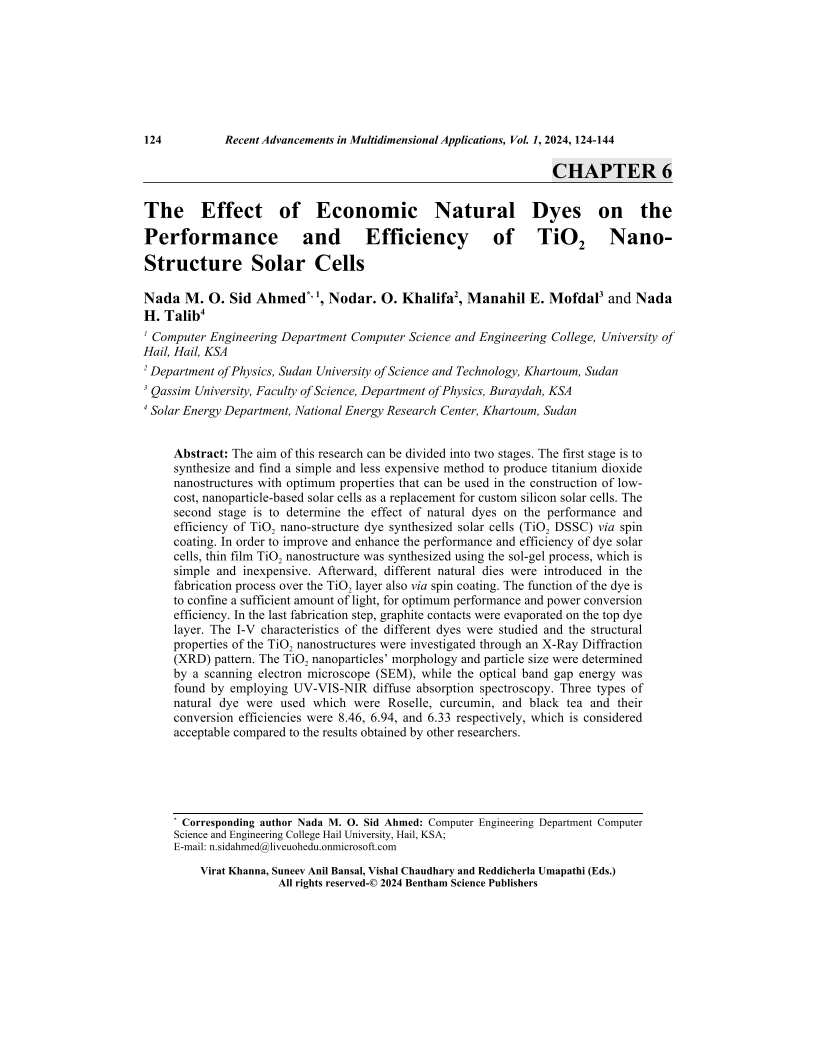
The aim of this research can be divided into two stages. The first stage is to synthesize and find a simple and less expensive method to produce titanium dioxide nanostructures with optimum properties that can be used in the construction of lowcost, nanoparticle-based solar cells as a replacement for custom silicon solar cells. The second stage is to determine the effect of natural dyes on the performance and efficiency of TiO2 nano-structure dye synthesized solar cells (TiO2 DSSC) via spin coating. In order to improve and enhance the performance and efficiency of dye solar cells, thin film TiO2 nanostructure was synthesized using the sol-gel process, which is simple and inexpensive. Afterward, different natural dies were introduced in the fabrication process over the TiO2 layer also via spin coating. The function of the dye is to confine a sufficient amount of light, for optimum performance and power conversion efficiency. In the last fabrication step, graphite contacts were evaporated on the top dye layer. The I-V characteristics of the different dyes were studied and the structural properties of the TiO2 nanostructures were investigated through an X-Ray Diffraction (XRD) pattern. The TiO2 nanoparticles' morphology and particle size were determined by a scanning electron microscope (SEM), while the optical band gap energy was found by employing UV-VIS-NIR diffuse absorption spectroscopy. Three types of natural dye were used which were Roselle, curcumin, and black tea and their conversion efficiencies were 8.46, 6.94, and 6.33 respectively, which is considered acceptable compared to the results obtained by other researchers.
-
From This Site
/content/books/9789815238846.chapter-6dcterms_subject,pub_keyword-contentType:Journal -contentType:Figure -contentType:Table -contentType:SupplementaryData105
