


Personalized Medicine (PM) A Critical Appraisal
- Authors: Syed Tasleem Raza1, Saliha Rizvi2, Allal Ouhtit3, Farhan Ali4, Sher Ali5
-
View Affiliations Hide Affiliations1 Department of Biochemistry, Eras Lucknow Medical College and Hospital, Lucknow 226003, India 2 Department of Biotechnology, Era University, Lucknow-226003, India 3 Biological and Environmental Sciences, College of Arts and Sciences, Qatar University, Qatar 4 Internal Medicine, Yakima Valley Memorial Hospital, WA-98902, USA 5 Department of Personalized and Molecular Medicine, Era University, Hardoi Road, Lucknow226003, India
- Source: Precision Medicine and Human Health , pp 1-30
- Publication Date: June 2024
- Language: English


Personalized Medicine (PM) A Critical Appraisal, Page 1 of 1
< Previous page | Next page > /docserver/preview/fulltext/9789815223583/chapter-1-1.gif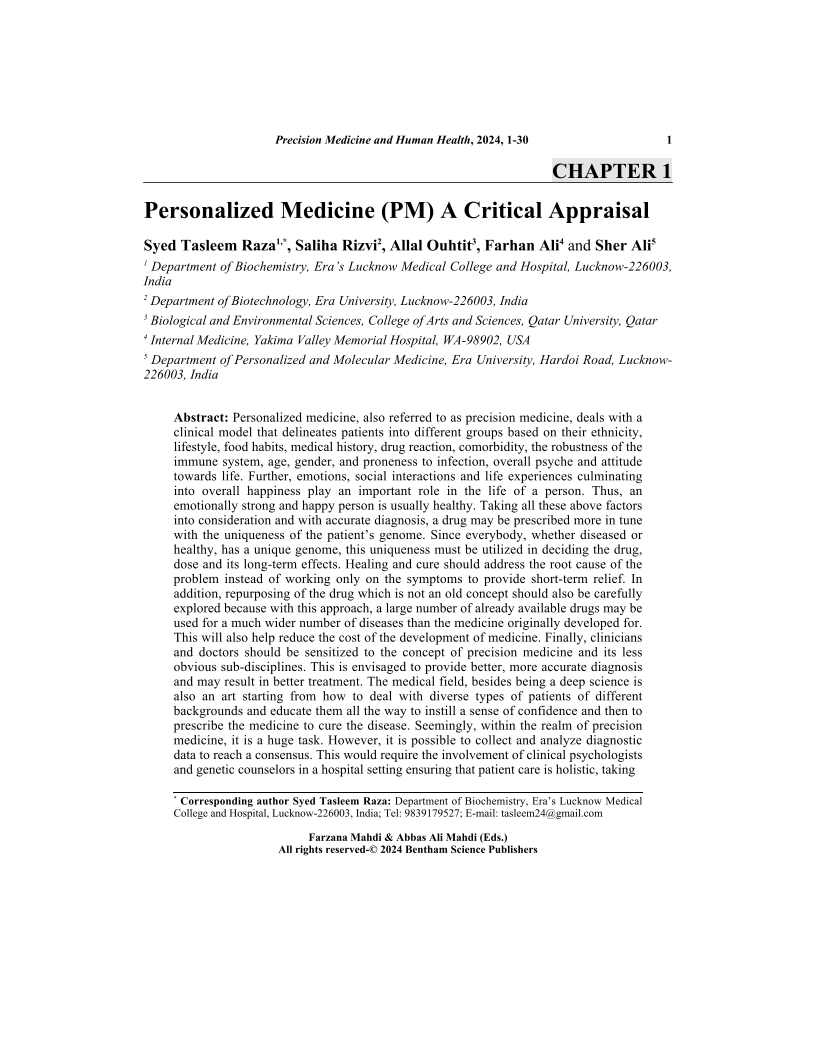
Personalized medicine, also referred to as precision medicine, deals with a clinical model that delineates patients into different groups based on their ethnicity, lifestyle, food habits, medical history, drug reaction, comorbidity, the robustness of the immune system, age, gender, and proneness to infection, overall psyche and attitude towards life. Further, emotions, social interactions and life experiences culminating into overall happiness play an important role in the life of a person. Thus, an emotionally strong and happy person is usually healthy. Taking all these above factors into consideration and with accurate diagnosis, a drug may be prescribed more in tune with the uniqueness of the patients genome. Since everybody, whether diseased or healthy, has a unique genome, this uniqueness must be utilized in deciding the drug, dose and its long-term effects. Healing and cure should address the root cause of the problem instead of working only on the symptoms to provide short-term relief. In addition, repurposing of the drug which is not an old concept should also be carefully explored because with this approach, a large number of already available drugs may be used for a much wider number of diseases than the medicine originally developed for. This will also help reduce the cost of the development of medicine. Finally, clinicians and doctors should be sensitized to the concept of precision medicine and its less obvious sub-disciplines. This is envisaged to provide better, more accurate diagnosis and may result in better treatment. The medical field, besides being a deep science is also an art starting from how to deal with diverse types of patients of different backgrounds and educate them all the way to instill a sense of confidence and then to prescribe the medicine to cure the disease. Seemingly, within the realm of precision medicine, it is a huge task. However, it is possible to collect and analyze diagnostic data to reach a consensus. This would require the involvement of clinical psychologists and genetic counselors in a hospital setting ensuring that patient care is holistic, takinginto account both the physical and psychological aspects of health. This integrated approach can lead to improved patient care and long-term well-being.
-
From This Site
/content/books/9789815223583.chapter-1dcterms_subject,pub_keyword-contentType:Journal -contentType:Figure -contentType:Table -contentType:SupplementaryData105
