


Mathematical Analysis of a Rumor Spreading Model within the Frame of Fractional Derivative

- Authors: Chandrali Baishya1, Sindhu J. Achar2, P. Veeresha3
-
View Affiliations Hide Affiliations1 Department of Studies and Research in Mathematics, Tumkur University, Tumkur 572103, India 2 Department of Studies and Research in Mathematics, Tumkur University, Tumkur 572103, India 3 Center for Mathematical Needs, Department of Mathematics, CHRIST (Deemed to be University), Bengaluru 560029, India
- Source: Fractional Calculus: New Applications in Understanding Nonlinear Phenomena , pp 186-209
- Publication Date: December 2022
- Language: English


Mathematical Analysis of a Rumor Spreading Model within the Frame of Fractional Derivative, Page 1 of 1
< Previous page | Next page > /docserver/preview/fulltext/9789815051933/chapter-8-1.gif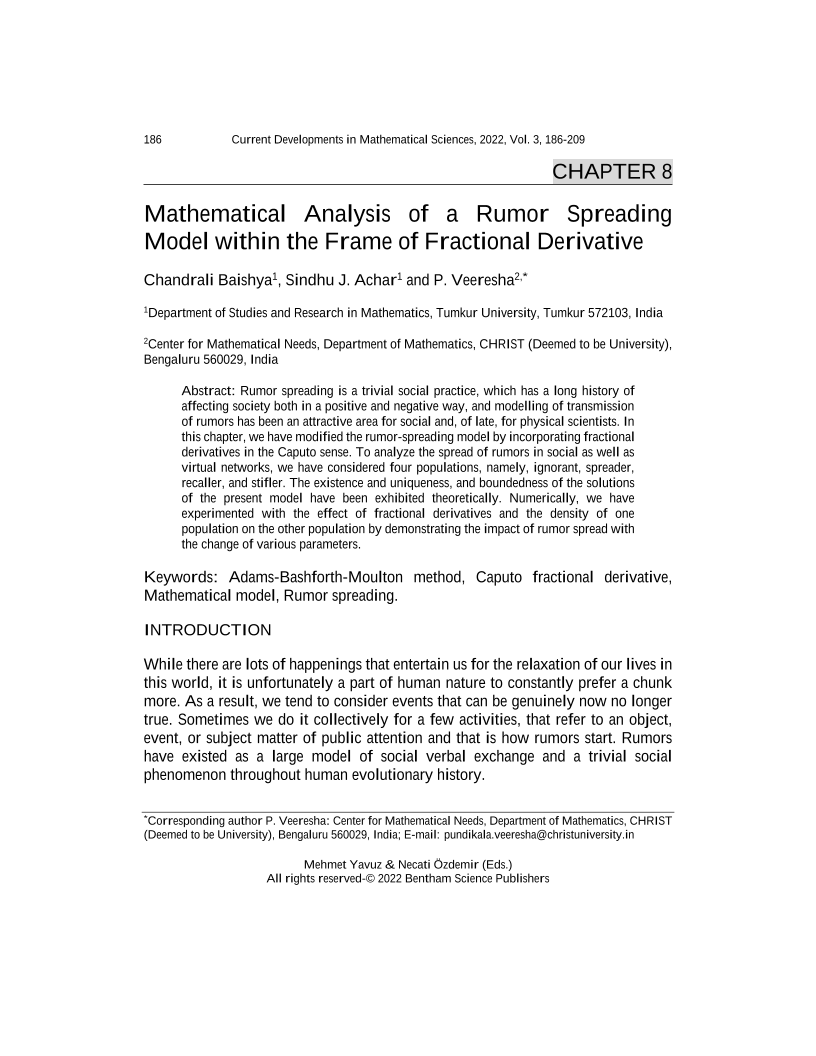
Rumor spreading is a trivial social practice, which has a long history of affecting society both in a positive and negative way, and modelling of transmission of rumors has been an attractive area for social and, of late, for physical scientists. In this chapter, we have modified the rumor-spreading model by incorporating fractional derivatives in the Caputo sense. To analyze the spread of rumors in social as well as virtual networks, we have considered four populations, namely, ignorant, spreader, recaller, and stifler. The existence and uniqueness, and boundedness of the solutions of the present model have been exhibited theoretically. Numerically, we have experimented with the effect of fractional derivatives and the density of one population on the other population by demonstrating the impact of rumor spread with the change of various parameters.
-
From This Site
/content/books/9789815051933.chapter-8dcterms_subject,pub_keyword-contentType:Journal -contentType:Figure -contentType:Table -contentType:SupplementaryData105
