


Adaptation of Blockchain in Internet of Medical Things for Remote Patient Monitoring
- Authors: Cinthia J. Godly1, Venki Balasubramanian2, Ram Srinivasan3, Bevish Y. Jinila4
-
View Affiliations Hide Affiliations1 School of Engineering, Information Technology and Physical Sciences, Federation University,Ballarat, Australia 2 School of Engineering, Information Technology and Physical Sciences, Federation University,Ballarat, Australia 3 School of Electrical and Technology, Central Queensland University, Rockhampton, Austrailia 4 School of Computing, Sathyabama Institute of Science and Technology, Semmancheri, Chennai,Tamil Nadu 600119, India
- Source: Artificial Intelligence for Smart Cities and Smart Villages: Advanced Technologies, Development, and Challenges , pp 67-84
- Publication Date: August 2022
- Language: English


Adaptation of Blockchain in Internet of Medical Things for Remote Patient Monitoring, Page 1 of 1
< Previous page | Next page > /docserver/preview/fulltext/9789815049251/chap4-1.gif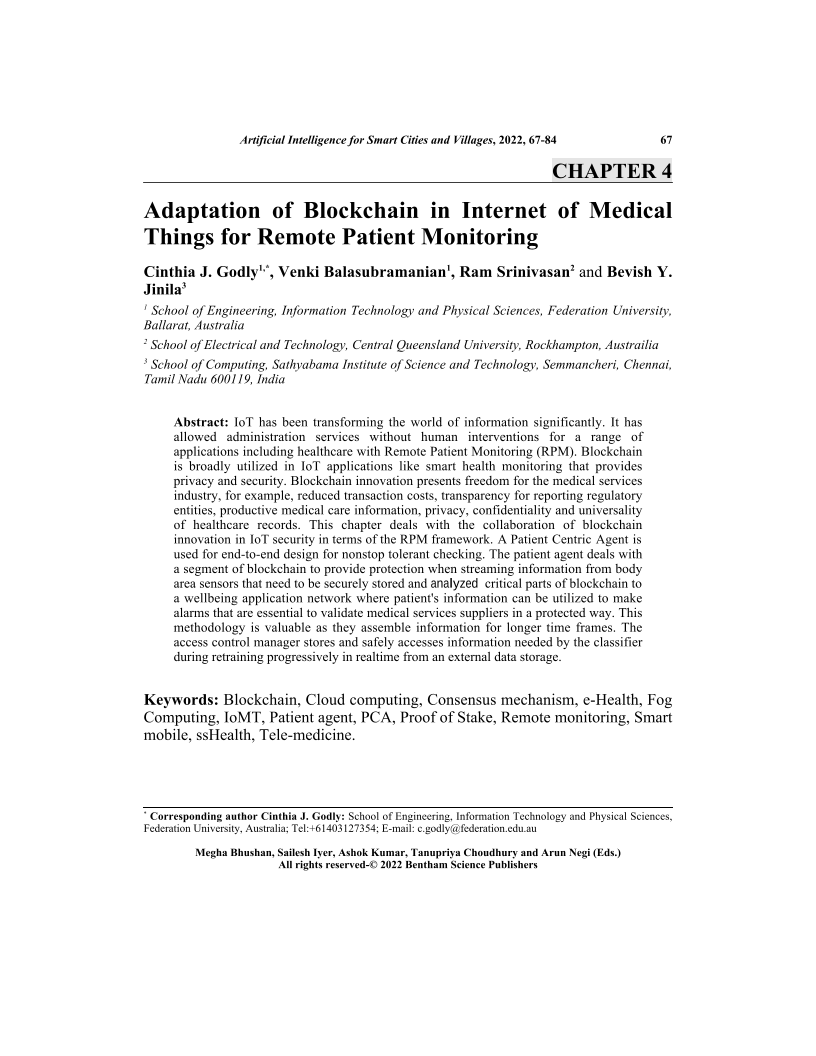
IoT has been transforming the world of information significantly. It has allowed administration services without human interventions for a range of applications including healthcare with Remote Patient Monitoring (RPM). Blockchain is broadly utilized in IoT applications like smart health monitoring that provides privacy and security. Blockchain innovation presents freedom for the medical services industry, for example, reduced transaction costs, transparency for reporting regulatory entities, productive medical care information, privacy, confidentiality and universality of healthcare records. This chapter deals with the collaboration of blockchain innovation in IoT security in terms of the RPM framework. A Patient Centric Agent is used for end-to-end design for nonstop tolerant checking. The patient agent deals with a segment of blockchain to provide protection when streaming information from body area sensors that need to be securely stored and analyzed critical parts of blockchain to a wellbeing application network where patient's information can be utilized to make alarms that are essential to validate medical services suppliers in a protected way. This methodology is valuable as they assemble information for longer time frames. The access control manager stores and safely accesses information needed by the classifier during retraining progressively in realtime from an external data storage.
-
From This Site
/content/books/9789815049251.chap4dcterms_subject,pub_keyword-contentType:Journal -contentType:Figure -contentType:Table -contentType:SupplementaryData105
