


Monitoring Therapeutic Response in Cancers: A Raman Spectroscopy Approach
- Authors: Kshama Pansare1, C. Murali Krishna2
-
View Affiliations Hide Affiliations1 Tata Memorial Centre, Advanced Centre for Treatment, Research and Education in Cancer, NaviMumbai, India 2 Tata Memorial Centre, Advanced Centre for Treatment, Research and Education in Cancer, NaviMumbai, India
- Source: Recent Advances in Analytical Techniques: Volume 5 , pp 192-275
- Publication Date: January 2022
- Language: English


Monitoring Therapeutic Response in Cancers: A Raman Spectroscopy Approach, Page 1 of 1
< Previous page | Next page > /docserver/preview/fulltext/9789815036930/chapter-5-1.gif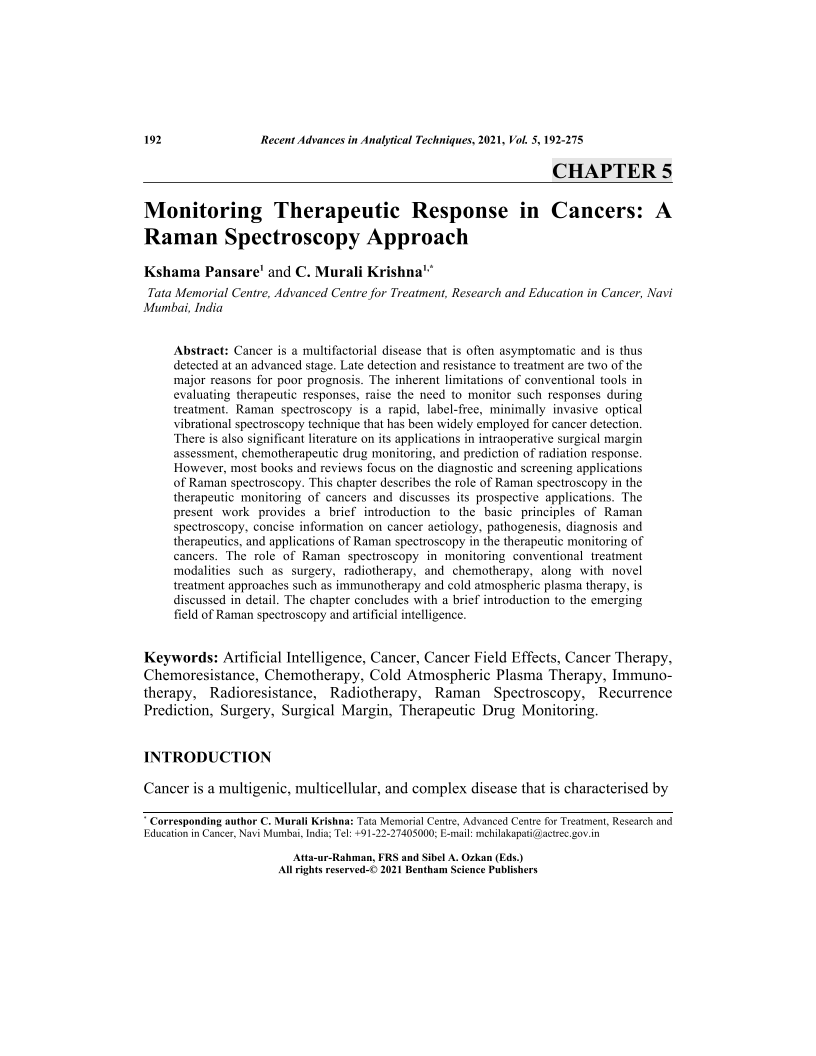
<div>Cancer is a multifactorial disease that is often asymptomatic and is thus</div><div>detected at an advanced stage. Late detection and resistance to treatment are two of the</div><div>major reasons for poor prognosis. The inherent limitations of conventional tools in</div><div>evaluating therapeutic responses, raise the need to monitor such responses during</div><div>treatment. Raman spectroscopy is a rapid, label-free, minimally invasive optical</div><div>vibrational spectroscopy technique that has been widely employed for cancer detection.</div><div>There is also significant literature on its applications in intraoperative surgical margin</div><div>assessment, chemotherapeutic drug monitoring, and prediction of radiation response.</div><div>However, most books and reviews focus on the diagnostic and screening applications</div><div>of Raman spectroscopy. This chapter describes the role of Raman spectroscopy in the</div><div>therapeutic monitoring of cancers and discusses its prospective applications. The</div><div>present work provides a brief introduction to the basic principles of Raman</div><div>spectroscopy, concise information on cancer aetiology, pathogenesis, diagnosis and</div><div>therapeutics, and applications of Raman spectroscopy in the therapeutic monitoring of</div><div>cancers. The role of Raman spectroscopy in monitoring conventional treatment</div><div>modalities such as surgery, radiotherapy, and chemotherapy, along with novel</div><div>treatment approaches such as immunotherapy and cold atmospheric plasma therapy, is</div><div>discussed in detail. The chapter concludes with a brief introduction to the emerging</div><div>field of Raman spectroscopy and artificial intelligence.</div>
-
From This Site
/content/books/9789815036930.chapter-5dcterms_subject,pub_keyword-contentType:Journal -contentType:Figure -contentType:Table -contentType:SupplementaryData105
