


Metal-Free and Acid-Free Activation of Carbonyl Moiety Using Molecular Halogens or N-Halamines
- Authors: Bojan Boić1, Klara Čebular2, Stojan Stavber3
-
View Affiliations Hide Affiliations1 Institute of Physiology and Biochemistry "Ivan Djaja", Faculty of Biology, University of Belgrade, Belgrade, Serbia 2 Department of Physical and Organic Chemistry, Joef Stefan Institute, Jamova 39, 1000 Ljubljana, Slovenia 3 Department of Physical and Organic Chemistry, Joef Stefan Institute, Jamova 39, 1000 Ljubljana, Slovenia
- Source: Advances in Organic Synthesis: Volume 15 , pp 1-97
- Publication Date: October 2021
- Language: English


Metal-Free and Acid-Free Activation of Carbonyl Moiety Using Molecular Halogens or N-Halamines, Page 1 of 1
< Previous page | Next page > /docserver/preview/fulltext/9789814998482/chapter-1-1.gif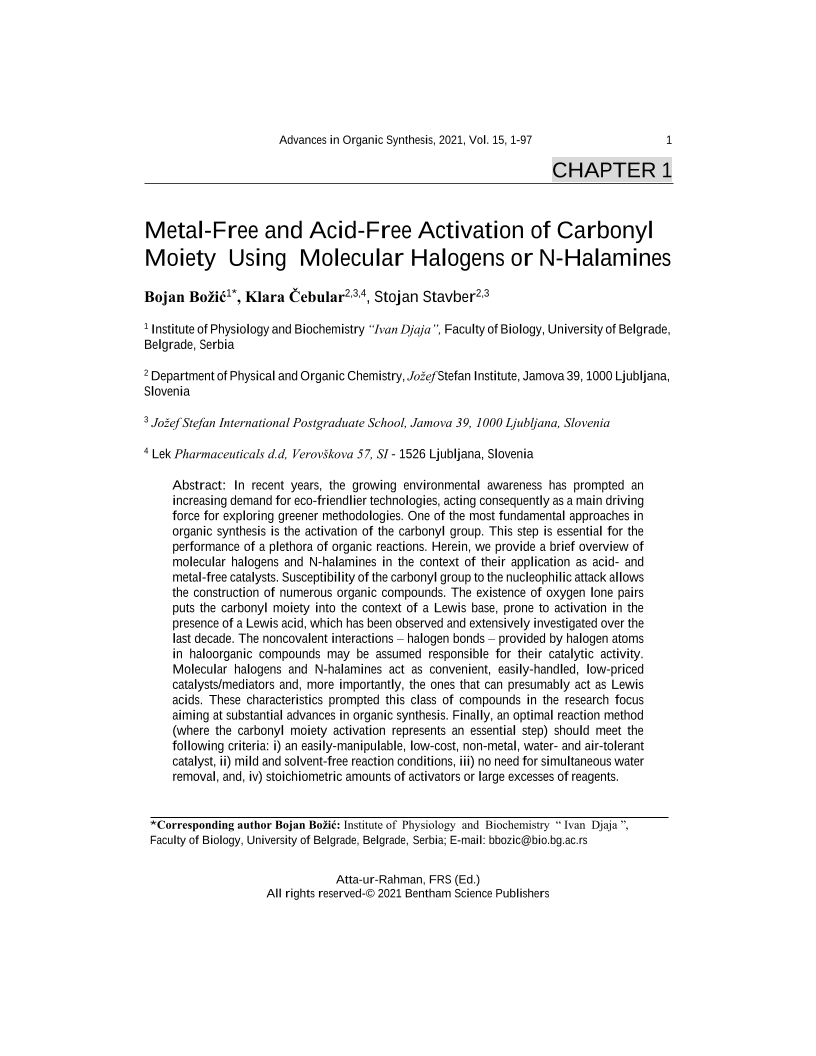
In recent years, the growing environmental awareness has prompted an increasing demand for eco-friendlier technologies, acting consequently as a main driving force for exploring greener methodologies. One of the most fundamental approaches in organic synthesis is the activation of the carbonyl group. This step is essential for the performance of a plethora of organic reactions. Herein, we provide a brief overview of molecular halogens and N-halamines in the context of their application as acid- and metal-free catalysts. Susceptibility of the carbonyl group to the nucleophilic attack allows the construction of numerous organic compounds. The existence of oxygen lone pairs puts the carbonyl moiety into the context of a Lewis base, prone to activation in the presence of a Lewis acid, which has been observed and extensively investigated over the last decade. The noncovalent interactions halogen bonds provided by halogen atoms in haloorganic compounds may be assumed responsible for their catalytic activity. Molecular halogens and N-halamines act as convenient, easily-handled, low-priced catalysts/mediators and, more importantly, the ones that can presumably act as Lewis acids. These characteristics prompted this class of compounds in the research focus aiming at substantial advances in organic synthesis. Finally, an optimal reaction method (where the carbonyl moiety activation represents an essential step) should meet the following criteria: i) an easily-manipulable, low-cost, non-metal, water- and air-tolerant catalyst, ii) mild and solvent-free reaction conditions, iii) no need for simultaneous water removal, and, iv) stoichiometric amounts of activators or large excesses of reagents.
-
From This Site
/content/books/9789814998482.chapter-1dcterms_subject,pub_keyword-contentType:Journal -contentType:Figure -contentType:Table -contentType:SupplementaryData105
