


Analysis of Bivariate Survival Data using Shared Inverse Gaussian Frailty Models: A Bayesian Approach

- Authors: Arvind Pandey, Shashi Bhushan, Lalpawimawha3, Shikhar Tyagi4
-
View Affiliations Hide Affiliations3 Department of Statistics, Pachhunga University College, Mizoram, India. 4 Department of Statistics, Pachhunga University College, Mizoram, India.
- Source: Predictive Analytics Using Statistics and Big Data: Concepts and Modeling , pp 75-88
- Publication Date: December 2020
- Language: English


Analysis of Bivariate Survival Data using Shared Inverse Gaussian Frailty Models: A Bayesian Approach, Page 1 of 1
< Previous page | Next page > /docserver/preview/fulltext/9789811490491/chapter-5-1.gif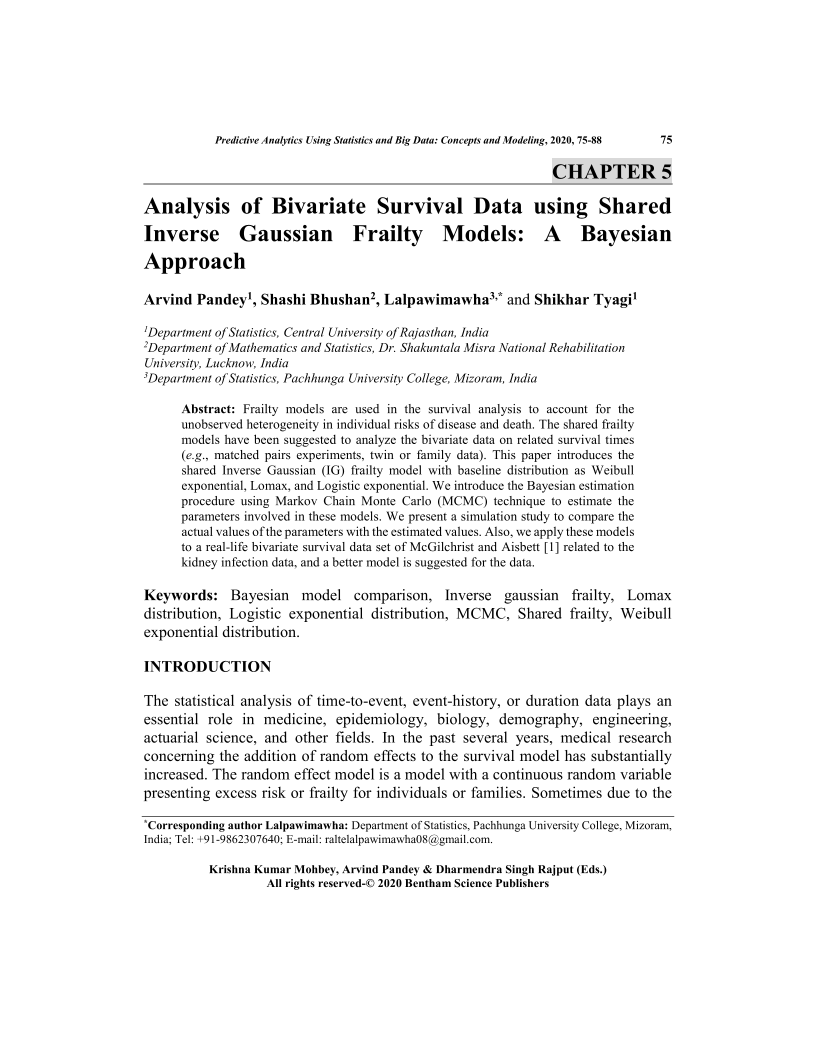
Frailty models are used in the survival analysis to account for the unobserved heterogeneity in individual risks of disease and death. The shared frailty models have been suggested to analyze the bivariate data on related survival times (e.g., matched pairs experiments, twin or family data). This paper introduces the shared Inverse Gaussian (IG) frailty model with baseline distribution as Weibull exponential, Lomax, and Logistic exponential. We introduce the Bayesian estimation procedure using Markov Chain Monte Carlo (MCMC) technique to estimate the parameters involved in these models. We present a simulation study to compare the actual values of the parameters with the estimated values. Also, we apply these models to a real-life bivariate survival data set of McGilchrist and Aisbett [1] related to the kidney infection data, and a better model is suggested for the data.
-
From This Site
/content/books/9789811490491.chapter-5dcterms_subject,pub_keyword-contentType:Journal -contentType:Figure -contentType:Table -contentType:SupplementaryData105
