


Practical Clinical Applications: Chemotherapy and Nuclear Medicine
- Authors: Turkan Ikizceli1, S. Karacavus2
-
View Affiliations Hide Affiliations1 Department of Radiology, University of Health Sciences Turkey, Haseki Training and Research Hospital, Istanbul, Turkey 2 Department of Radiology, University of Health Sciences Turkey, Haseki Training and Research Hospital, Istanbul, Turkey
- Source: Advances in Cancer Nanotheranostics for Experimental and Personalized Medicine , pp 150-170
- Publication Date: June 2020
- Language: English


Practical Clinical Applications: Chemotherapy and Nuclear Medicine, Page 1 of 1
< Previous page | Next page > /docserver/preview/fulltext/9789811456916/chapter-7-1.gif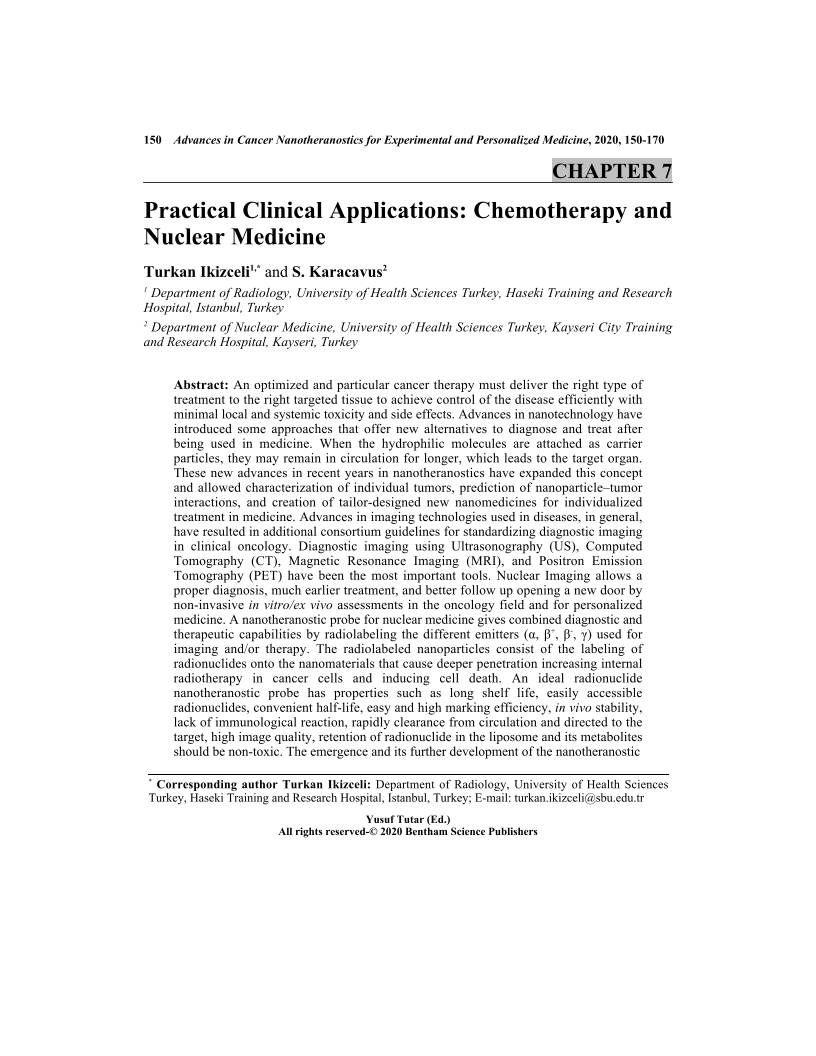
An optimized and particular cancer therapy must deliver the right type of treatment to the right targeted tissue to achieve control of the disease efficiently with minimal local and systemic toxicity and side effects. Advances in nanotechnology have introduced some approaches that offer new alternatives to diagnose and treat after being used in medicine. When the hydrophilic molecules are attached as carrier particles, they may remain in circulation for longer, which leads to the target organ. These new advances in recent years in nanotheranostics have expanded this concept and allowed characterization of individual tumors, prediction of nanoparticletumor interactions, and creation of tailor-designed new nanomedicines for individualized treatment in medicine. Advances in imaging technologies used in diseases, in general, have resulted in additional consortium guidelines for standardizing diagnostic imaging in clinical oncology. Diagnostic imaging using Ultrasonography (US), Computed Tomography (CT), Magnetic Resonance Imaging (MRI), and Positron Emission Tomography (PET) have been the most important tools. Nuclear Imaging allows a proper diagnosis, much earlier treatment, and better follow up opening a new door by non-invasive in vitro/ex vivo assessments in the oncology field and for personalized medicine. A nanotheranostic probe for nuclear medicine gives combined diagnostic and therapeutic capabilities by radiolabeling the different emitters (α, β+, β-, γ) used for imaging and/or therapy. The radiolabeled nanoparticles consist of the labeling of radionuclides onto the nanomaterials that cause deeper penetration increasing internal radiotherapy in cancer cells and inducing cell death. An ideal radionuclide nanotheranostic probe has properties such as long shelf life, easily accessible radionuclides, convenient half-life, easy and high marking efficiency, in vivo stability, lack of immunological reaction, rapidly clearance from circulation and directed to the target, high image quality, retention of radionuclide in the liposome and its metabolites should be non-toxic. The emergence and its further development of the nanotheranostic concept illustrate the need for a multidisciplinary approach with the common objective of improving the management of clinical oncology trials. The simultaneous yield of imaging in radiologic and nuclear medicine applications and therapeutic agents offer the possibility of diagnosis and treatment feedbacks on the treatment effectiveness in real-time.
-
From This Site
/content/books/9789811456916.chapter-7dcterms_subject,pub_keyword-contentType:Journal -contentType:Figure -contentType:Table -contentType:SupplementaryData105
