


Basic Principles of NMR and Experimental Techniques
- By Victor V. Rodin1
-
View Affiliations Hide Affiliations1 Institute of Organic Chemistry Johannes Kepler University Linz 4040 Linz, Austria.
- Source: Magnetic Resonance in Studying Natural and Synthetic Materials , pp 1-25
- Publication Date: October 2018
- Language: English


Basic Principles of NMR and Experimental Techniques, Page 1 of 1
< Previous page | Next page > /docserver/preview/fulltext/9781681086293/chapter-1-1.gif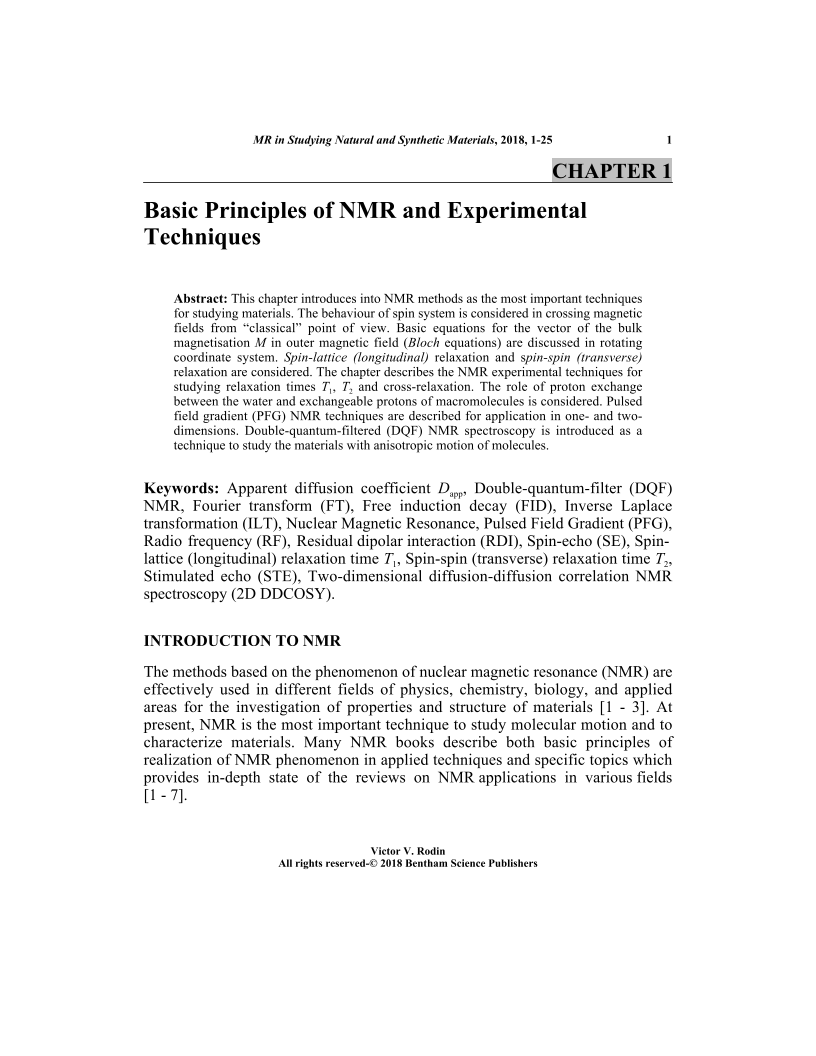
This chapter introduces into NMR methods as the most important techniques for studying materials. The behaviour of spin system is considered in crossing magnetic fields from "classical" point of view. Basic equations for the vector of the bulk magnetisation M in outer magnetic field (Bloch equations) are discussed in rotating coordinate system. Spin-lattice (longitudinal) relaxation and spin-spin (transverse) relaxation are considered. The chapter describes the NMR experimental techniques for studying relaxation times T1, T2 and cross-relaxation. The role of proton exchange between the water and exchangeable protons of macromolecules is considered. Pulsed field gradient (PFG) NMR techniques are described for application in one- and twodimensions. Double-quantum-filtered (DQF) NMR spectroscopy is introduced as a technique to study the materials with anisotropic motion of molecules.
-
From This Site
/content/books/9781681086293.chapter-1dcterms_subject,pub_keyword-contentType:Journal -contentType:Figure -contentType:Table -contentType:SupplementaryData105
