


Multielectronic Processes in Particle and Antiparticle Collisions with Rare Gases
- By Claudia C. Montanari1
-
View Affiliations Hide Affiliations1 Instituto de Astronomía y Física del Espacio, Consejo Nacional de Investigaciones Científicas y Técnicas, and Universidad de Buenos Aires, casilla de correo 67, sucursal 28, C1428EGA, Buenos Aires, Argentina.
- Source: Multi-electronic Processes in Collisions Involving Charged Particles and Photons with Atoms and Molecules , pp 89-118
- Publication Date: October 2018
- Language: English


Multielectronic Processes in Particle and Antiparticle Collisions with Rare Gases, Page 1 of 1
< Previous page | Next page > /docserver/preview/fulltext/9781681086132/chapter-5-1.gif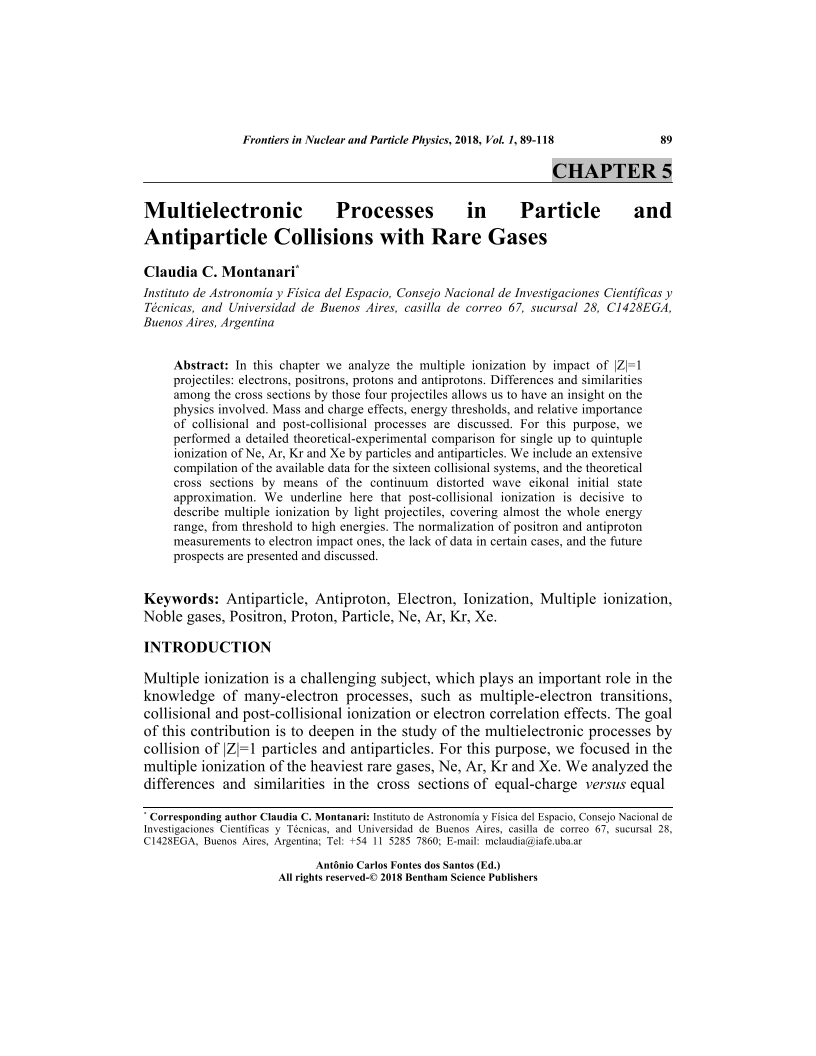
In this chapter we analyze the multiple ionization by impact of ⋅Z⋅=1 projectiles: electrons, positrons, protons and antiprotons. Differences and similarities among the cross sections by those four projectiles allows us to have an insight on the physics involved. Mass and charge effects, energy thresholds, and relative importance of collisional and post-collisional processes are discussed. For this purpose, we performed a detailed theoretical-experimental comparison for single up to quintuple ionization of Ne, Ar, Kr and Xe by particles and antiparticles. We include an extensive compilation of the available data for the sixteen collisional systems, and the theoretical cross sections by means of the continuum distorted wave eikonal initial state approximation. We underline here that post-collisional ionization is decisive to describe multiple ionization by light projectiles, covering almost the whole energy range, from threshold to high energies. The normalization of positron and antiproton measurements to electron impact ones, the lack of data in certain cases, and the future prospects are presented and discussed.
-
From This Site
/content/books/9781681086132.chapter-5dcterms_subject,pub_keyword-contentType:Journal -contentType:Figure -contentType:Table -contentType:SupplementaryData105
