


Vaccine and Antibody Therapy Against Thomsen- Friedenreich Tumor-Associated Carbohydrate Antigens
- Authors: Paula A. Videira1, Sylvain Julien2, Liliana R. Loureiro3, Diana P. Sousa4, Mylène A. Carrascal5, Philippe Delannoy6
-
View Affiliations Hide Affiliations1 UCIBIO, Departamento de Ciências da Vida, Faculdade de Ciências e Tecnologia, Universidade NOVA de Lisboa, Portugal 2 Univ. Lille, Inserm, U908 - CPAC - Cell Plasticity and Cancer, F-59000 Lille, France 3 UCIBIO, Departamento de Ciências da Vida, Faculdade de Ciências e Tecnologia, Universidade NOVA de Lisboa, Portugal 4 UCIBIO, Departamento de Ciências da Vida, Faculdade de Ciências e Tecnologia, Universidade NOVA de Lisboa, Portugal 5 UCIBIO, Departamento de Ciências da Vida, Faculdade de Ciências e Tecnologia, Universidade NOVA de Lisboa, Portugal 6 Univ. Lille, CNRS, UMR 8576 - UGSF - Unité de Glycobiologie Structurale et Fonctionnelle, F- 59000 Lille, France
- Source: Recent Progress in Glycotherapy , pp 3-38
- Publication Date: December 2016
- Language: English


Vaccine and Antibody Therapy Against Thomsen- Friedenreich Tumor-Associated Carbohydrate Antigens, Page 1 of 1
< Previous page | Next page > /docserver/preview/fulltext/9781681083919/chapter-1-1.gif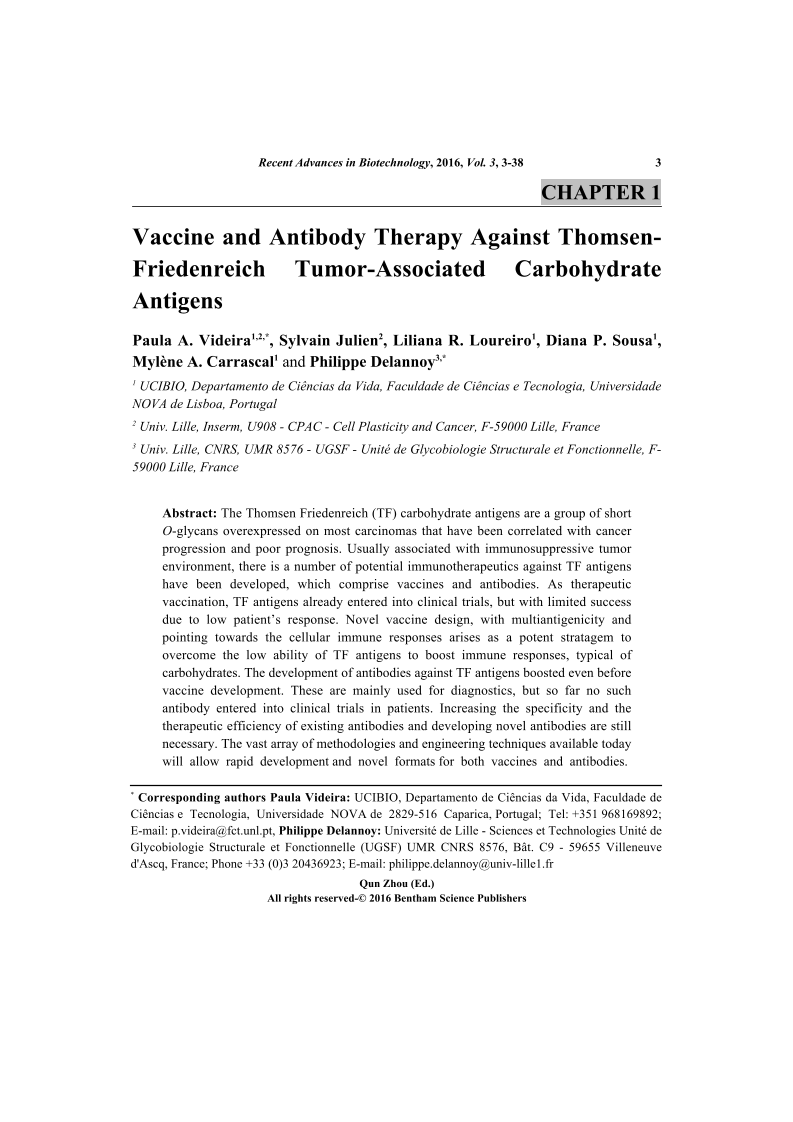
The Thomsen Friedenreich (TF) carbohydrate antigens are a group of short O-glycans overexpressed on most carcinomas that have been correlated with cancer progression and poor prognosis. Usually associated with immunosuppressive tumor environment, there is a number of potential immunotherapeutics against TF antigens have been developed, which comprise vaccines and antibodies. As therapeutic vaccination, TF antigens already entered into clinical trials, but with limited success due to low patient's response. Novel vaccine design, with multiantigenicity and pointing towards the cellular immune responses arises as a potent stratagem to overcome the low ability of TF antigens to boost immune responses, typical of carbohydrates. The development of antibodies against TF antigens boosted even before vaccine development. These are mainly used for diagnostics, but so far no such antibody entered into clinical trials in patients. Increasing the specificity and the therapeutic efficiency of existing antibodies and developing novel antibodies are still necessary. The vast array of methodologies and engineering techniques available today will allow rapid development and novel formats for both vaccines and antibodies. Vaccines and antibodies targeting the same epitopes can function in synergy both to protect and to clear patient's cancer cells. Whilst on one hand, TF antigens dampen immune responses against tumor cells, it is anticipated that the challenge is overcome by applying our increasing knowledge of the mechanisms behind to improve molecular design. Novel solutions are also envisaged by combining anti-TF therapies with other immunotherapies.
-
From This Site
/content/books/9781681083919.chapter-1dcterms_subject,pub_keyword-contentType:Journal -contentType:Figure -contentType:Table -contentType:SupplementaryData105
