


Anti-Tubercular Drug Designing Using Structural Descriptors

- Authors: Manish C. Bagchi1, Payel Ghosh2
-
View Affiliations Hide Affiliations1 School of Bioscience & Engineering, Jadavpur University, Kolkata 700032, India 2 School of Bioscience & Engineering, Jadavpur University, Kolkata 700032, India.
- Source: Advances in Mathematical Chemistry and Applications: Volume 2 , pp 179-190
- Publication Date: July 2015
- Language: English


Anti-Tubercular Drug Designing Using Structural Descriptors, Page 1 of 1
< Previous page | Next page > /docserver/preview/fulltext/9781681080529/chapter-8-1.gif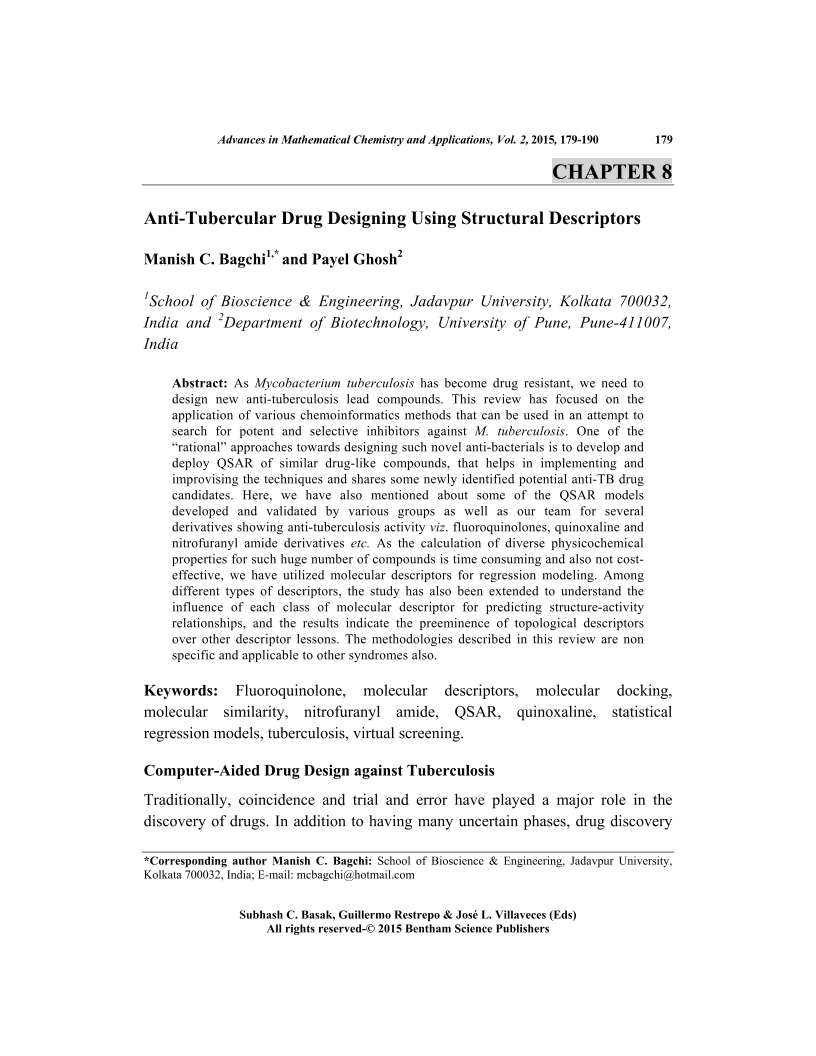
As Mycobacterium tuberculosis has become drug resistant, we need to design new anti-tuberculosis lead compounds. This review has focused on the application of various chemoinformatics methods that can be used in an attempt to search for potent and selective inhibitors against M. tuberculosis. One of the "rational" approaches towards designing such novel anti-bacterials is to develop and deploy QSAR of similar drug-like compounds, that helps in implementing and improvising the techniques and shares some newly identified potential anti-TB drug candidates. Here, we have also mentioned about some of the QSAR models developed and validated by various groups as well as our team for several derivatives showing anti-tuberculosis activity viz. fluoroquinolones, quinoxaline and nitrofuranyl amide derivatives etc. As the calculation of diverse physicochemical properties for such huge number of compounds is time consuming and also not costeffective, we have utilized molecular descriptors for regression modeling. Among different types of descriptors, the study has also been extended to understand the influence of each class of molecular descriptor for predicting structure-activity relationships, and the results indicate the preeminence of topological descriptors over other descriptor lessons. The methodologies described in this review are non specific and applicable to other syndromes also.
-
From This Site
/content/books/9781681080529.chapter-8dcterms_subject,pub_keyword-contentType:Journal -contentType:Figure -contentType:Table -contentType:SupplementaryData105
