


The Periodicity of Molecules

- Authors: Fanao Kong1, Weiqiang Wu, Na Ji, C. L. Calson
-
View Affiliations Hide Affiliations1 The Institute of Chemistry, Chinese Academy of Sciences, Beijing, 100190, China
- Source: Advances in Mathematical Chemistry and Applications: Volume 2 , pp 74-95
- Publication Date: July 2015
- Language: English


The Periodicity of Molecules, Page 1 of 1
< Previous page | Next page > /docserver/preview/fulltext/9781681080529/chapter-4-1.gif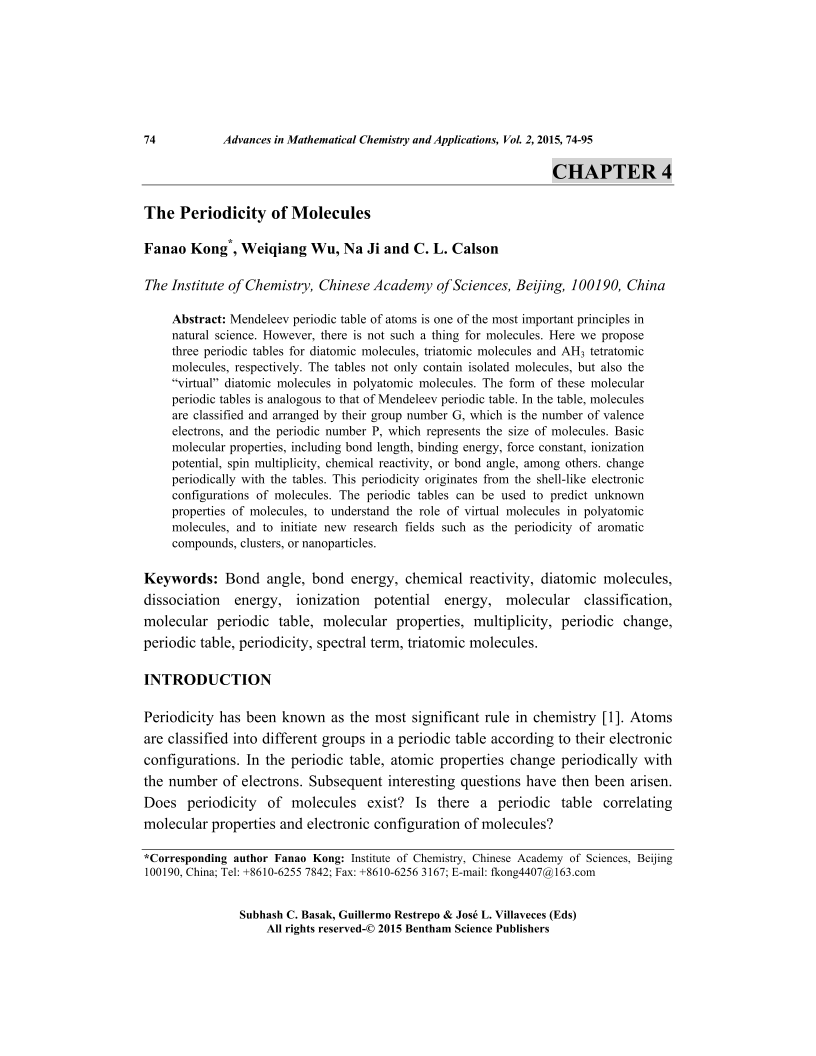
Mendeleev periodic table of atoms is one of the most important principles in natural science. However, there is not such a thing for molecules. Here we propose three periodic tables for diatomic molecules, triatomic molecules and AH3 tetratomic molecules, respectively. The tables not only contain isolated molecules, but also the "virtual" diatomic molecules in polyatomic molecules. The form of these molecular periodic tables is analogous to that of Mendeleev periodic table. In the table, molecules are classified and arranged by their group number G, which is the number of valence electrons, and the periodic number P, which represents the size of molecules. Basic molecular properties, including bond length, binding energy, force constant, ionization potential, spin multiplicity, chemical reactivity, or bond angle, among others. change periodically with the tables. This periodicity originates from the shell-like electronic configurations of molecules. The periodic tables can be used to predict unknown properties of molecules, to understand the role of virtual molecules in polyatomic molecules, and to initiate new research fields such as the periodicity of aromatic compounds, clusters, or nanoparticles.
-
From This Site
/content/books/9781681080529.chapter-4dcterms_subject,pub_keyword-contentType:Journal -contentType:Figure -contentType:Table -contentType:SupplementaryData105
