


Generalized Topologies: Hypergraphs, Chemical Reactions, and Biological Evolution
- Authors: Christoph Flamm1, Bärbel M. R. Stadler2, Peter F. Stadler3
-
View Affiliations Hide Affiliations1 Institute for Theoretical Chemistry, University of Vienna, Währingerstraße 17, A-1090 Vienna, Austria 2 Max Planck Institute for Mathematics in the Sciences, Inselstraße 22, D-04103 Leipzig, Germany 3 Härtelstraße 16 18, D-04107 Leipzig, Germany.
- Source: Advances in Mathematical Chemistry and Applications: Volume 2 , pp 300-328
- Publication Date: July 2015
- Language: English


Generalized Topologies: Hypergraphs, Chemical Reactions, and Biological Evolution, Page 1 of 1
< Previous page | Next page > /docserver/preview/fulltext/9781681080529/chapter-13-1.gif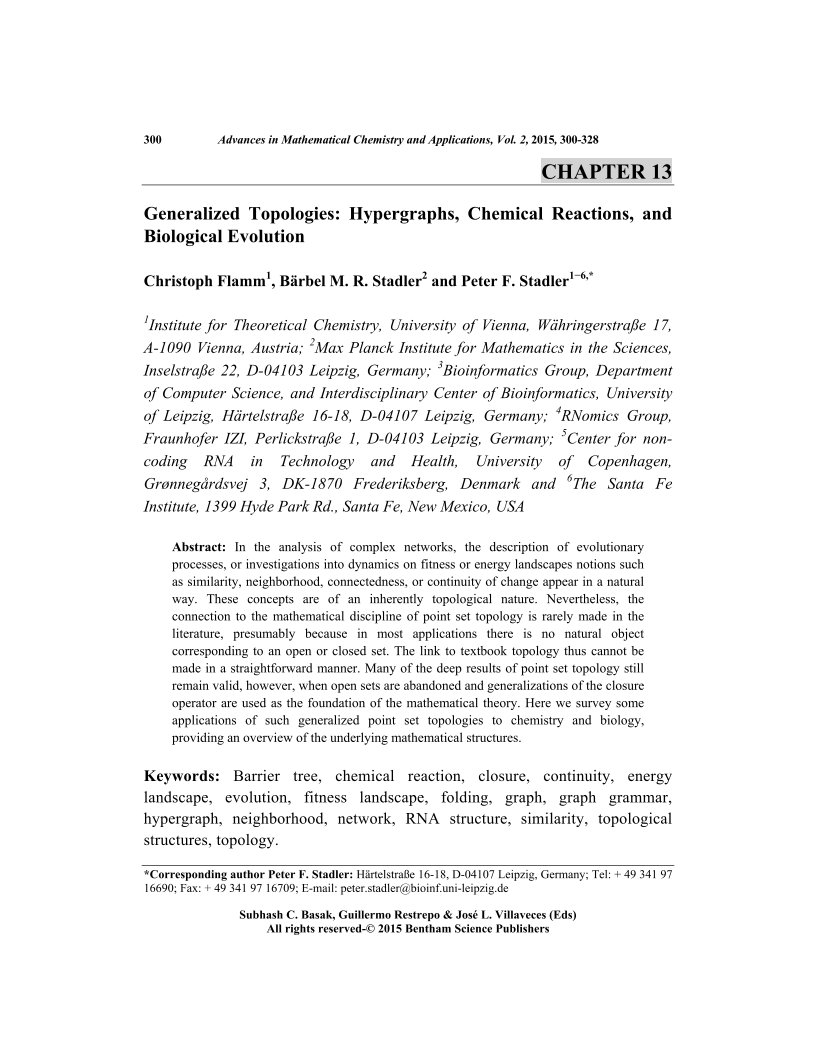
In the analysis of complex networks, the description of evolutionary processes, or investigations into dynamics on fitness or energy landscapes notions such as similarity, neighborhood, connectedness, or continuity of change appear in a natural way. These concepts are of an inherently topological nature. Nevertheless, the connection to the mathematical discipline of point set topology is rarely made in the literature, presumably because in most applications there is no natural object corresponding to an open or closed set. The link to textbook topology thus cannot be made in a straightforward manner. Many of the deep results of point set topology still remain valid, however, when open sets are abandoned and generalizations of the closure operator are used as the foundation of the mathematical theory. Here we survey some applications of such generalized point set topologies to chemistry and biology, providing an overview of the underlying mathematical structures.
-
From This Site
/content/books/9781681080529.chapter-13dcterms_subject,pub_keyword-contentType:Journal -contentType:Figure -contentType:Table -contentType:SupplementaryData105
