


Citizens vs. Consumers: 0 - 1: Is Consumption Behaviour Congruent with Citizens Attitudes towards Sustainable Pork Production?
- By Athanasios Krystallis1
-
View Affiliations Hide Affiliations1 MAPP Centre for Research on Customer Relations in the Food Sector, Aarhus University, Bartholins Alle 10, DK 8000, Aarhus C, Denmark.
- Source: Markets, Business and Sustainability , pp 73-97
- Publication Date: March 2015
- Language: English


Citizens vs. Consumers: 0 - 1: Is Consumption Behaviour Congruent with Citizens Attitudes towards Sustainable Pork Production?, Page 1 of 1
< Previous page | Next page > /docserver/preview/fulltext/9781681080253/chapter-4-1.gif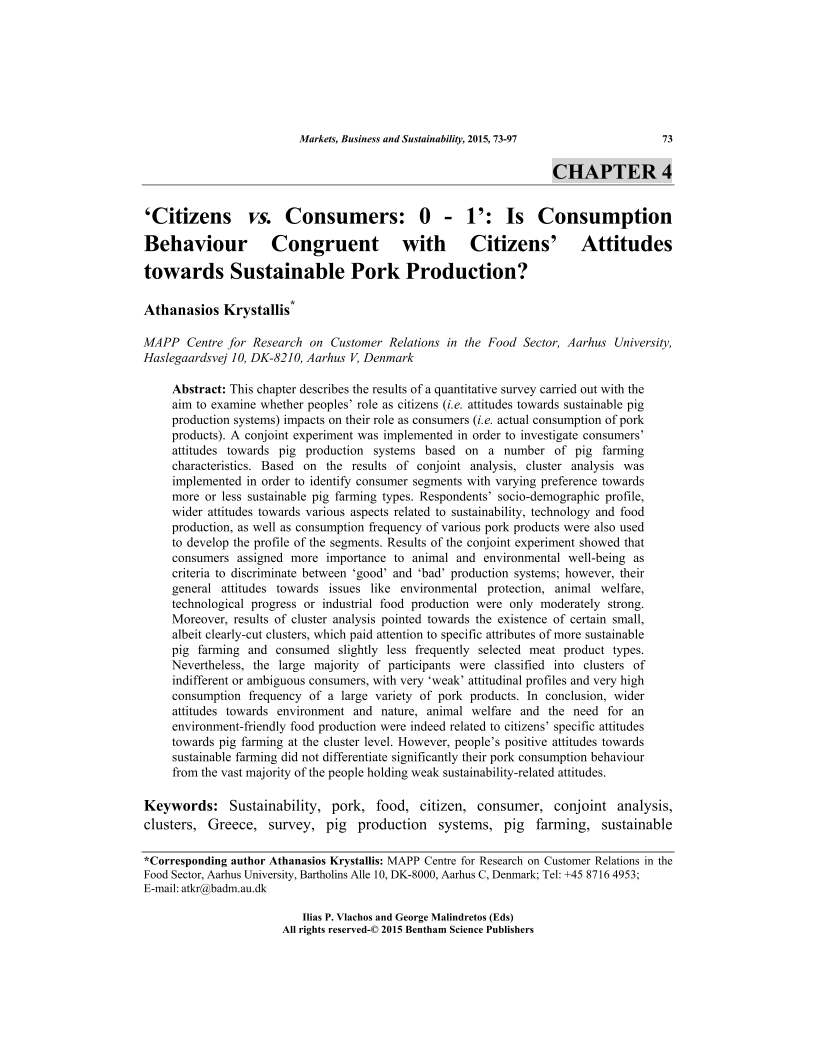
This chapter describes the results of a quantitative survey carried out with the aim to examine whether peoples role as citizens (i.e. attitudes towards sustainable pig production systems) impacts on their role as consumers (i.e. actual consumption of pork products). A conjoint experiment was implemented in order to investigate consumers attitudes towards pig production systems based on a number of pig farming characteristics. Based on the results of conjoint analysis, cluster analysis was implemented in order to identify consumer segments with varying preference towards more or less sustainable pig farming types. Respondents socio-demographic profile, wider attitudes towards various aspects related to sustainability, technology and food production, as well as consumption frequency of various pork products were also used to develop the profile of the segments. Results of the conjoint experiment showed that consumers assigned more importance to animal and environmental well-being as criteria to discriminate between good and bad production systems; however, their general attitudes towards issues like environmental protection, animal welfare, technological progress or industrial food production were only moderately strong. Moreover, results of cluster analysis pointed towards the existence of certain small, albeit clearly-cut clusters, which paid attention to specific attributes of more sustainable pig farming and consumed slightly less frequently selected meat product types. Nevertheless, the large majority of participants were classified into clusters of indifferent or ambiguous consumers, with very weak attitudinal profiles and very high consumption frequency of a large variety of pork products. In conclusion, wider attitudes towards environment and nature, animal welfare and the need for an environment-friendly food production were indeed related to citizens specific attitudes towards pig farming at the cluster level. However, peoples positive attitudes towards sustainable farming did not differentiate significantly their pork consumption behaviour from the vast majority of the people holding weak sustainability-related attitudes.
-
From This Site
/content/books/9781681080253.chapter-4dcterms_subject,pub_keyword-contentType:Journal -contentType:Figure -contentType:Table -contentType:SupplementaryData105
