


Introduction of Splitting Procedures Part A: Implementation of Splitting Procedures
- Authors: István Faragó1, Ágnes Havasi2, Zahari Zlatev3
-
View Affiliations Hide Affiliations1 Department of Applied Analysis and Computational Mathematics and HAS, ELTE Research Group “Numerical Analysis and Large Networks” Eötvös Loránd University, Pázmány P. s. 1/C, H-1117, Budapest, Hungary 2 Department of Applied Analysis and Computational Mathematics and HAS, ELTE Research Group “Numerical Analysis and Large Networks” Eötvös Loránd University, Pázmány P. s. 1/C, H-1117, Budapest, Hungary 3 National Environmental Research Institute, Aarhus University, Frederiksborgvej 399, P. O. Box 358, DK-4000, Roskilde, Denmark
- Source: Advanced Numerical Methods for Complex Environmental Models: Needs and Availability , pp 79-125
- Publication Date: December 2013
- Language: English


Introduction of Splitting Procedures Part A: Implementation of Splitting Procedures, Page 1 of 1
< Previous page | Next page > /docserver/preview/fulltext/9781608057788/chapter-4-1.gif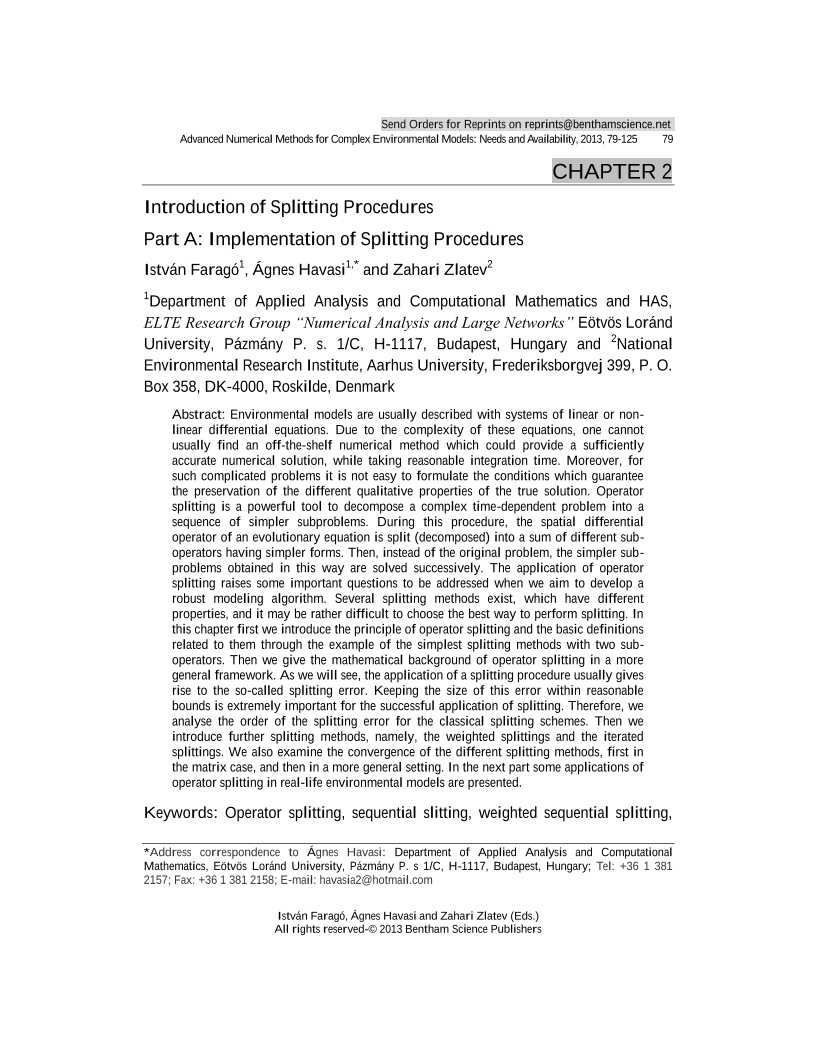
Environmental models are usually described with systems of linear or non-linear differential equations. Due to the complexity of these equations, one cannot usually find an off-the-shelf numerical method which could provide a sufficiently accurate numerical solution, while taking reasonable integration time. Moreover, for such complicated problems it is not easy to formulate the conditions which guarantee the preservation of the different qualitative properties of the true solution. Operator splitting is a powerful tool to decompose a complex time-dependent problem into a sequence of simpler subproblems. During this procedure, the spatial differential operator of an evolutionary equation is split (decomposed) into a sum of different sub-operators having simpler forms. Then, instead of the original problem, the simpler sub-problems obtained in this way are solved successively. The application of operator splitting raises some important questions to be addressed when we aim to develop a robust modeling algorithm. Several splitting methods exist, which have different properties, and it may be rather difficult to choose the best way to perform splitting. In this chapter first we introduce the principle of operator splitting and the basic definitions related to them through the example of the simplest splitting methods with two sub-operators. Then we give the mathematical background of operator splitting in a more general framework. As we will see, the application of a splitting procedure usually gives rise to the so-called splitting error. Keeping the size of this error within reasonable bounds is extremely important for the successful application of splitting. Therefore, we analyse the order of the splitting error for the classical splitting schemes. Then we introduce further splitting methods, namely, the weighted splittings and the iterated splittings. We also examine the convergence of the different splitting methods, first in the matrix case, and then in a more general setting. In the next part some applications of operator splitting in real-life environmental models are presented.
-
From This Site
/content/books/9781608057788.chapter-4dcterms_subject,pub_keyword-contentType:Journal -contentType:Figure -contentType:Table -contentType:SupplementaryData105
