


Homogeneous Nature of the True Catalytic Species for Heck Reactions with Supported Pd Particles
- Authors: Lin Huang, Pui Kwan Wong2
-
View Affiliations Hide Affiliations2 Institute of Chemical and Engineering Sciences, Agency for Science, Technology and Research, 1 Pesek Road, Jurong Island, Singapore 627833, Singapore, Singapore
- Source: Advances in Organic Synthesis: Volume 3 , pp 139-173
- Publication Date: January 2013
- Language: English


Homogeneous Nature of the True Catalytic Species for Heck Reactions with Supported Pd Particles, Page 1 of 1
< Previous page | Next page > /docserver/preview/fulltext/9781608054688/chapter-4-1.gif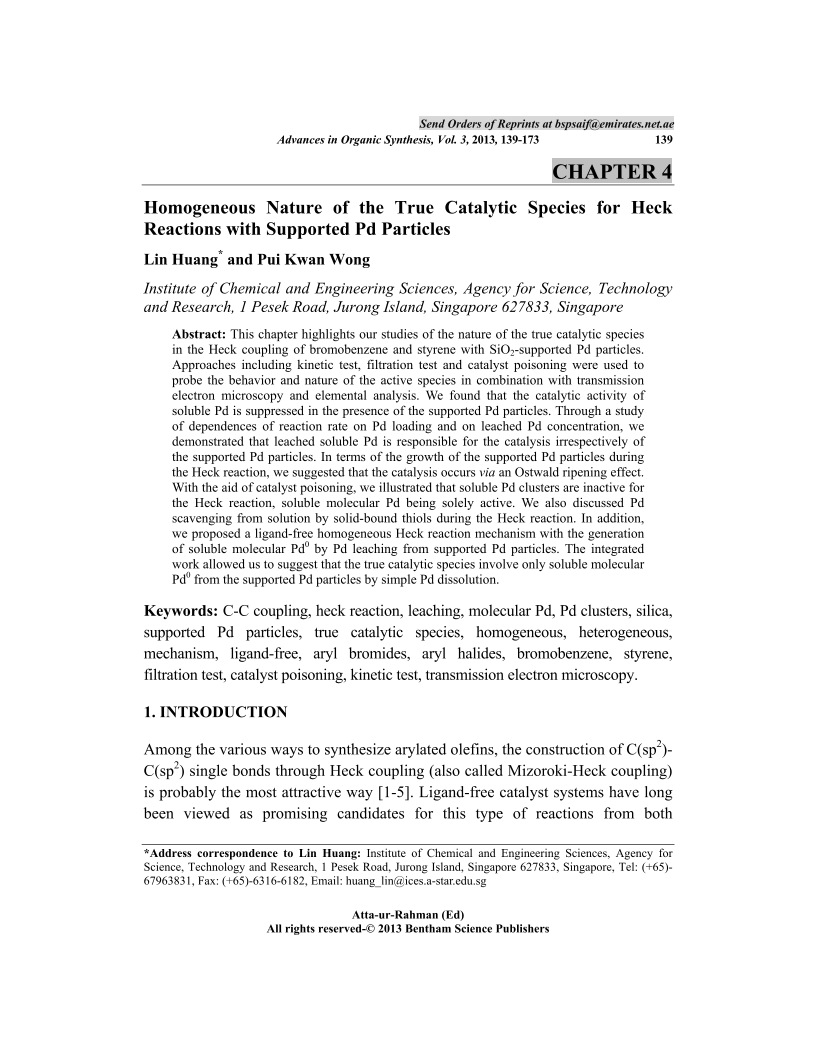
This chapter highlights our studies of the nature of the true catalytic species in the Heck coupling of bromobenzene and styrene with SiO2-supported Pd particles. Approaches including kinetic test, filtration test and catalyst poisoning were used to probe the behavior and nature of the active species in combination with transmission electron microscopy and elemental analysis. We found that the catalytic activity of soluble Pd is suppressed in the presence of the supported Pd particles. Through a study of dependences of reaction rate on Pd loading and on leached Pd concentration, we demonstrated that leached soluble Pd is responsible for the catalysis irrespectively of the supported Pd particles. In terms of the growth of the supported Pd particles during the Heck reaction, we suggested that the catalysis occurs via an Ostwald ripening effect. With the aid of catalyst poisoning, we illustrated that soluble Pd clusters are inactive for the Heck reaction, soluble molecular Pd being solely active. We also discussed Pd scavenging from solution by solid-bound thiols during the Heck reaction. In addition, we proposed a ligand-free homogeneous Heck reaction mechanism with the generation of soluble molecular Pd0 by Pd leaching from supported Pd particles. The integrated work allowed us to suggest that the true catalytic species involve only soluble molecular Pd0 from the supported Pd particles by simple Pd dissolution.
-
From This Site
/content/books/9781608054688.chapter-4dcterms_subject,pub_keyword-contentType:Journal -contentType:Figure -contentType:Table -contentType:SupplementaryData105
