


Biological Activity of Organotin(IV) Compounds: Structural and Chemical Aspects
- Authors: Laszlo Nagy1, Claudia Pellerito2, Lorenzo Pellerito3
-
View Affiliations Hide Affiliations1 Department of Inorganic and Analytical Chemistry, University of Szeged, Hungary 2 Department of Analytic and Inorganic Chemistry "Stanislao Cannizzaro", University of Palermo, Viale delle Scienze, Parco d, Orleans, 90128 Palermo, Italy 3 Department of Analytic and Inorganic Chemistry "Stanislao Cannizzaro", University of Palermo, Viale delle Scienze, Parco d, Orleans, 90128 Palermo, Italy
- Source: Biochemical and Biological Effects of Organotins , pp 25-52
- Publication Date: March 2012
- Language: English


Biological Activity of Organotin(IV) Compounds: Structural and Chemical Aspects, Page 1 of 1
< Previous page | Next page > /docserver/preview/fulltext/9781608052653/chapter-2-1.gif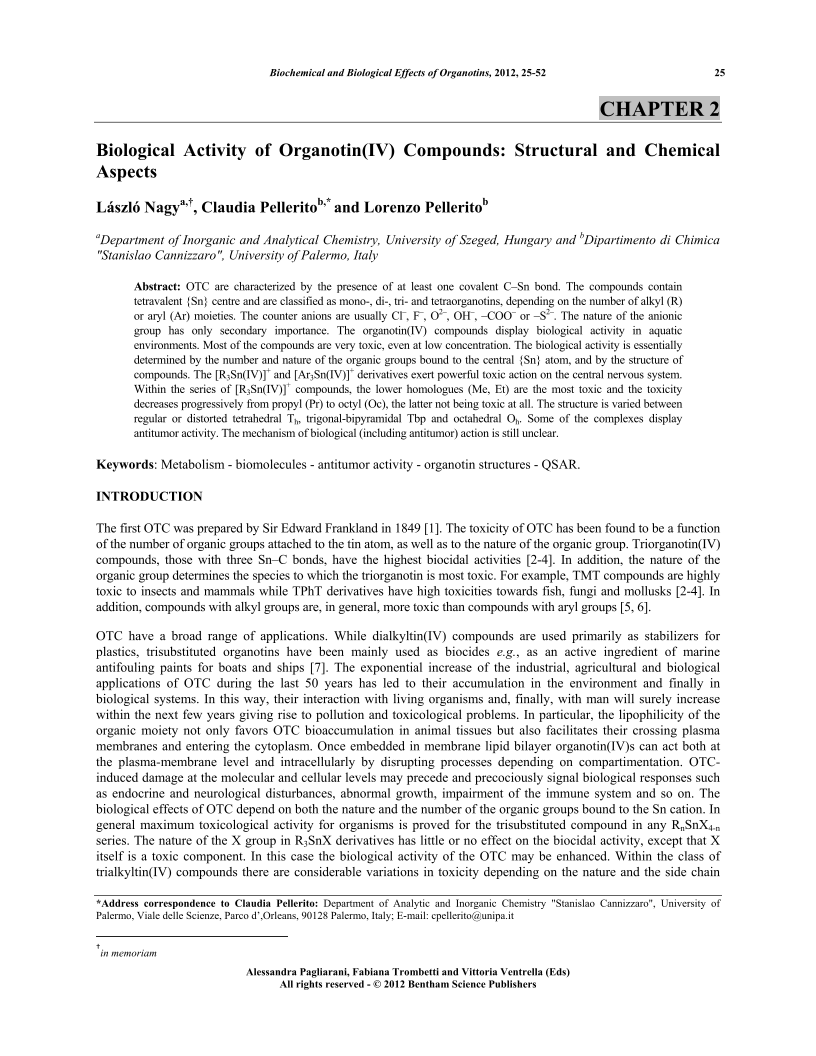
OTC are characterized by the presence of at least one covalent CSn bond. The compounds contain tetravalent {Sn} centre and are classified as mono-, di-, tri- and tetraorganotins, depending on the number of alkyl (R) or aryl (Ar) moieties. The counter anions are usually Cl, F, O2, OH, COO or S2. The nature of the anionic group has only secondary importance. The organotin(IV) compounds display biological activity in aquatic environments. Most of the compounds are very toxic, even at low concentration. The biological activity is essentially determined by the number and nature of the organic groups bound to the central {Sn} atom, and by the structure of compounds. The [R3Sn(IV)]+ and [Ar3Sn(IV)]+ derivatives exert powerful toxic action on the central nervous system. Within the series of [R3Sn(IV)]+ compounds, the lower homologues (Me, Et) are the most toxic and the toxicity decreases progressively from propyl (Pr) to octyl (Oc), the latter not being toxic at all. The structure is varied between regular or distorted tetrahedral Th, trigonal-bipyramidal Tbp and octahedral Oh. Some of the complexes display antitumor activity. The mechanism of biological (including antitumor) action is still unclear.
-
From This Site
/content/books/9781608052653.chapter-2dcterms_subject,pub_keyword-contentType:Journal -contentType:Figure -contentType:Table -contentType:SupplementaryData105
