


Heatsink EMI Effects in Power Electronic Systems
- By Gordana Klaric Felic1
-
View Affiliations Hide Affiliations1 NICTA, Electrical and Electronic Engineering, The University of Melbourne, Parkville VIC 3010, Australia; Tel: 613 83443804., Australia
- Source: Electromagnetic Interference Issues in Power Electronics and Power Systems , pp 57-76
- Publication Date: March 2012
- Language: English


Heatsink EMI Effects in Power Electronic Systems, Page 1 of 1
< Previous page | Next page > /docserver/preview/fulltext/9781608052400/chapter-3-1.gif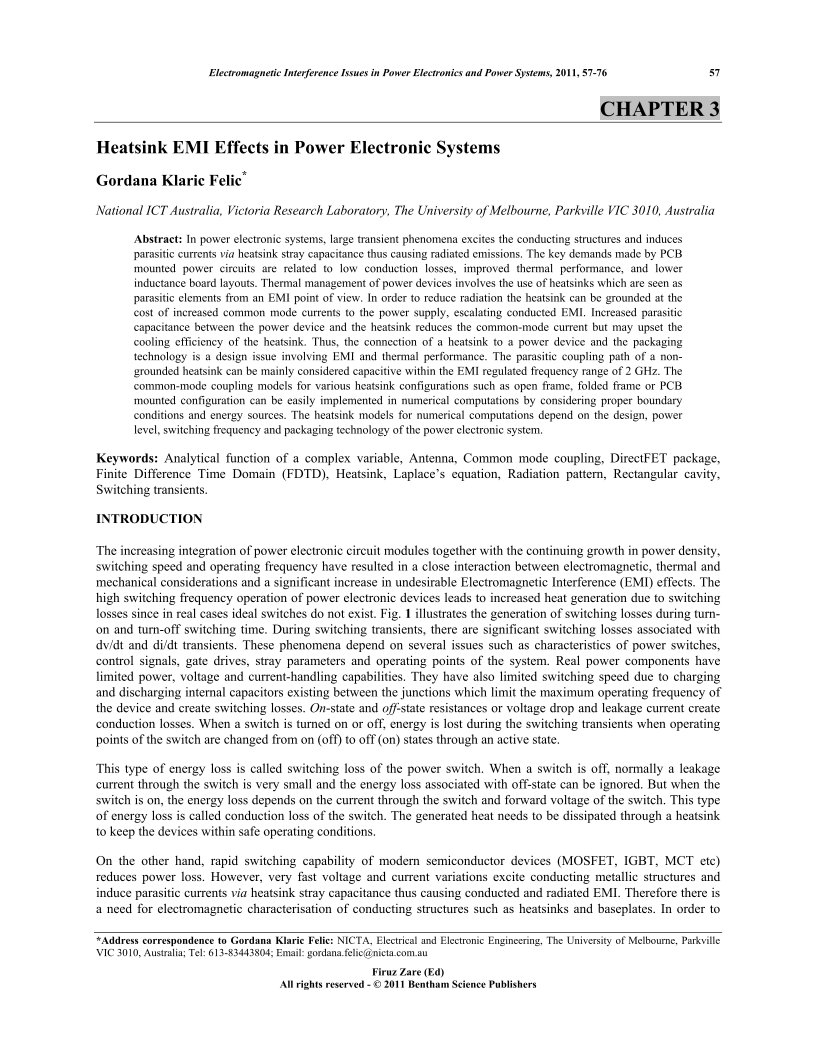
In power electronic systems, large transient phenomena excites the conducting structures and induces parasitic currents via heatsink stray capacitance thus causing radiated emissions. The key demands made by PCB mounted power circuits are related to low conduction losses, improved thermal performance, and lower inductance board layouts. Thermal management of power devices involves the use of heatsinks which are seen as parasitic elements from an EMI point of view. In order to reduce radiation the heatsink can be grounded at the cost of increased common mode currents to the power supply, escalating conducted EMI. Increased parasitic capacitance between the power device and the heatsink reduces the common-mode current but may upset the cooling efficiency of the heatsink. Thus, the connection of a heatsink to a power device and the packaging technology is a design issue involving EMI and thermal performance. The parasitic coupling path of a nongrounded heatsink can be mainly considered capacitive within the EMI regulated frequency range of 2 GHz. The common-mode coupling models for various heatsink configurations such as open frame, folded frame or PCB mounted configuration can be easily implemented in numerical computations by considering proper boundary conditions and energy sources. The heatsink models for numerical computations depend on the design, power level, switching frequency and packaging technology of the power electronic system.
-
From This Site
/content/books/9781608052400.chapter-3dcterms_subject,pub_keyword-contentType:Journal -contentType:Figure -contentType:Table -contentType:SupplementaryData105
