


Targeting Drug Resistant Mutations Using Novel Binding Interactions Lessons Learned from Abl-T315I and their Implications in Drug Design
- Authors: Glen Noronha1, Jianguo Cao, Chun Chow, Elena Dneprovskaia, Linda Hwang, Dan Lohse, Chi Ching Mak, Andrew McPherson, Richard M. Fine, Xinshan Kang, Boris Klebansky, Moorthy S.S. Palanki, Ved P. Pathak, Joel Renick, Richard Soll, Binqi Zeng
-
View Affiliations Hide Affiliations1 TargeGen, Inc., 9380 Judicial Drive, San Diego, CA 92121, USA
- Source: Frontiers in Drug Design and Discovery: Volume 3 , pp 121-144
- Publication Date: January 2007
- Language: English


Targeting Drug Resistant Mutations Using Novel Binding Interactions Lessons Learned from Abl-T315I and their Implications in Drug Design, Page 1 of 1
< Previous page | Next page > /docserver/preview/fulltext/9781608052011/chapter-6-1.gif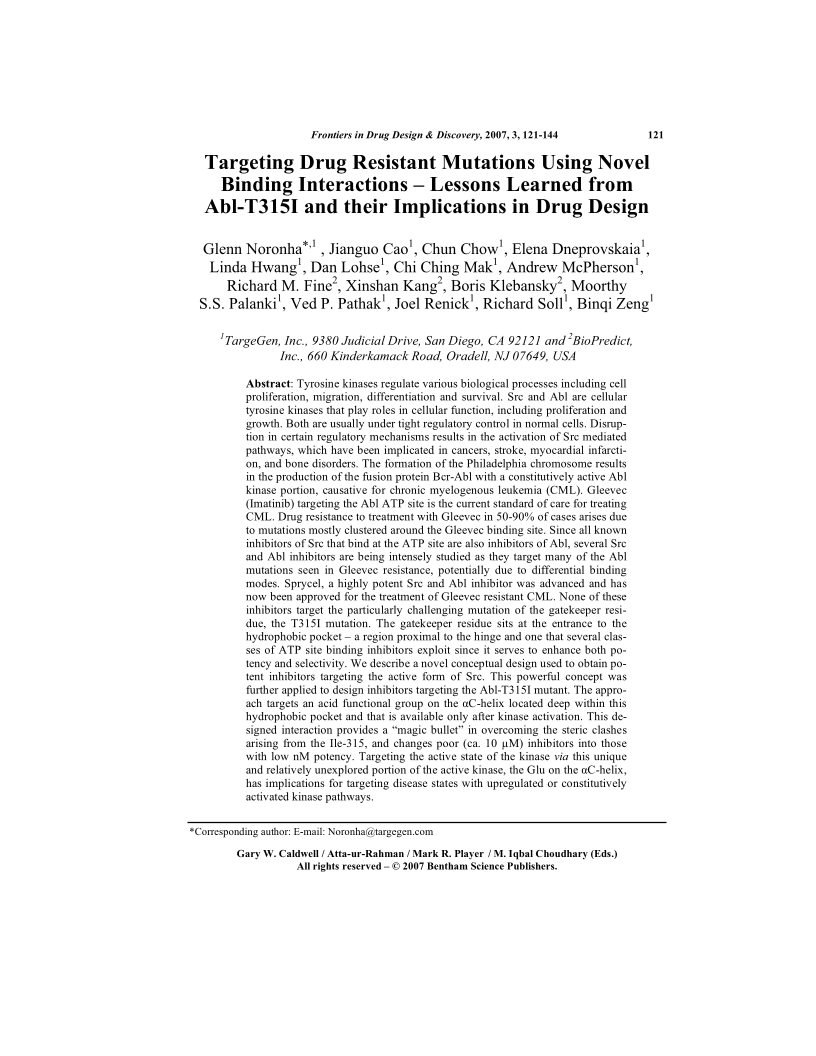
Tyrosine kinases regulate various biological processes including cell proliferation, migration, differentiation and survival. Src and Abl are cellular tyrosine kinases that play roles in cellular function, including proliferation and growth. Both are usually under tight regulatory control in normal cells. Disruption in certain regulatory mechanisms results in the activation of Src mediated pathways, which have been implicated in cancers, stroke, myocardial infarction, and bone disorders. The formation of the Philadelphia chromosome results in the production of the fusion protein Bcr-Abl with a constitutively active Abl kinase portion, causative for chronic myelogenous leukemia (CML). Gleevec (Imatinib) targeting the Abl ATP site is the current standard of care for treating CML. Drug resistance to treatment with Gleevec in 50-90% of cases arises due to mutations mostly clustered around the Gleevec binding site. Since all known inhibitors of Src that bind at the ATP site are also inhibitors of Abl, several Src and Abl inhibitors are being intensely studied as they target many of the Abl mutations seen in Gleevec resistance, potentially due to differential binding modes. Sprycel, a highly potent Src and Abl inhibitor was advanced and has now been approved for the treatment of Gleevec resistant CML. None of these inhibitors target the particularly challenging mutation of the gatekeeper residue, the T315I mutation. The gatekeeper residue sits at the entrance to the hydrophobic pocket - a region proximal to the hinge and one that several classes of ATP site binding inhibitors exploit since it serves to enhance both potency and selectivity. We describe a novel conceptual design used to obtain potent inhibitors targeting the active form of Src. This powerful concept was further applied to design inhibitors targeting the Abl-T315I mutant. The approach targets an acid functional group on the αC-helix located deep within this hydrophobic pocket and that is available only after kinase activation. This designed interaction provides a "magic bullet" in overcoming the steric clashes arising from the Ile-315, and changes poor (ca. 10 µM) inhibitors into those with low nM potency. Targeting the active state of the kinase via this unique and relatively unexplored portion of the active kinase, the Glu on the αC-helix, has implications for targeting disease states with upregulated or constitutively activated kinase pathways.
-
From This Site
/content/books/9781608052011.chapter-6dcterms_subject,pub_keyword-contentType:Journal -contentType:Figure -contentType:Table -contentType:SupplementaryData105
