


Activation of Organic Reactions by Microwaves
- Authors: Antonio de la Hoz1, Angel Diaz-Ortiz2, Andres Moreno3
-
View Affiliations Hide Affiliations1 Departamento de Qumica Orgnica, Facultad de Qumica, Universidad de Castilla La Mancha, E-13071 Ciudad Real,Spain 2 Departamento de Qumica Orgnica, Facultad de Qumica, Universidad de Castilla La Mancha, E-13071 Ciudad Real,Spain 3 Departamento de Qumica Orgnica, Facultad de Qumica, Universidad de Castilla La Mancha, E-13071 Ciudad Real,Spain
- Source: Advances in Organic Synthesis: Volume 1 , pp 119-171
- Publication Date: December 2004
- Language: English


Activation of Organic Reactions by Microwaves, Page 1 of 1
< Previous page | Next page > /docserver/preview/fulltext/9781608051977/chapter-4-1.gif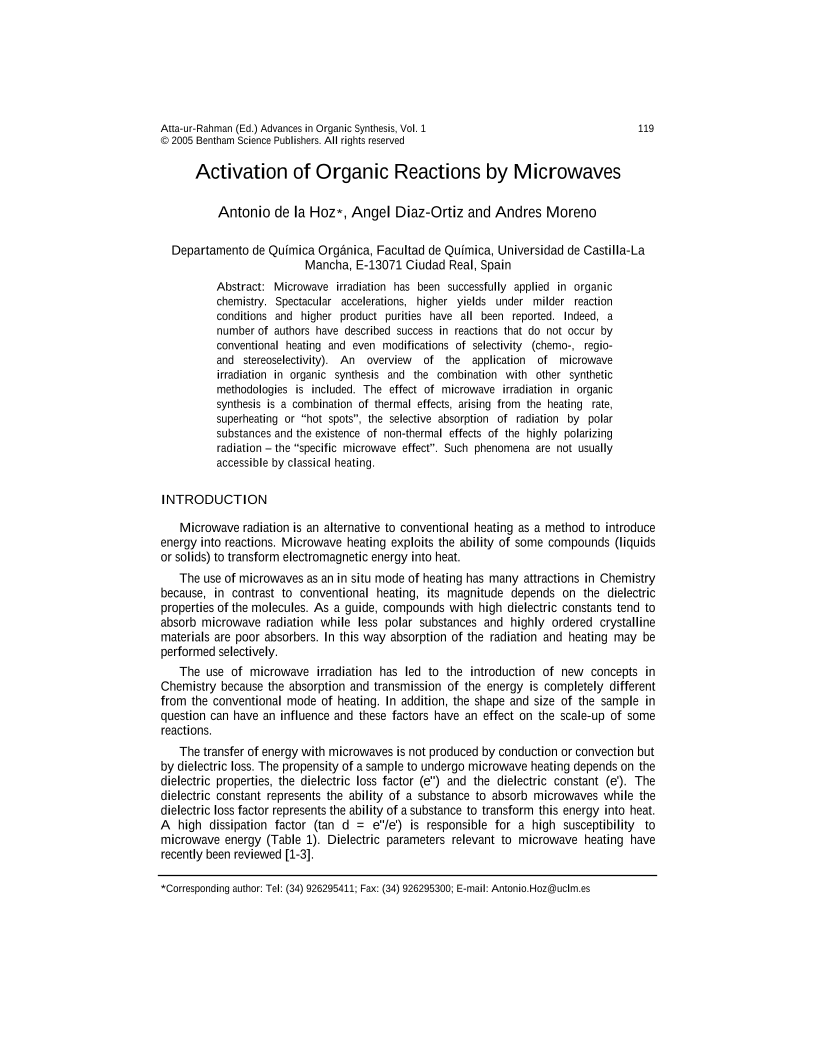
Microwave irradiation has been successfully applied in organic chemistry. Spectacular accelerations, higher yields under milder reaction conditions and higher product purities have all been reported. Indeed, a number of authors have described success in reactions that do not occur by conventional heating and even modifications of selectivity (chemo-, regio and stereoselectivity). An overview of the application of microwave irradiation in organic synthesis and the combination with other synthetic methodologies is included. The effect of microwave irradiation in organic synthesis is a combination of thermal effects, arising from the heating rate, superheating or "hot spots", the selective absorption of radiation by polar substances and the existence of non-thermal effects of the highly polarizing radiation the "specific microwave effect". Such phenomena are not usually accessible by classical heating.
-
From This Site
/content/books/9781608051977.chapter-4dcterms_subject,pub_keyword-contentType:Journal -contentType:Figure -contentType:Table -contentType:SupplementaryData105
