


Human Interactions and Sustainability

- Authors: Michael E. Gorman1, Lekelia D. Jenkins2, Raina K. Plowright3
-
View Affiliations Hide Affiliations1 Department of Science, Technology & Society, University of Virginia, USA 2 School of Marine and Environmental Affairs, University of Washington, 3707Brooklyn Avenue Northeast, Seattle, Washington 98105, USA 3 David H. Smith Conservation Research Fellow, Center for Infectious Disease Dynamics, ThePennsylvania State University, University Park, PA 16802, USA
- Source: Sustainability: Multi-Disciplinary Perspectives , pp 88-111
- Publication Date: August 2012
- Language: English


Human Interactions and Sustainability, Page 1 of 1
< Previous page | Next page > /docserver/preview/fulltext/9781608051038/chapter-5-1.gif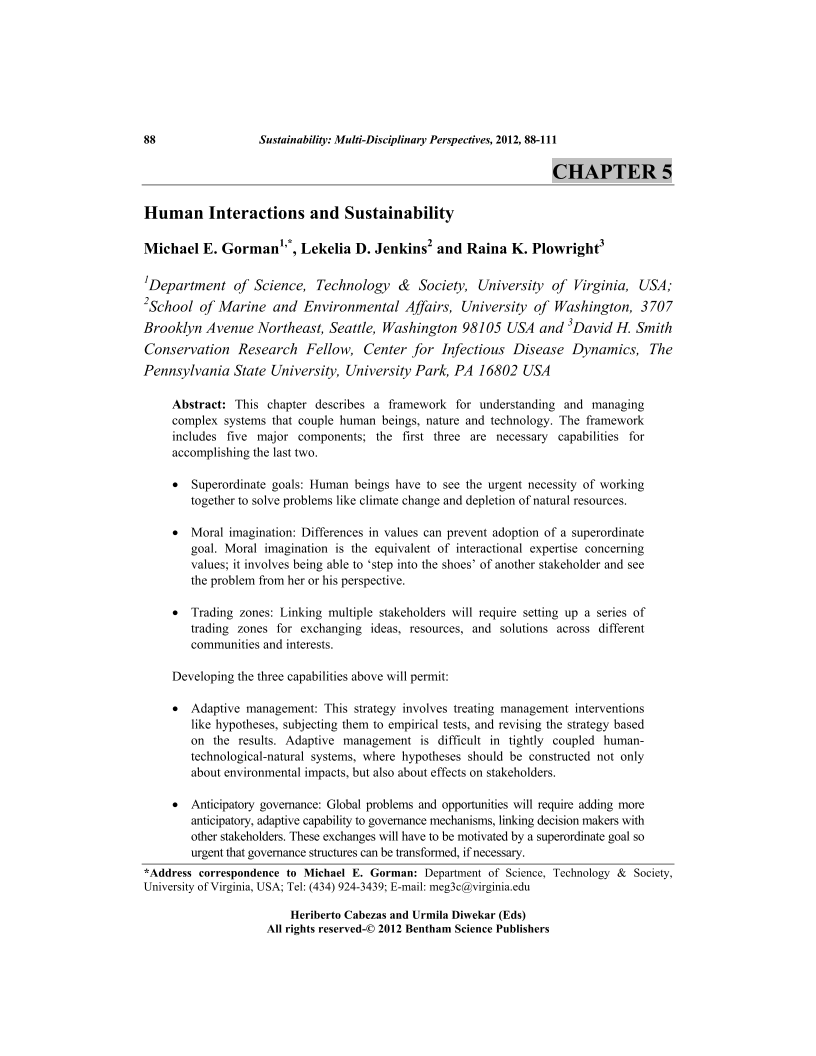
This chapter describes a framework for understanding and managing complex systems that couple human beings, nature and technology. The framework includes five major components; the first three are necessary capabilities for accomplishing the last two.
• Superordinate goals: Human beings have to see the urgent necessity of working together to solve problems like climate change and depletion of natural resources.
• Moral imagination: Differences in values can prevent adoption of a superordinate goal. Moral imagination is the equivalent of interactional expertise concerning values; it involves being able to step into the shoes of another stakeholder and see the problem from her or his perspective.
• Trading zones: Linking multiple stakeholders will require setting up a series of trading zones for exchanging ideas, resources, and solutions across different communities and interests.
Developing the three capabilities above will permit:
• Adaptive management: This strategy involves treating management interventions like hypotheses, subjecting them to empirical tests, and revising the strategy based on the results. Adaptive management is difficult in tightly coupled humantechnological- natural systems, where hypotheses should be constructed not only about environmental impacts, but also about effects on stakeholders.
• Anticipatory governance: Global problems and opportunities will require adding more anticipatory, adaptive capability to governance mechanisms, linking decision makers with other stakeholders. These exchanges will have to be motivated by a superordinate goal so urgent that governance structures can be transformed, if necessary.
This framework will be applied to two detailed case studies, one concerned with developing better management practices for reducing bycatch in fisheries, the other with ecosystem disruptions like the 2001 outbreak of foot and mouth disease in the UK. Limitations of the framework will be discussed in the light of these case studies, along with suggestions for how it can be improved.
-
From This Site
/content/books/9781608051038.chapter-5dcterms_subject,pub_keyword-contentType:Journal -contentType:Figure -contentType:Table -contentType:SupplementaryData105
