


Economics of Inclusiveness: Can We as a Society Afford Not to Provide Assistive Technology or Use Universal Design?
- Authors: Desleigh de Jonge, Ingrid Schraner2
-
View Affiliations Hide Affiliations2 Division of Occupational Therapy, School of Health and Rehabilitation Sciences, University of Queensland, St. Lucia, Brisbane, QLD 4072, Australia.
- Source: The State of the Science in Universal Design: Emerging Research and Developments , pp 132-143
- Publication Date: March 2012
- Language: English


Economics of Inclusiveness: Can We as a Society Afford Not to Provide Assistive Technology or Use Universal Design?, Page 1 of 1
< Previous page | Next page > /docserver/preview/fulltext/9781608050635/chapter-12-1.gif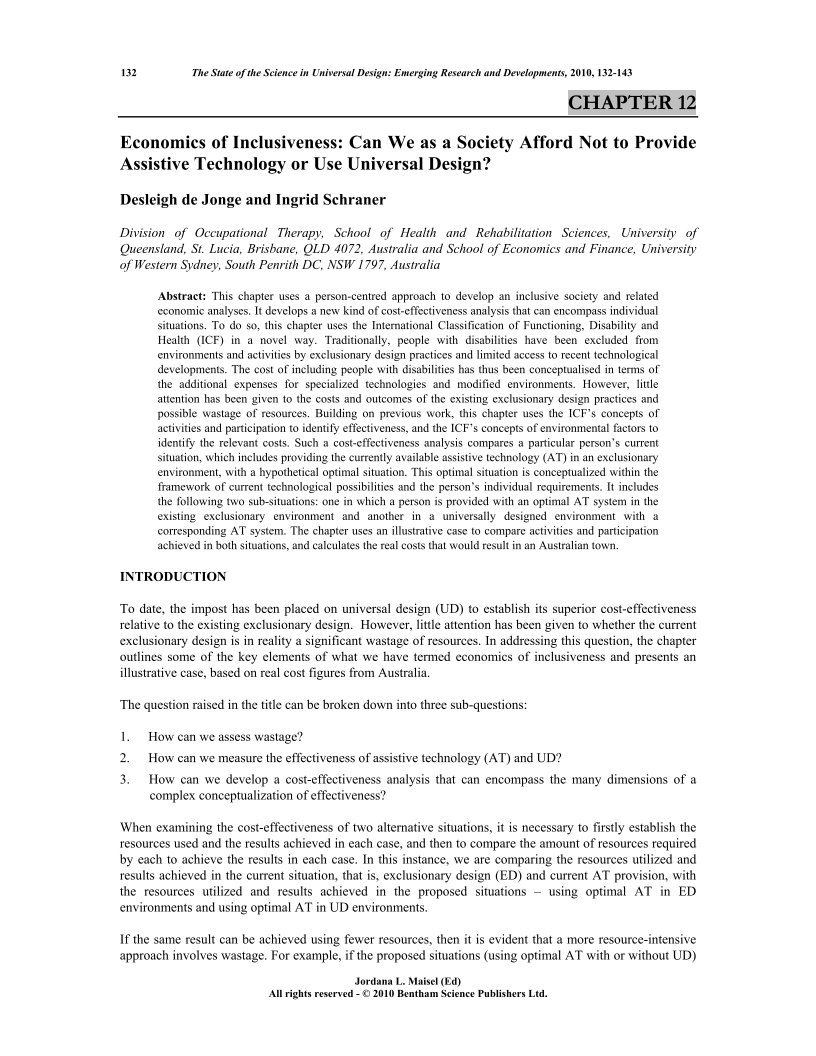
This chapter uses a person-centred approach to develop an inclusive society and related economic analyses. It develops a new kind of cost-effectiveness analysis that can encompass individual situations. To do so, this chapter uses the International Classification of Functioning, Disability and Health (ICF) in a novel way. Traditionally, people with disabilities have been excluded from environments and activities by exclusionary design practices and limited access to recent technological developments. The cost of including people with disabilities has thus been conceptualised in terms of the additional expenses for specialized technologies and modified environments. However, little attention has been given to the costs and outcomes of the existing exclusionary design practices and possible wastage of resources. Building on previous work, this chapter uses the ICFs concepts of activities and participation to identify effectiveness, and the ICFs concepts of environmental factors to identify the relevant costs. Such a cost-effectiveness analysis compares a particular persons current situation, which includes providing the currently available assistive technology (AT) in an exclusionary environment, with a hypothetical optimal situation. This optimal situation is conceptualized within the framework of current technological possibilities and the persons individual requirements. It includes the following two sub-situations: one in which a person is provided with an optimal AT system in the existing exclusionary environment and another in a universally designed environment with a corresponding AT system. The chapter uses an illustrative case to compare activities and participation achieved in both situations, and calculates the real costs that would result in an Australian town.
-
From This Site
/content/books/9781608050635.chapter-12dcterms_subject,pub_keyword-contentType:Journal -contentType:Figure -contentType:Table -contentType:SupplementaryData105
